
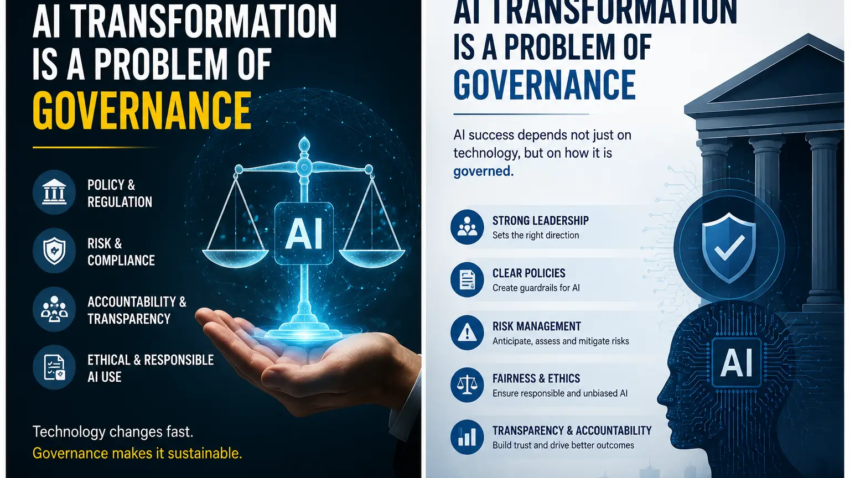
Ai transformation is a problem of governance
A couple of years ago, I was sitting in a post-mortem meeting at a mid-sized logistics company. Their AI rollout — a year in the making, somewhere north of $800,000 spent — had quietly stalled. The dashboards were built. The models were trained. The vendor demos had gone beautifully. But nine months after launch, fewer than 20% of the operations staff were actually using the system, the output was routinely overridden without anyone documenting why, and leadership had no idea whether the AI was helping or hurting decisions.
The CTO kept asking the same question: “Is this a data quality problem?”
It wasn’t. The data was fine. The model was fine. The problem was that nobody had decided who owned AI-generated recommendations, what happened when the AI was wrong, or how an operations manager was supposed to push back when the output made no sense. There were no rules for any of that. And without rules, people just quietly stopped trusting it.
That meeting stuck with me. Because I’ve seen almost the same story play out in different shapes — at a healthcare startup, at a retail chain, at a financial services firm I consulted with last year. The technology keeps getting better. The governance keeps being an afterthought.
Why Everyone Gets This Backwards
When a company decides to “do AI,” the default instinct is to treat it as an IT project. Pick a vendor. Set up infrastructure. Train a model. Ship it. The governance conversation — who decides, who’s accountable, how errors get handled — gets deferred to “after we see how it performs.”
That deferral is the mistake.
AI tools don’t behave like traditional software. A CRM system either processes your order or it doesn’t. An AI recommendation engine might be right 78% of the time, might be confidently wrong on edge cases, might drift over six months as the underlying data shifts. That’s not a bug — it’s the nature of probabilistic systems. But it means the humans around it need a completely different operating structure than they’d need for deterministic software.
“We treated the AI like a very expensive Excel formula. We forgot that someone still needs to decide whether to trust the formula.”
That’s a direct quote from a head of operations I interviewed last year. She wasn’t being flippant. She was describing a genuine blind spot that most organizations walk into.
Ai transformation is a problem of governance. Means Here (Without the Buzzwords)
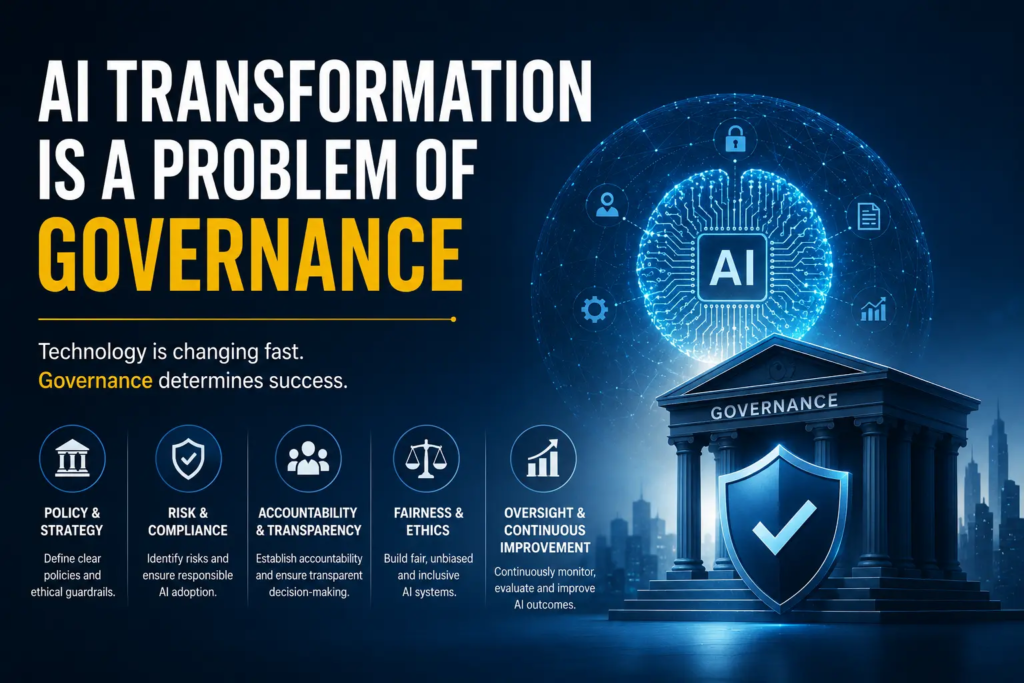
When I say governance, I’m not talking about compliance frameworks or ethics theater. I mean boring, practical stuff like:
- Who can deploy an AI tool in a department, and what approval do they need?
- When the AI makes a recommendation that turns out to be wrong, who reviews that incident?
- How do you document when a human overrides an AI decision, and does that data feed back into improvement cycles?
- What happens when two teams are using AI tools that produce conflicting outputs?
These questions feel administrative. They are. But they’re also the exact questions that determine whether an AI investment actually changes anything, or just creates an expensive layer of automation that nobody trusts.
A Framework That Actually Worked (I Saw It Firsthand)
The best AI governance setup I’ve personally encountered was at a supply chain company in the Netherlands. They weren’t doing anything exotic. No massive AI ethics board. No 40-page policy document. They had three things in place that most companies don’t:
1. Clear ownership per decision type
Every AI-assisted decision was classified into one of three tiers: autonomous (AI decides, humans monitor), advisory (AI recommends, human approves), and flagged (AI surfaces anomaly, human investigates). Before any AI tool went live, someone had to decide which tier it sat in. That single classification resolved about 60% of the “who’s responsible?” ambiguity.
2. A lightweight override log
When a human overrode an AI recommendation, they logged it in a shared system — just three fields: what the AI said, what the human did instead, and a one-line reason. At the end of each month, those logs got reviewed. Patterns got escalated. This sounds obvious but almost nobody does it consistently.
3. Quarterly confidence reviews
Every AI model in production got a 30-minute review each quarter. Is it still performing as expected? Has the business context changed? Should this still be autonomous, or should it be downgraded to advisory? The discipline of just asking these questions regularly caught drift problems before they became expensive surprises.
None of this required a massive team or a specialized AI ethics unit. It required someone owning the question and a calendar invite that actually happened.
The Tools People Are Using (and Where They Fall Short)
Platforms like Microsoft Azure AI Foundry and AWS SageMaker Governance have built-in monitoring dashboards — model cards, audit trails, access controls. They’re genuinely useful. Arize AI and Fiddler AI are excellent for model observability. Weights & Biases handles experiment tracking well.
But here’s what I’ve learned the hard way: the tool is not the policy. I’ve seen teams set up beautiful monitoring dashboards in Arize AI that nobody looked at, because there was no process or person responsible for acting on what they showed. Weights & Biases doesn’t tell you who owns the decision to promote a model to production. Notion can hold your policy documents, but it won’t enforce them.
The gap is almost always organizational, not technical.
Mistakes I’ve Watched Happen (Painfully, in Real Time)
- Building governance after the tools are already deployed. By then, teams have workarounds baked in and no appetite for new constraints. Start governance during the pilot phase. below more about Ai transformation is a problem of governance.
- Making the AI team responsible for governance. They’re too close to the technology and rarely have the authority to enforce accountability on business teams.
- Treating governance as a one-time setup. AI systems drift. Business context changes. What was appropriate oversight last year might be dangerously light this year.
- Confusing auditability with accountability. Logging everything is not the same as someone being responsible for reviewing logs and acting on them.
What to Actually Do If You’re Starting This Conversation
If you’re in a position where you need to push this conversation forward — whether you’re a product manager, a team lead, or someone who just watched an AI project quietly fail — here’s the practical starting point:
- Inventory what’s already deployed. Most organizations have more AI in production than they realize. Before building a governance framework, know what you’re governing.
- Classify by impact and autonomy. Use a simple 2×2: how high-stakes is the decision, and how autonomous is the AI in making it? High-stakes and highly autonomous is your top priority for oversight.
- Assign human owners, not just technical owners. Every AI system in production needs a named business owner — someone outside the AI team who is responsible for the outcomes it influences.
- Design a minimal feedback loop. What’s the lightest possible mechanism for capturing when the AI is wrong, and getting that signal back to people who can do something about it? Start there.
- Review cadence before you need it. Put the quarterly review on the calendar before anything goes live. Not after the first incident forces you to.
The hard truth: You can have the most sophisticated AI in your industry and still have a governance problem. A company with modest AI tools and strong governance will almost always outperform one with powerful tools and no structure around them.
The Real Reason This Is Hard
Governance is genuinely difficult to prioritize, not because people don’t understand it matters, but because it produces no immediate ROI you can put in a deck. You don’t get a slide that says “We prevented three AI governance failures this quarter.” The benefit is invisible until it isn’t — until a model makes a pattern of bad calls that nobody noticed because no one was watching.
The organizations I’ve seen get this right have one thing in common: someone with enough seniority and enough credibility took personal ownership of the question. Not as a bureaucratic exercise. Because they genuinely understood that the risk wasn’t the technology — it was the organizational vacuum around the technology.
AI transformation really is a governance problem. The companies that figure that out before the expensive post-mortem will be the ones that actually transform.

Hamad Arshad
SEO Specialist | SEO Manager | GEO Strategist
7+ Years of Experience in SEO, GEO, AEO, AI SEO, Local SEO, Technical SEO, PPC, Google Ads & Meta Ads.




Leave a Reply