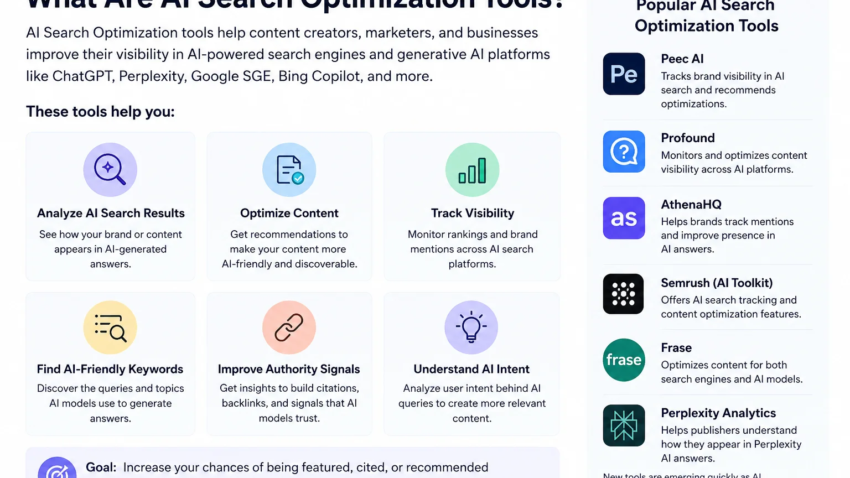
what are ai search optimization tools
A few months ago, I spent three weeks completely rewriting content for a client’s website. Traditional SEO. Keyword research, meta titles, internal linking the works. Google rankings improved slightly. Then I noticed something strange: my client was getting a decent chunk of referral traffic from people citing an AI answer that mentioned their brand. No click from Google. The AI just… recommended them unprompted.
That sent me down a rabbit hole. I started looking into what it actually takes to show up in AI-generated answers in ChatGPT, in Google’s AI Overviews, in Perplexity. And that’s when I stumbled into the world of AI search optimization tools.
Let me be honest upfront: this space is messy, fast-moving, and full of hype. But there are also some genuinely useful tools in here if you know what you’re looking for.
So What Exactly Are These Tools?
AI search optimization tools (sometimes called GEO tools — for Generative Engine Optimization) are software products designed to help your content perform better in AI-powered search results. That includes Google’s AI Overviews, ChatGPT’s web browsing answers, Perplexity, Microsoft Copilot, and similar platforms.
Traditional SEO tools like Ahrefs or Semrush were built to help you rank in Google’s “blue links” — the ten results you’d see on a classic search page. AI search optimization tools are trying to solve a different, harder problem: how do you get an AI language model to mention, cite, or recommend you?
“The difference between old SEO and AI optimization is like the difference between getting your résumé in front of a recruiter versus getting genuinely recommended by a trusted colleague.”
It’s a fundamentally different game. Search ranking is algorithmic and measurable. AI citation is probabilistic and harder to track.
The Main Types of Tools Out There
When I started mapping out this category, I found it helpful to break these tools into a few groups based on what they actually do:
- Visibility Trackers (Brand Mention Monitors): Track when and how AI systems mention your brand or competitors in responses. Think of them as rank trackers for AI.
- Content Analyzers (GEO Content Auditors): Analyze your existing content and flag what’s likely to get cited versus ignored by AI engines.
- Query Simulators (AI Answer Testers): Run your target keywords through multiple AI engines at once and see who gets cited — including whether it’s you.
- Schema Builders (Structured Data Tools): Help you add the right markup so AI systems can more easily parse and trust your content.
- All-in-One (GEO Suites): Platforms trying to cover visibility, content, and recommendations under one roof. Still maturing.
Tools I’ve Actually Tested
I want to be real here — a lot of tools in this space are in early beta or behind expensive enterprise paywalls. But here are some I’ve had hands-on time with:
| Tool | What it does well | Pricing |
| Perplexity Pages | Understanding how Perplexity structures and cites content; useful for publishers | Freemium |
| Alli AI | On-page optimization with some AI visibility features layered in | Paid |
| Semrush Copilot | AI-assisted recommendations inside the familiar Semrush interface | Paid |
| Otterly.ai | Monitors brand mentions specifically in AI chatbot outputs | Freemium |
| Search Atlas | Combines traditional SEO with some GEO-specific content guidance | Paid |
| Brand24 (AI monitoring) | Excellent for catching mentions across AI platforms and the web | Paid |
There are also newer entrants like Goodie AI and Profound that are building specifically for AI search monitoring. I’ve only demo’d those, not used them in a real workflow, so I’ll leave them off the deeper analysis for now.
What These Tools Actually Help With
Here’s where it gets practical. After using a few of these tools on real projects, I’d break their value into three meaningful areas:
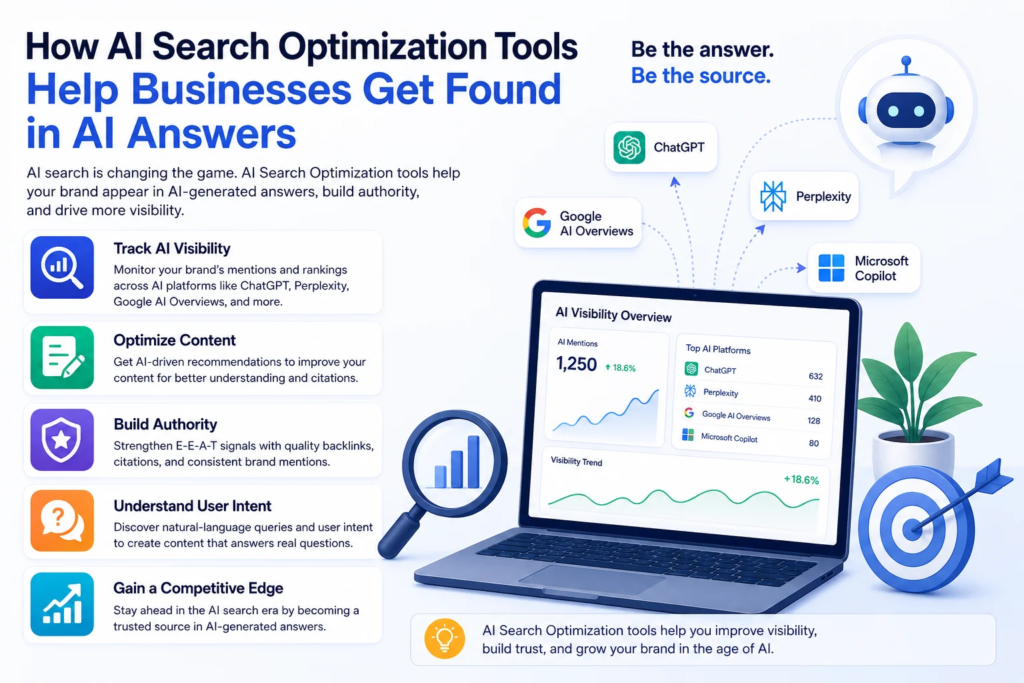
1. Knowing if You Even Exist in AI Answers
This was honestly the most shocking part for me. I ran a test for a client in the legal SaaS space and found they were being mentioned by ChatGPT in answers about contract management — but they had no idea. We’d never tracked that. Brand monitoring tools that cover AI outputs are actually useful for this exact reason.
2. Understanding What Gets Cited and Why
AI systems tend to prefer content that’s clear, structured, specific, and authoritative. Tools that audit your content against these signals are useful — not because they have a secret formula, but because they help you stop doing things that actively hurt your chances. Vague, generic pages don’t get cited. Specific, well-sourced answers do.
3. Testing Before Publishing
Some of these tools let you simulate what AI answers look like for your target queries. That’s genuinely useful. Before you publish a big pillar page, you can check: does the current landscape already have this well-covered? Is there a specific angle or question that’s underserved?
Key Insight: The single biggest thing these tools confirmed is that AI systems heavily favor content with specific facts, named sources, and clear structure. Writing in vague, fluffy paragraphs isn’t just bad for readers — it’s invisible to what are ai search optimization tools. Headers, numbered lists, and specific claims with context outperform walls of text every time.
A Step-by-Step Process That Actually Works
You don’t need to buy five tools to get started. Here’s the process I’d recommend if you’re new to this:
- Start with free monitoring. Set up Otterly.ai or even just run your brand name and key topics manually through ChatGPT, Perplexity, and Google AI Overview. See what comes up. Write it down. This is your baseline.
- Audit your top 10 pages for AI-readiness. Ask yourself: Does this page have a clear, specific answer to a question? Are there stats, dates, or named references? Is the structure scannable? If not, those are your quick wins.
- Add or improve structured data. Schema markup (FAQ schema, HowTo schema, Article schema) still matters. Tools like Google’s Rich Results Test are free. Use them.
- Identify your “answer” pages. Which pages directly answer common questions in your niche? These are highest priority for AI visibility. Rewrite them to be more direct — lead with the answer, then explain.
- Track changes over 60–90 days. AI search visibility doesn’t shift overnight. Set a monthly reminder to rerun your monitoring queries and note what’s changed.
The Mistakes I Made Early On
⚠ Common Mistakes to Avoid
- ✗ Treating it like traditional keyword SEO. AI systems don’t respond to keyword density. Stuffing your target phrase everywhere backfires. Write for clarity and specificity instead.
- ✗ Buying an expensive tool before understanding the basics. Most paid GEO tools are useful for at-scale monitoring, not foundational fixes. Do the free audit first.
- ✗ Ignoring Wikipedia and third-party mentions. AI systems pull from authoritative third-party sources heavily. Getting mentioned in industry roundups, Wikipedia, or trusted directories often matters more than optimizing your own site.
- ✗ Expecting guaranteed results. Any tool that promises you’ll “rank” in ChatGPT is overstating what’s possible. This space is still probabilistic. Manage expectations accordingly.
- ✗ Forgetting that traditional SEO still matters. AI systems use web crawls. Your page still needs to be indexable, load fast, and have backlinks. GEO doesn’t replace SEO — it extends it.
Is It Worth Investing In These Tools Right Now?
Honestly? It depends on your situation. If you’re running a small blog or a local business, the free monitoring approach I described above is probably enough for now. The category is still early, and the more expensive platforms are honestly better suited for brands with dedicated SEO teams and real budgets.
If you’re in content marketing, SaaS, e-commerce, or any space where thought leadership matters, then yes — getting some basic AI visibility tracking in place makes sense. Even just knowing whether your brand shows up when someone asks an AI about your category is valuable information.
“The brands that are going to do well in AI search aren’t the ones who game it best. They’re the ones whose content is genuinely the best answer to the question.”
I’ve come to believe that’s actually more true now than it ever was with traditional SEO. The algorithmic shortcuts that worked in Google results — exact match anchors, spammy backlinks, thin category pages — those don’t carry over to AI systems. The AI just knows when content is useful and specific versus when it’s performing usefulness.
One Last Thing Worth Knowing
The most useful reframe I’ve had around AI search optimization is this: stop thinking about it as “how do I rank” and start thinking about it as “how do I become the answer.” AI systems are synthesizing answers from the content they find. If your content is the clearest, most specific, most trustworthy explanation of a given topic, the probability of citation goes up — no tool can shortcut that, but a good tool can help you see where your gaps are.
That client I mentioned at the start? The one getting AI referral traffic without knowing it? We started deliberately tracking that channel and realized it was sending more qualified visitors than their second and third page Google rankings combined. That was a real wake-up call.
This stuff is worth paying attention to. Just go in with realistic expectations, start with the free methods, and don’t let any vendor convince you they’ve cracked a code that doesn’t exist yet.

Hamad Arshad
SEO Specialist | SEO Manager | GEO Strategist
7+ Years of Experience in SEO, GEO, AEO, AI SEO, Local SEO, Technical SEO, PPC, Google Ads & Meta Ads.





Leave a Reply