
How Much Water Does AI Use Per Day Globally?
A few months back, my city sent out one of those “please conserve water” notices, the kind that shows up during a dry summer and asks you to stop running the sprinklers at noon. I was staring at it while simultaneously asking ChatGPT to help me rewrite a cover letter. And something clicked: wait, is this thing also drinking water right now?
Turns out, yes. Quite a lot of it. And once I started researching the actual numbers, I couldn’t stop. The scale is genuinely surprising, not in an alarmist way, but in a “huh, nobody really talks about this” kind of way.
Let me break it down the way I’d explain it to a friend who just got curious — with real numbers, real comparisons, and zero exaggeration.
First, Why Does AI Even Need Water? How Much Water Does AI Use Per Day Globally
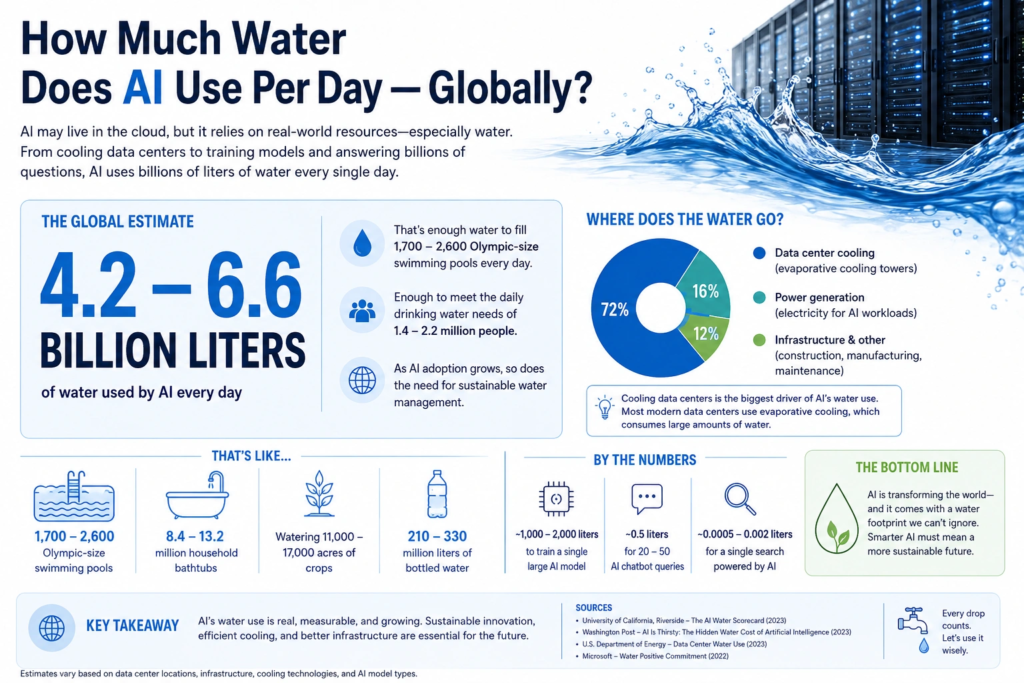
It’s not like your laptop has a water tank. The connection is the data center. Every time you type a prompt into ChatGPT, Claude, Gemini, or any other AI tool, that query travels to a warehouse packed with servers — thousands of specialized chips running at full tilt, generating enormous amounts of heat. That heat has to go somewhere.
The solution most data centers use is evaporative cooling — running huge volumes of water through cooling towers to absorb heat and then evaporating it into the air. It’s highly effective. It’s also extremely water-hungry.
There’s also an indirect water footprint: the water used by power plants to generate the electricity that those data centers run on. Coal and natural gas plants use a lot of water in their cooling processes, too. So every kilowatt-hour of electricity has a hidden water cost attached to it.
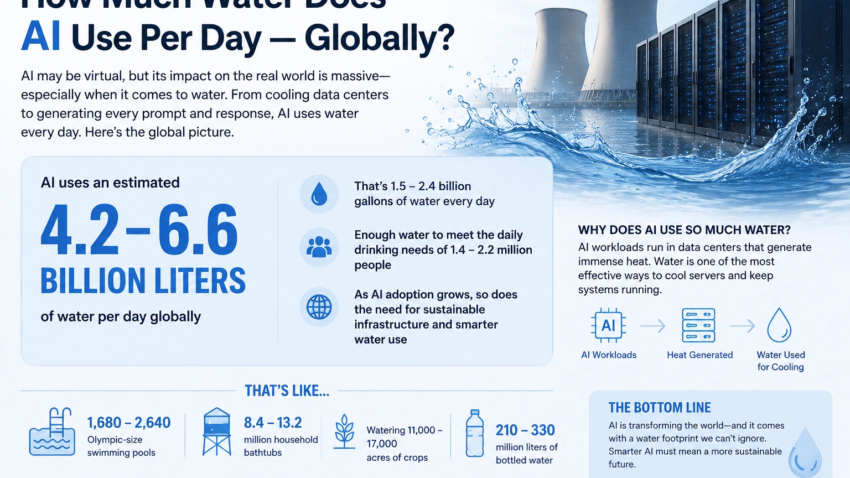
How Much Water Does AI Use Per Day, Globally?
Here’s where it gets genuinely eye-opening. Researchers have been trying to pin this down, and the numbers are big enough that you need context to make sense of them.
| Metric | Figure |
| AI data centers – water per day (2025) | 550 million gallons |
| Total AI data center water – 2025 | ~1 trillion liters |
| GPT-3 training (one-time) | 700,000 liters |
| Per 100-word AI prompt | ~519 ml (1 water bottle) |
| Projected annual use by 2028 | 1,068 billion liters |
According to market research firm Mordor Intelligence, nearly 1 trillion liters of water were consumed by AI data centers in 2025. That amounts to roughly 264 billion gallons for the year — or about 550 million gallons every single day. For context, that’s comparable to the entire world’s bottled water consumption rate.
A Morgan Stanley report also found that AI data centers’ global annual water consumption is set to reach 1,068 billion liters by 2028 — an estimate 11 times higher than the projection from just a year earlier.
How Much Water Per AI Query?
This is where the numbers get a bit murky, because different researchers measure different things.
- UC Riverside researchers estimated ~519 mL (about 1 water bottle) per 100-word prompt.
- OpenAI CEO Sam Altman claimed each ChatGPT query uses only ~0.000085 gallons (roughly 1/15 of a teaspoon).
- Independent analysts argue that company figures often exclude indirect water use for electricity generation.
The truth is probably somewhere in between. What’s clear is that billions of people entering prompts every day adds up to a very large aggregate number — regardless of where exactly the per-query figure lands.
Why the Numbers Are So Hard to Pin Down
Big tech companies don’t break down their sustainability reports to show the actual consumption of their AI operations specifically. On top of that, water use varies wildly by location — a data center in Arizona needs far more cooling than one in Scandinavia.
There’s also a direct vs. indirect split. Most company disclosures only count water used on-site for cooling, not the water consumed upstream at power plants. When researchers include both, the estimates climb significantly.
Key insight: When you see wildly different figures online — “tiny teaspoon” vs. “full water bottle” — they’re often measuring different things. Direct vs. indirect, training vs. inference. Context matters enormously.
The Geography Problem Nobody Mentions
A lot of the biggest AI data center expansions are happening in places that frankly can’t afford it. Arizona is experiencing aggressive data center growth while simultaneously dealing with severe drought. You’ve got massive facilities evaporating millions of gallons per day in a desert, while residents are asked to cut back on lawn watering.
For comparison, Google’s thirstiest data center in Iowa consumed about 2.7 million gallons per day in 2024. A single large AI data center can use as much water daily as a town of 10,000 to 50,000 people combined.
Is This Actually a Crisis, or Are We Panicking?
Somewhere between “AI is fine, stop worrying” and “AI is draining the planet” is the honest answer.
Right now, AI’s water use is still a footnote compared to the 26.4 trillion gallons used by US agriculture in 2024. Agriculture dwarfs tech in water terms. But AI’s water footprint is projected to rise to 40% of all data center use by 2030 — consuming enough water to supply 500 million people in Sub-Saharan Africa.
Only 3% of Earth’s water is freshwater, and only 0.5% of all water is accessible and safe for human consumption. Data centers are not tapping ocean water — they’re competing for the same freshwater that communities, farms, and ecosystems depend on.
What Tech Companies Are Actually Doing About It
The industry isn’t ignoring this. Real efforts are underway:
- Microsoft is deploying closed-loop, zero-water evaporation cooling, reducing annual water use by 125M+ liters per facility.
- Google and Microsoft have pledged to become “Water Positive” by 2030 — returning more water than they consume.
- Immersion cooling submerges servers in non-conductive fluids, eliminating water-based cooling towers.
- ISO/IEC’s first international standard on sustainable AI now includes water footprint as a key metric.
Common Mistakes When Reading About This Topic
- Comparing incomparable numbers: some stats are per-query, some per-year, some cover all data centers (not just AI).
- Trusting company self-reporting at face value: corporate disclosures rarely count indirect electricity and water use.
- Thinking it’s all about cooling: water use is growing primarily from power demands and hardware manufacturing, not just cooling towers.
- Dismissing it because agriculture uses more: exponential AI growth happening in drought zones is a separate and growing concern.
Where Things Are Headed
The honest picture: AI’s water footprint is real, growing fast, and unevenly distributed across water-stressed regions. The technology to reduce this impact exists — closed-loop cooling, smarter siting, and renewable-powered facilities. The question is whether adoption keeps pace with AI’s expansion.
The conversation around AI’s environmental cost has mostly been about carbon and energy. Water deserves the same seat at the table. It’s the quieter, less glamorous resource — but in the long run, it might matter just as much.

Hamad Arshad
SEO Specialist | SEO Manager | GEO Strategist
7+ Years of Experience in SEO, GEO, AEO, AI SEO, Local SEO, Technical SEO, PPC, Google Ads & Meta Ads.







Leave a Reply