
What Is Agentic AI? The Complete Beginner’s Guide
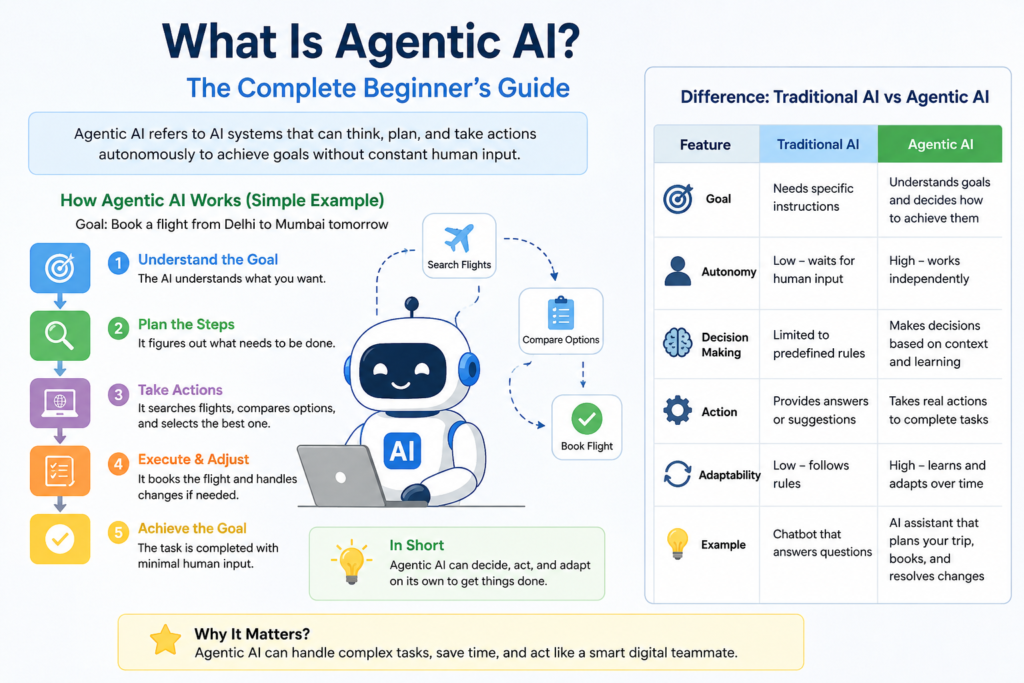
A few months ago, I asked an AI tool to “book me a table for two at an Italian place near downtown, sometime Friday evening.” I wasn’t expecting much maybe a list of restaurant names and phone numbers, like every chatbot before it.
Instead, it actually went and did the thing. It searched for restaurants, checked reviews, picked one with decent ratings and availability, and gave me a confirmation. No back-and-forth. No me copy-pasting information into five different tabs. For the commerce angle, see Agentic Commerce Journey Discovery to Transaction.
That was the moment agentic AI stopped being a buzzword for me and started being something I actually understood, because I’d watched it work.
If you’ve been hearing “agentic AI” thrown around in tech articles, YouTube videos, or LinkedIn posts and you’re not totally sure what it means beyond “AI that does stuff on its own” you’re in the right place. I’m going to explain it the way I wish someone had explained it to me, using real examples instead of textbook definitions.
So What Actually Is Agentic AI?
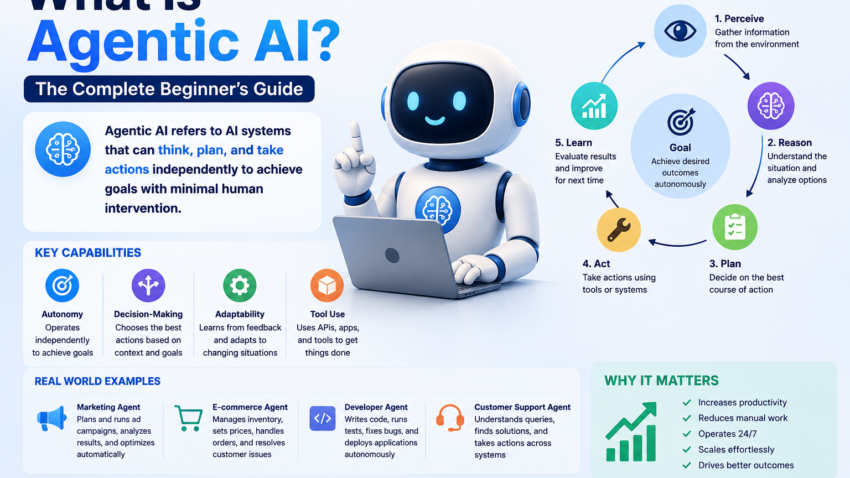
Here’s the simplest way I can put it: regular AI chatbots answer questions. Agentic AI takes actions.
Think about the difference between asking a really smart friend for advice versus asking a capable assistant to handle something for you. If you ask ChatGPT “what’s a good subject line for a follow-up email,” it gives you options and you take it from there. That’s a normal chatbot doing normal chatbot things.
But if you tell an agentic AI system “follow up with the client from yesterday’s meeting and schedule a call for next week,” it can: For audit workflows, see AI for Integrated ISO Audits: A Practical Guide for Auditors.
- Look up the client’s email
- Draft the follow-up
- Check your calendar for open slots
- Send a scheduling link or actually book the meeting
- Maybe even send you a summary of what it did
It doesn’t just respond. It plans a sequence of steps, uses tools to carry them out, and adjusts if something doesn’t go as expected. That “doesn’t just respond, keeps going until the job is done” part is really the heart of it. For a website-builder example, see Hostinger AI Builder: The Complete Guide to Features, Pricing, and Whether It’s Worth It.
The Difference I Noticed the Hard Way
I’ll be honest, my first real attempt at using an agentic tool was messy. I was testing an early version of an autonomous coding assistant to fix a bug in a small side project. I gave it a vague instruction: “fix the login issue.”
It ran off and made about a dozen changes across multiple files, some of which had nothing to do with the actual bug. It technically completed a “task,” just not the one I actually wanted.
That taught me something important early on: agentic AI is only as good as the clarity of what you give it. It’s not a mind reader. It’s more like delegating to a very fast, very literal new employee who will absolutely do what you say even if what you said wasn’t quite what you meant.
Lesson learned: be specific. Instead of “fix the login issue,” I later learned to say something like “the login button doesn’t respond when the password field is empty add validation so it shows an error message instead of doing nothing.” Much better results.
The Building Blocks of an Agentic System
Once you’ve seen a few of these tools in action, you start noticing they’re usually built from the same core pieces: For launch stacks, see AI Tools for Product Launches The Complete Stack for Every Stage.
1. A goal or task something you want accomplished, not just answered.
2. Reasoning planning the AI breaks the goal into smaller steps.
3. Tools or actions the ability to browse the web, run code, send emails, use apps, or call other software. For an app example, see Microsoft SwiftKey AI Keyboard: The Complete Guide to Features, Setup, Privacy, and Whether It’s Worth It.
Everyday Examples of Agentic AI You Can Actually Try
You do not need a developer account to watch agentic AI work anymore. Email assistants sort your inbox, summarise the long threads and draft replies in your voice. Research agents open ten sources and hand you back one short brief. Coding assistants write a piece of code, run it, read the error message and fix it themselves. Scheduling agents negotiate a meeting time with another person over email, back and forth, without you in the loop. I have tried most of these, and the pattern never changes: you hand over a goal and a boundary, and the agent takes the steps in between.
Agentic AI vs Chatbots vs Automation – The Simple Difference
Here is the cleanest way I have found to separate the three. A chatbot answers. Automation follows a fixed recipe — if this happens, do that — and it breaks the moment reality changes the ingredients. An agent sits in between: it follows your goal, but it chooses its own steps, and it adjusts when a step fails. That freedom is exactly why agents are more useful than both — and exactly why they need more watching than both.
The Risks Nobody Mentions in the Hype Videos
An agent that can act can also act wrongly, at machine speed. It can send the email to the wrong person, book the non-refundable option, or confidently finish the wrong task and report success. There is also the bill: agents use far more AI processing than a single chat answer, because they think, act, check and retry in a loop — and those costs surprise people. My rule is simple. The more an action involves money, messages to real people, or deleting things, the more firmly I keep a human checkpoint in front of it.
How to Start Using Agentic AI Safely
Start with read-only tasks — research, summaries, first drafts — where a mistake costs you nothing but a delete key. Give one clear goal at a time, and state the boundary out loud in the instruction: the budget, the deadline, and what it must never do. Read the first few runs in full instead of trusting the summary; agents earn trust the same way new employees do. And keep the undo button within reach — drafts instead of sends, shopping carts instead of checkouts — until the agent has earned the promotion.
Agentic AI is AI that does not just answer questions — it takes actions toward a goal. It can search, click, write, book and check its own work, while a person sets the goal and the limits.
An assistant that books a restaurant table for you — searching the options, comparing reviews and confirming the booking — instead of simply giving you a list of restaurants to call yourself.
A plain chat with ChatGPT is not agentic, because it only answers. ChatGPT’s agent features, which browse websites and complete tasks step by step, are agentic.
A chatbot replies; an agent acts. The chatbot gives you information, while the agent uses tools to finish a task and adjusts its approach when something goes wrong.
It is safe for low-stakes tasks with a quick review — research, drafts and summaries. For payments, sending messages or deleting anything, keep a human approval step until the agent has proven itself.
No. Most agent tools are built for non-coders. You describe the goal in plain language and set the limits in the settings, and the agent handles the steps.

Hamad Arshad writes and edits AI Next Top from Rahim Yar Khan, Pakistan. He has worked in SEO and digital marketing for over 7 years and started this site to explain AI tools and news in plain language for non-technical readers. Every guide here is checked against the real tool before it is published.








Leave a Reply