
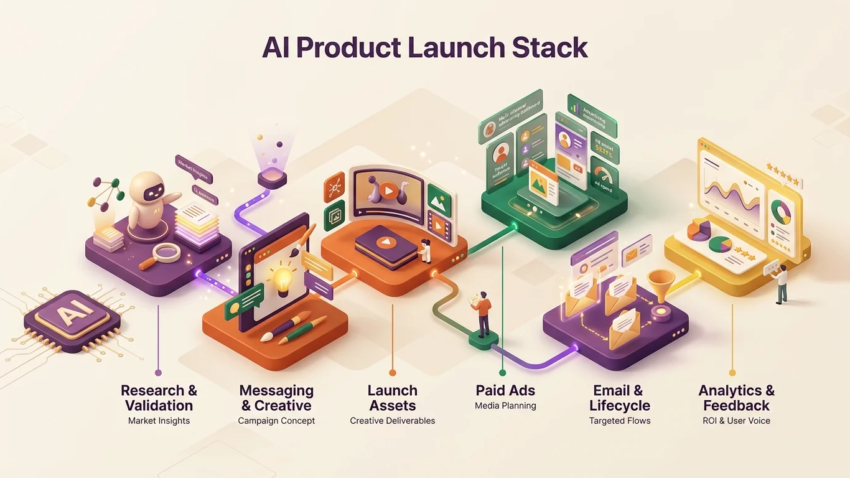
AI Tools for Product Launches The Complete Stack for Every Stage
A product launch touches more different kinds of work than almost anything else in a company’s calendar — research, messaging, design, advertising, email, and measurement, often within the same few weeks. AI tools now genuinely help with several of those stages, but not all of them equally, and treating “AI tools for product launches” as one undifferentiated category is exactly how teams end up either underusing AI where it would help most, or over-relying on it where it quietly hurts the launch.
This guide breaks the stack down stage by stage — where AI tools are worth adding to your workflow, where human judgment still needs to lead, and how a realistic AI-assisted launch actually comes together over a few weeks.
Quick Answer: Which Tools Matter Most at Each Stage
The highest-value AI tools for a product launch cluster around research and optimization rather than creative and strategy: research assistants like Claude, ChatGPT, and Perplexity for market and audience research; ad platforms’ built-in AI optimizers like Meta Advantage+ and Google Performance Max for distribution; analytics tools like GA4 and Amplitude for understanding what’s working after launch; and send-time optimization in email platforms like Klaviyo. AI-generated creative and messaging (copy, brand voice, positioning) can speed up a first draft, but should be treated as a starting point a human refines, not a finished output — this is where AI tools are most likely to work against a launch if used unedited.
Why This Phrase Means Different Things at Different Stages
A launch isn’t one task — it’s a sequence of different jobs, and “AI tool” covers genuinely different categories of software depending on which job you’re looking at. A research assistant summarizing competitor positioning, an ad platform’s bidding algorithm, and an image generator creating launch graphics are all “AI tools,” but they solve completely unrelated problems and have very different reliability profiles. Lumping them together is why so many “best AI tools for launches” articles read like an unfocused grab-bag — the honest, useful version of this topic has to be organized by what stage of the launch you’re actually working on.
Where AI Genuinely Helps a Launch (and Where It Doesn’t)
Broadly, AI tools perform best on tasks involving data processing, pattern recognition, and optimization at a scale humans can’t match by hand — analyzing ad performance across thousands of impressions, summarizing large volumes of user research, or predicting the best time to send an email to each individual subscriber. These are genuinely things AI does better than manual review, and skipping them is leaving real time and performance on the table.
Where AI tools tend to underperform is anything requiring emotional resonance, brand judgment, or a genuinely original creative angle — the parts of a launch that make people care, not just notice. A launch is, at its core, a story about why a product matters, and that’s still a human-led job. Treating AI output in this area as a fast first draft to be substantially reworked, rather than a finished asset, is the difference between using AI well here and using it badly.
AI Tools for Product Launches, Organized by Stage
Research and Validation
Before writing a word of launch copy, research tools help validate positioning and understand the competitive landscape. General-purpose AI assistants — Claude, ChatGPT, and Perplexity — are widely used here for summarizing competitor messaging, synthesizing user interview notes, and stress-testing a positioning angle before committing to it. For planning and roadmap work leading into launch, Notion AI turns rough notes into structured plans and summaries, and Jira Product Discovery helps track the research and prioritization work feeding into what actually ships.
Messaging, Copy, and Creative
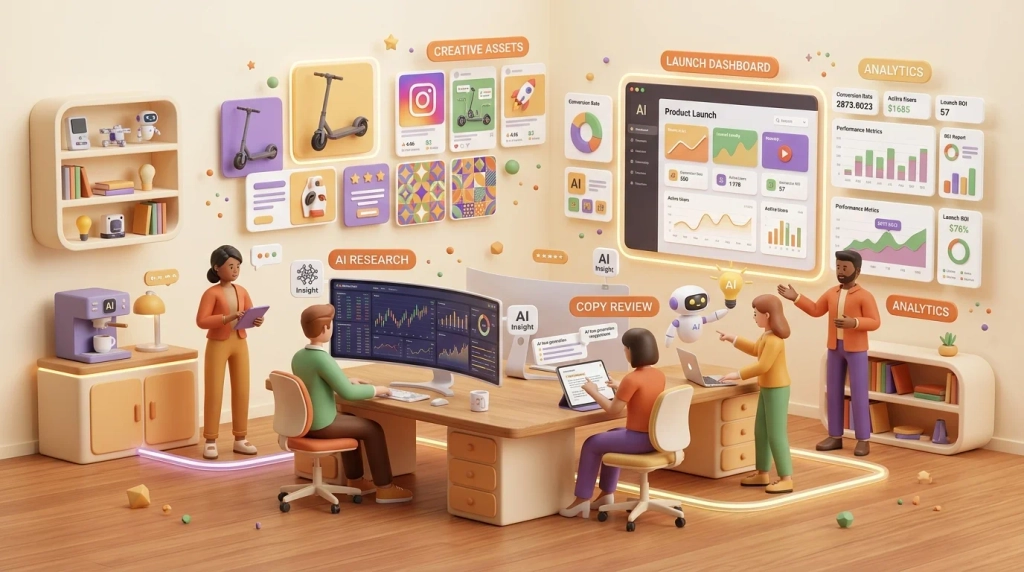
Tools like Jasper and Copy.ai have carved out a specific niche in the marketing layer around a launch — sales page drafts, product descriptions, and email sequence first drafts — even though they’re less suited to long-form content. Claude is also commonly used for longer-form launch writing (landing page copy, longer explainer content) where more nuanced reasoning about structure and tone matters. On the visual side, Midjourney and DALL-E handle launch imagery and stylistically consistent visual assets, while Canva remains the fastest route to polished, on-brand graphics without needing a dedicated designer for every asset.
Launch Assets — Video, Landing Page, and Store
A short launch video is now genuinely cheap to produce with AI: tools like Topview Motion Studio can generate a launch video for a small fraction of what a produced video traditionally cost, which matters for teams that would otherwise skip video entirely due to budget. For the launch site itself, all-in-one builders like Hostinger AI Builder can generate a website, product copy, and basic SEO setup from one subscription — a reasonable option specifically for solo founders and small teams without dev resources, though it trades some customization for speed.
Paid Ads and Distribution
This is one of the strongest genuine use cases for AI in a launch: platform-native optimizers like Meta Advantage+ and Google Performance Max handle audience targeting and bid optimization at a scale and speed manual campaign management can’t match. These tools are specifically built for pattern recognition across large ad-performance datasets, which is exactly the kind of task AI is well-suited for — worth prioritizing over AI creative tools if you’re deciding where limited setup time should go first.
Email and Lifecycle
Launch-related email — announcement sequences, waitlist nurture, post-launch follow-up — benefits from AI-driven send-time optimization, with Klaviyo a widely used option that adjusts delivery timing per subscriber based on engagement patterns rather than a single blanket send time for the whole list.
Analytics and Post-Launch Feedback
Once the launch is live, GA4 and Amplitude both use AI-assisted analysis to surface patterns in user behavior that would take much longer to find manually — drop-off points, engagement trends, and cohort behavior differences. This stage is often under-prioritized by teams excited about the launch itself, but it’s where AI tools help you understand what to actually do next, which matters more than the launch-day spike itself.
Where to Actually Launch, Not Just What to Build With
Tools are only half the picture — where you actually announce the product matters just as much, and this is a decision AI can inform but shouldn’t make for you. Product Hunt remains the loudest single-day launch platform, but a strong showing there generally requires an audience you’ve already built beforehand, not just showing up cold on launch day. For teams without that audience yet, smaller or niche launch boards, along with Hacker News for a technical audience, Reddit and Indie Hackers for community-driven feedback, and BetaList for early adopters, often deliver more relevant traffic per hour of effort than competing for attention on a large, crowded platform. The realistic approach most experienced founders land on is stacking several smaller launches — a build-in-public thread, a niche directory, a community post — rather than betting everything on one large platform on a single day.
A Sample Four-Week AI-Assisted Launch Workflow
- Week 1 — Research and positioning. Use Claude, ChatGPT, or Perplexity to synthesize competitor messaging and user research; draft (but don’t finalize) positioning based on that synthesis.
- Week 2 — Assets and copy. Draft landing page copy and launch messaging with an AI writing tool, then have a person substantially revise it for voice and emotional resonance. Generate launch visuals and a short launch video.
- Week 3 — Distribution setup. Configure ad campaigns in Meta Advantage+ or Google Performance Max, set up email sequences in a platform with send-time optimization, and confirm which launch platforms you’re targeting and in what order.
- Week 4 — Launch and measure. Execute the launch across chosen platforms, monitor analytics daily for the first week, and feed early feedback back into messaging and targeting adjustments rather than treating launch day as the finish line.
Common Mistakes Teams Make Using AI for Launches
Publishing AI-generated copy without a real editing pass. First-draft AI copy is a starting point; publishing it as-is is one of the most common ways a launch reads as generic rather than distinctive.
Over-indexing on AI tools while under-investing in distribution planning. A polished AI-generated landing page with no plan for where traffic comes from won’t produce results on its own.
Treating Product Hunt as a strategy rather than one tactic. A strong Product Hunt showing generally depends on an audience built beforehand — showing up without one and expecting the platform to generate an audience for you tends to disappoint.
Skipping the analytics stage because the launch itself feels like the finish line. The week after launch, when AI-assisted analytics can show what’s actually working, is often more valuable than launch day itself.
Assuming one tool covers the whole workflow. No single AI tool handles research, creative, ads, and analytics well — matching a specific tool to a specific stage produces better results than trying to force one platform to do everything.
Where AI Still Can’t Replace Strategy and Judgment
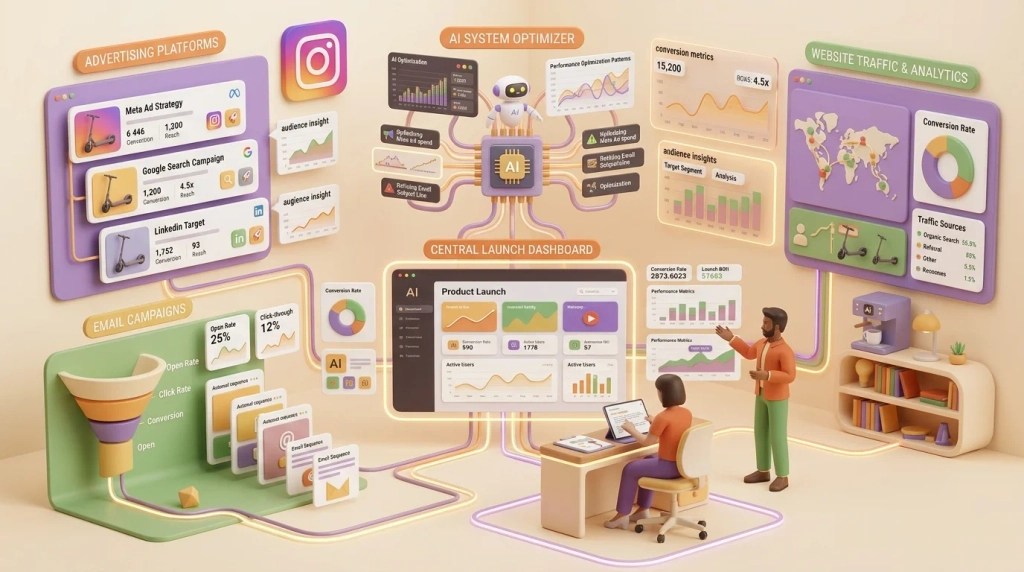
AI tools are strongest at tasks with a clear, measurable objective and a lot of data to optimize against — which is exactly why they excel at ad bidding and send-time optimization, and exactly why they struggle with brand voice, emotional resonance, and the judgment calls about what story a launch should actually tell. A launch is fundamentally about convincing people something is worth their attention and trust, and that’s still a fundamentally human job — media relationships, creative judgment, and strategic positioning decisions are the parts of a launch where experienced human input consistently outperforms unedited AI output, regardless of how sophisticated the underlying model is.
Expert Tips for Building Your Launch Stack
- Assign each tool to a specific stage rather than adopting tools generally — a research assistant, an ad optimizer, and an analytics platform solve different problems and shouldn’t be evaluated against the same criteria.
- Use AI for the first draft, not the final version, on anything customer-facing. Copy, video scripts, and messaging all benefit from a human revision pass before publishing.
- Prioritize AI tools for ads and analytics before creative tools, since that’s where AI’s optimization strength has the clearest, most measurable payoff.
- Build an audience before your primary launch platform date, since AI tools can help you create assets faster but can’t manufacture an audience that isn’t there yet.
- Revisit your tool stack after the launch, not just before it — the post-launch analytics stage is where AI-assisted insight often has the most compounding value.
Frequently Asked Questions
What are the best AI tools for a product launch? The strongest, most defensible use cases are research assistants (Claude, ChatGPT, Perplexity) for validation, ad platform optimizers (Meta Advantage+, Google Performance Max) for distribution, and analytics tools (GA4, Amplitude) for post-launch insight — creative and messaging tools like Jasper or Midjourney are useful for first drafts but need human refinement.
Should I use AI to write my launch messaging and brand copy? It’s a reasonable starting point for a first draft, but AI-generated copy tends to read as generic unless a person substantially revises it for voice, emotional resonance, and a genuinely original angle — that revision step matters more than which tool generated the draft.
What AI tools help most with launch-day advertising? Platform-native optimizers like Meta Advantage+ and Google Performance Max are specifically built for this and generally outperform manual bid and targeting management at scale.
Can AI help me pick where to launch my product? It can help you research and compare platforms (audience size, typical traffic, competition level), but the decision itself still depends on strategic factors — like whether you already have an audience to mobilize — that require human judgment rather than a tool recommendation.
How much of a launch can realistically be automated with AI? The data-heavy, optimization-focused parts (ad targeting, send-time optimization, analytics) can be substantially AI-assisted; the strategic and creative core of a launch — positioning, story, brand voice — still needs human-led decision-making.
What’s a simple AI-assisted launch workflow for a small team? A reasonable structure is research and positioning in week one, assets and copy (with human revision) in week two, distribution setup in week three, and launch plus active measurement in week four.
Are AI tools worth it for a solo founder launch, or only bigger teams? They’re arguably more valuable for solo founders specifically, since tools like all-in-one site builders and AI copy assistants can cover work that would otherwise require hiring specialists a solo founder can’t yet afford.
What AI tools help track how a launch is actually performing? GA4 and Amplitude both use AI-assisted analysis to surface behavior patterns and drop-off points that would take much longer to find through manual review.
What’s the biggest mistake teams make using AI for a launch? Publishing AI-generated creative and messaging without a substantial human revision pass — this is the most common way a launch ends up reading as generic rather than distinctive.
Do I still need an agency or PR help if I’m using AI tools? For the strategic and relationship-driven parts of a launch — media relationships, brand positioning, high-stakes messaging decisions — experienced human expertise still generally outperforms AI tools alone, even though AI tools can meaningfully reduce the amount of manual work needed around that core strategic work.
Final Takeaway
The most effective AI tools for a product launch aren’t the ones doing the most — they’re the ones matched to the stage where AI’s actual strengths (data processing, optimization, pattern recognition at scale) apply. Lean on AI heavily for research, ad optimization, email timing, and post-launch analytics; use it as a fast first draft, not a finished output, for messaging and creative; and remember that the platforms you launch on matter as much as the tools you build with. A launch stack built stage-by-stage, with human judgment still leading on strategy and story, consistently outperforms one built around “use AI for everything.”

Hamad Arshad
SEO Specialist | SEO Manager | GEO Strategist
7+ Years of Experience in SEO, GEO, AEO, AI SEO, Local SEO, Technical SEO, PPC, Google Ads & Meta Ads.



Leave a Reply