Best AI Search Optimization Software for Precise Data (2026)
Not all AI visibility tools measure the same thing the same way. Some run your brand’s name against a handful of generic prompts and hand you a vague “visibility score.” Others log real, granular, prompt-level data across specific AI platforms, giving you numbers precise enough to actually act on — and precise enough to defend in front of a client or a CFO. If you’ve been comparing AI search optimization software and noticed the data quality feels wildly inconsistent between products, that’s not your imagination; it’s a real methodological difference between tools in this category.
This guide is for marketers, SEO professionals, and small business owners who specifically need accurate, granular AI search visibility data — not just a general sense of whether their brand comes up in ChatGPT sometimes. We’ll define what “precise data” actually means in this context, then walk through the best AI search optimization software for precise data at different budget levels.
Quick Answer: The Best AI Search Optimization Software for Precise Data
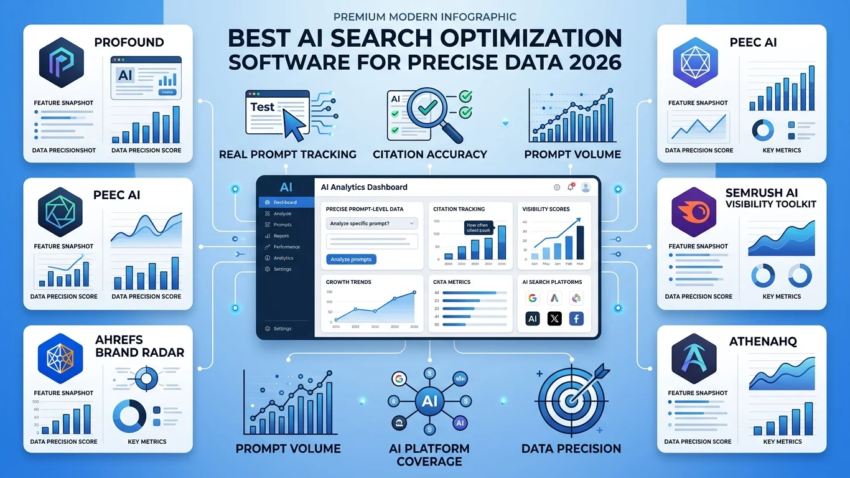
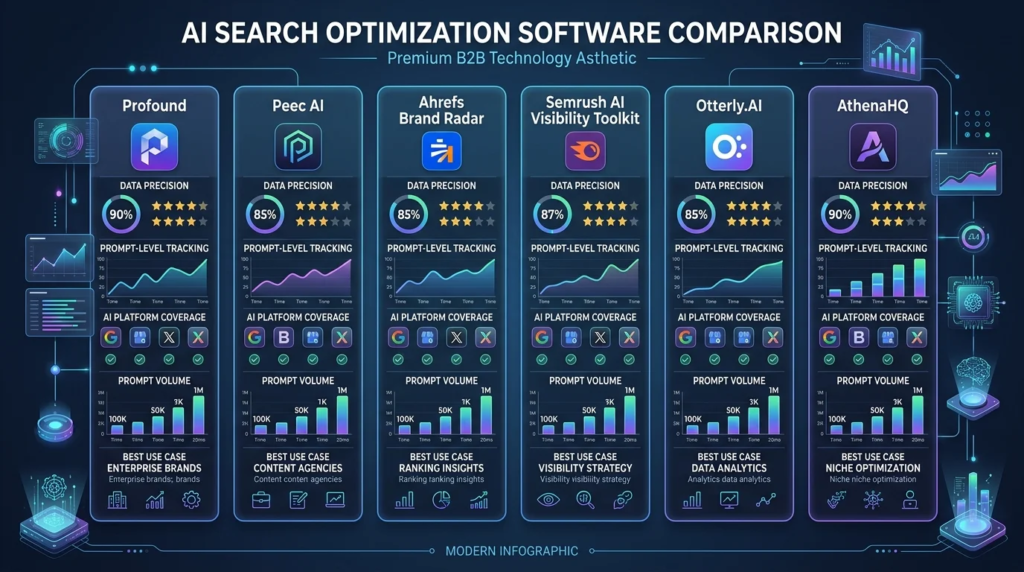
For the most precise, enterprise-grade citation data, Profound leads the category, since it logs real conversation and prompt-to-response data rather than relying purely on simulated queries. For strong precision at a more accessible mid-market price, Peec AI offers genuine prompt-level tracking with multi-language support. Ahrefs Brand Radar and Semrush AI Visibility Toolkit are strong choices if you already use those SEO suites and want AI visibility data alongside your existing rankings data. Otterly.AI is the most credible budget option that still delivers real prompt-level tracking rather than a vague aggregate score. Pricing across all of these changes frequently, so treat any specific figure as a starting point to reconfirm.
What Does “Precise Data” Mean in AI Search Optimization Software?
Before comparing tools, it’s worth being specific about what separates precise AI visibility data from vague AI visibility data, because the marketing language across this category tends to blur the distinction.
Real Prompts vs. Simulated Prompts
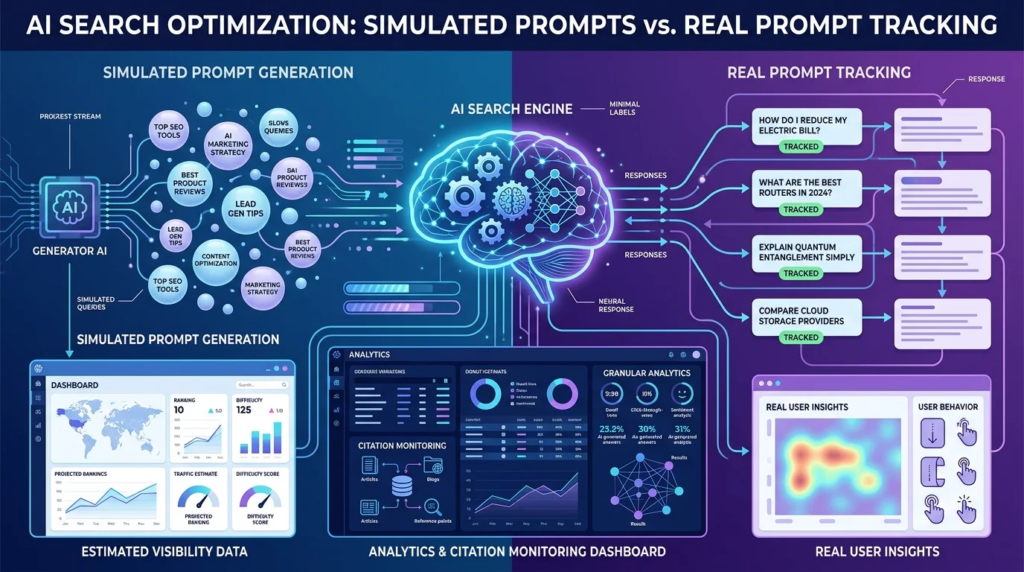
Some tools generate broad, synthetic prompts based on your industry or keywords and run those against AI platforms to estimate visibility. This produces a reasonable directional signal, but it’s an approximation of what your actual customers might ask, not a measurement of it. Other tools — Profound is the clearest example — build their tracking around prompt-to-response logging tied to how AI systems are actually queried and cited in practice, which tends to produce a more accurate picture of real citation patterns than a purely simulated approach. Neither method is “wrong,” but they answer subtly different questions, and it matters which one you’re actually paying for.
Sample Size and Prompt Volume
Precision also depends on how many prompts a tool tracks and how often it re-checks them. A tool tracking 15–25 prompts monthly gives you a small, useful sample for a narrow use case, but it won’t reliably capture how your brand performs across the dozens of ways real customers phrase category questions. Tools priced higher in this category typically track larger prompt volumes — from roughly 50 prompts on entry tiers up into the hundreds on higher tiers — specifically because a larger, more frequently refreshed sample produces more statistically meaningful trend data, given how much AI answers vary between individual runs.
How We Evaluated Software for AI Search Optimization Precision
This comparison prioritizes four factors specifically related to data precision, rather than general feature breadth: whether the tool uses real conversation/citation data versus purely simulated prompts; how many prompts and AI platforms are tracked at each pricing tier; whether prompt-level detail is available (versus only an aggregated score); and how transparent the vendor is about the directional, sampled nature of AI visibility data rather than presenting it as a perfectly repeatable measurement. Tools that market themselves primarily on content generation or broad SEO features, with AI visibility as a secondary add-on, are noted as such rather than evaluated as if precision were their core focus.
The Best AI Search Optimization Software for Precise Data
Profound — Best for Enterprise-Grade Citation Accuracy
Profound is widely regarded as the category leader for AI visibility tracking, built around monitoring how brands are cited and described across platforms including ChatGPT, Perplexity, Google AI Overviews, and several others. Its key precision advantage is architectural: rather than relying solely on synthetic, simulated prompts, its tracking is built around prompt-to-response logging tied to real query and citation patterns, which several independent reviews point to as producing a more accurate real-world picture than tools using only generated prompts.
Pricing starts around $99/month for a Starter tier covering a single AI engine and a limited prompt volume, scaling to several hundred dollars monthly for broader multi-engine coverage, with enterprise pricing handled through custom quotes. It’s worth noting — and to Profound’s credit, the vendor is upfront about this — that even its data is described as directional and probabilistic rather than perfectly repeatable, which is true of every tool in this category, not a unique weakness. Profound tends to make the most sense for larger organizations with a dedicated budget for AI visibility specifically, rather than a small business testing the waters.
Peec AI — Best Mid-Market Precision-to-Price Ratio
Peec AI has grown quickly in this category and is frequently cited as offering strong prompt-level analytics at a more accessible price point than enterprise platforms like Profound. It tracks visibility across major AI engines with genuine per-prompt detail, and supports multi-language and multi-market tracking, which matters for brands operating outside a single English-speaking market.
Pricing tends to scale with prompt volume — lower tiers in the range of roughly $80–90/month for a smaller prompt set, up to several hundred dollars monthly for higher volumes, with additional AI engines sometimes billed separately. For a mid-sized marketing team that needs real prompt-level data without committing to enterprise-tier spending, Peec AI is one of the more frequently recommended options specifically on the basis of its data depth relative to cost.
Ahrefs Brand Radar — Best for Large-Scale Prompt Indexing
If your team already relies on Ahrefs for traditional SEO, Brand Radar extends that into AI visibility tracking across AI Overviews, ChatGPT, Copilot, Gemini, and Perplexity, with a large-scale prompt index behind it. Its precision advantage is scale: because it draws on Ahrefs’ existing infrastructure, it can offer breadth across a large volume of tracked queries.
The tradeoff is pricing structure — Brand Radar’s model has historically layered a base fee with per-platform add-ons, which can make full multi-platform coverage considerably more expensive than the entry price suggests, in some reports totaling several hundred dollars monthly once every platform is included. It’s a strong choice for teams that want AI visibility data integrated with the ranking, backlink, and content data they already track in Ahrefs, less ideal for someone who wants AI visibility as a lean, standalone purchase.
Semrush AI Visibility Toolkit — Best If You Already Use Semrush
Semrush’s AI Visibility Toolkit takes a similar integrated approach, showing how AI platforms like ChatGPT and Google’s AI Mode describe and compare your brand against competitors, layered into the broader Semrush ecosystem. For teams already paying for Semrush, this tends to be one of the more cost-efficient ways to add AI visibility tracking, since it’s typically priced as an add-on rather than a separate full-price product.
Its precision is generally considered solid for directional tracking and competitive benchmarking, though — similar to Ahrefs — it’s positioned as part of a broader SEO suite rather than a purpose-built, precision-first AI visibility platform, so dedicated software may offer deeper prompt-level granularity for teams where that specific depth is the priority.
Otterly.AI — Best Affordable Option With Real Prompt-Level Data
Otterly.AI has carved out a position as the most accessible serious option in this category, with entry pricing reported around $29/month for a lite tier tracking a modest number of search prompts, scaling up through mid-tier plans with API access and larger prompt volumes. Importantly, even its lower tiers are generally described as offering genuine prompt-level tracking rather than a vague composite score, which is what distinguishes it from tools that are cheap because they’re shallow.
The tradeoff at the entry tier is prompt volume and platform coverage — some AI engines are gated to higher tiers or offered as add-ons — but for a freelancer or small business that wants to start with real, if limited, precision rather than a free but vague check, Otterly.AI is one of the more consistently recommended starting points across independent comparisons.
AthenaHQ — Best for Multi-Engine Enterprise Coverage
AthenaHQ positions itself around broad engine coverage — commonly cited around eight AI platforms — combined with action-oriented workflows for larger teams, at self-serve pricing reported in the low-to-mid hundreds of dollars monthly. For organizations that need both wide platform coverage and workflow features that go beyond pure monitoring, it’s frequently mentioned alongside Profound as an enterprise-tier option, generally at a lower price point than Profound’s higher tiers while still offering meaningful engine breadth.
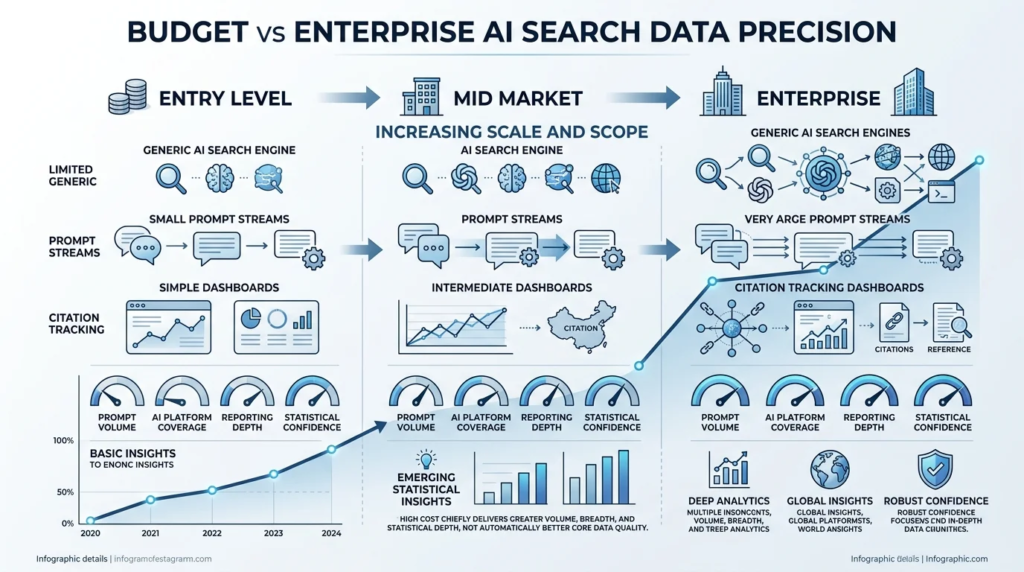
Budget vs. Enterprise: What Extra Precision Actually Costs
Broadly, this market splits into three price bands. Entry-level tools (roughly $29–90/month) offer real but limited prompt-level tracking — enough to validate whether AI visibility is worth investing in further, without enough volume for robust trend analysis across a large query set. Mid-market tools (roughly $100–500/month) typically expand prompt volume, add more AI platforms, and in some cases add multi-language support — this is where most growing marketing teams land once they’ve confirmed the category matters to their business. Enterprise tools (several hundred to several thousand dollars monthly, often custom-quoted) add the largest prompt volumes, the broadest platform coverage, security certifications, and in some cases move from real conversation data toward genuinely large-scale citation logging — the added cost is buying statistical depth and platform breadth, not a fundamentally different kind of data.
The practical decision-making question isn’t “which tier is best” in the abstract — it’s whether your current prompt volume and reporting needs actually require what the next tier up adds. A five-person team validating a new content strategy rarely needs the same prompt volume as an enterprise brand benchmarking share-of-voice against a dozen named competitors.
Common Mistakes When Choosing AI Search Optimization Software
Assuming a higher price always means more precise data. Price in this category often tracks prompt volume and platform breadth more than it tracks fundamental data quality — a well-built mid-tier tool can be more precise for your specific need than an underused enterprise plan.
Comparing tools on feature lists instead of methodology. Two tools can list nearly identical features while using fundamentally different data collection methods (simulated versus real prompt/citation data) — the methodology is usually the more important comparison point.
Not checking current pricing directly with the vendor. This category’s pricing changes often enough that even recent third-party comparisons can be out of date within a few months; always confirm current numbers before budgeting.
Buying enterprise-tier prompt volume you won’t use. A large prompt allowance is only valuable if you have that many genuinely distinct customer questions worth tracking — padding a small, well-chosen prompt list with irrelevant volume doesn’t add precision.
Treating any single tool’s number as a hard fact. Every vendor in this category, including the most reputable ones, describes their visibility data as directional and probabilistic rather than perfectly repeatable — a good tool gives you a precise methodology, not a guarantee of an exact, unchanging number.
How to Test AI Search Optimization Software’s Data Precision Before You Buy
- Ask specifically how prompts are sourced. Find out whether the tool uses simulated prompts, real conversation/citation data, or a mix, and how that maps to the number you’ll actually see in your dashboard.
- Check prompt volume at your target pricing tier. Confirm exactly how many distinct prompts and which AI platforms are covered at the plan you’re actually considering, not the headline plan featured in marketing materials.
- Run a free trial against your own customer-question list, not the tool’s suggested prompts, so you’re testing precision on the queries that actually matter to your business.
- Compare the same handful of prompts across two tools during a trial period to see how consistent the reported results are — meaningful divergence is worth investigating before committing to an annual contract.
- Ask the vendor directly how they describe data reliability — a vendor that’s transparent about the sampled, directional nature of AI visibility data is generally a better sign than one that presents its numbers as exact and guaranteed.
FAQs About AI Search Optimization Software and Data Precision
What does “precise data” mean for AI search optimization software? It refers to how granular, methodologically sound, and well-sampled a tool’s AI visibility data is — specifically whether it tracks individual, real prompts across named AI platforms with adequate volume, rather than producing a single vague aggregate “visibility score.”
What’s the difference between real prompt tracking and simulated prompt tracking? Simulated prompt tracking generates likely questions based on your industry or keywords and runs those against AI platforms. Real prompt or conversation-based tracking is built around logging actual query and citation patterns, which several reviews suggest produces a more accurate real-world picture, though it’s a more complex approach to build and typically costs more.
Which AI search optimization software is most accurate? Profound is generally regarded as the category leader for citation accuracy at scale, largely due to its prompt-to-response logging approach, though “most accurate” depends partly on your specific prompt set and budget — a well-configured mid-market tool can outperform an underused enterprise one for a specific need.
Do I need expensive software to get reliable AI visibility data? Not necessarily. Several budget and mid-market tools, including Otterly.AI and Peec AI, offer genuine prompt-level tracking rather than a shallow composite score; the main tradeoff at lower price points is typically prompt volume and platform breadth, not fundamental data reliability.
Can I track AI search visibility manually instead of buying software? Yes, for a small number of prompts — manually asking AI platforms your key questions on a regular schedule is a legitimate, free starting point, though it becomes time-consuming and less consistent than software once you need to track many prompts across multiple platforms and competitors.
How many prompts should software track for the data to be meaningful? There’s no universal number, but tracking fewer than roughly 15–20 prompts tends to produce a narrow, less reliable picture, while 50 or more prompts (available on most mid-tier and higher plans) generally supports more meaningful trend analysis, especially once you factor in normal answer-to-answer variation.
Do these tools guarantee my brand will be mentioned by AI more often? No. Tracking software measures and reports visibility; it doesn’t directly cause AI platforms to mention your brand more often. Improving visibility requires separate content, structured data, and authority-building work informed by what the tracking data shows.
Which software is best if I already use Ahrefs or Semrush? Ahrefs Brand Radar or the Semrush AI Visibility Toolkit are the natural starting points, since both integrate AI visibility data alongside the ranking and content data you’re already using in those platforms, though dedicated tools may offer deeper prompt-level granularity if that becomes a priority.
How often does AI visibility software pricing change? Frequently enough that independent comparisons published even a few months apart often show different numbers for the same tool — this is a fast-moving, well-funded category, so always confirm current pricing directly with the vendor before budgeting.
What’s the best free or low-cost option to start with? Several vendors offer free trials or low-cost entry tiers (Otterly.AI’s lite tier and various vendors’ free one-off visibility checks are commonly cited starting points) — using one of these to validate whether AI visibility tracking is worth deeper investment is a reasonable first step before committing to a paid annual plan.
Final Takeaway: The Best AI Search Optimization Software for Precise Data
The AI search optimization software market has matured quickly, and the tools genuinely differ on data precision — not just price or logo count. If enterprise-grade citation accuracy and large prompt volumes matter most, Profound leads the category, with AthenaHQ and Ahrefs Brand Radar as strong alternatives depending on your existing tool stack. If you need real prompt-level precision without enterprise spending, Peec AI and Otterly.AI both deliver genuine, if smaller-scale, tracking at meaningfully lower prices. Whichever tier fits your budget, the most important next step is the same: confirm current pricing and prompt volume directly with the vendor, then run a trial against your own customers’ actual questions before committing to a plan.

Hamad Arshad
SEO Specialist | SEO Manager | GEO Strategist
7+ Years of Experience in SEO, GEO, AEO, AI SEO, Local SEO, Technical SEO, PPC, Google Ads & Meta Ads.



Leave a Reply