

A Comprehensive Review of Binary Neural Networks
Binary neural networks represent one of the most extreme forms of model compression in deep learning — instead of storing weights and activations as 32-bit floating-point numbers, these models constrain them to just two values, typically +1 and −1. That single constraint cuts memory usage dramatically and replaces expensive multiplication operations with simple bitwise logic, which is exactly why the approach has remained a serious research direction for nearly a decade despite the accuracy challenges that come with such extreme compression.
This review is written for machine learning practitioners, researchers, and engineers evaluating whether binary neural networks are a realistic option for constrained-hardware deployment — mobile devices, FPGAs, microcontrollers — or who simply want an accurate, up-to-date picture of where the field stands. We’ll cover how the technique works, how these networks are trained, how accuracy has evolved from early results to current state-of-the-art, and where the real limitations remain.
Quick Answer: What Is a Binary Neural Network and Does It Still Sacrifice Accuracy?
A binary neural network is a neural network in which weights, activations, or both are constrained to binary values (typically +1/−1) instead of full-precision floating-point numbers, dramatically reducing memory footprint and enabling fast bitwise computation. Early versions of this architecture (2016) sacrificed substantial accuracy — the original BNN reached roughly 42% Top-1 accuracy on ImageNet with a ResNet-18 backbone, well below the ~69% full-precision baseline. Modern research has closed much of that gap: architectures like BNext have pushed fully binarized ImageNet Top-1 accuracy above 80%, making the approach genuinely competitive for specific efficiency-constrained applications, even though a meaningful accuracy gap to full-precision models often still remains depending on the architecture and task.
What Is a Binary Neural Network?
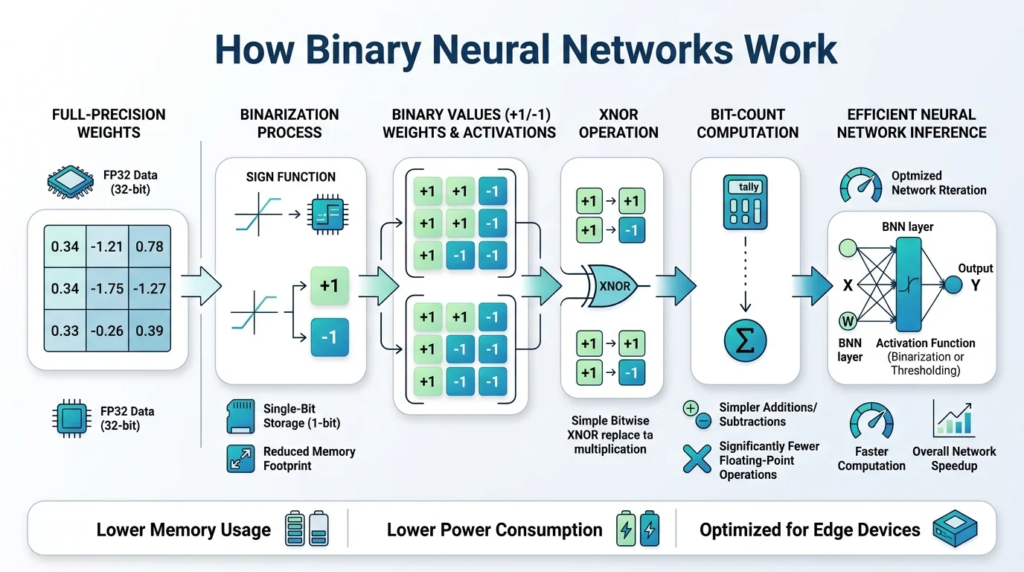
At its core, this is a neural network where the standard floating-point weights (and often activations) are replaced with binary values, most commonly represented as +1 and −1 rather than 0 and 1, since this maps cleanly onto the sign function and standard matrix multiplication math. This isn’t the same as simply rounding numbers to fewer decimal places — it’s an extreme form of quantization that collapses an entire continuous range of possible values down to two.
The appeal is straightforward: weights can be stored using a single bit instead of 32, shrinking model size by up to roughly 32x in the ideal case, while replacing costly floating-point multiply-accumulate operations with XNOR and bit-count operations that specialized hardware can execute extremely efficiently. This is why the approach has been studied so persistently for edge and embedded deployment, where memory and power budgets are the binding constraint rather than raw accuracy.
Binary Weights vs. Binary Weights and Activations
This distinction matters more than most casual explanations acknowledge, and conflating the two is one of the more common sources of confusion around accuracy claims in this field. A binary-weight network (like the original Binary-Weight-Network variant introduced alongside XNOR-Net) binarizes only the weights, keeping activations in full precision — this preserves noticeably more accuracy but sacrifices some of the computational efficiency gain, since activations still require floating-point operations. A fully binarized network (binary weights and binary activations, as in the original BNN and full XNOR-Net configurations) maximizes computational and memory efficiency but historically came with a larger accuracy cost. When you see wildly different accuracy figures quoted for “binary neural networks” across different sources, checking which of these two categories is being described usually explains the discrepancy.
How Binary Neural Networks Are Trained
Training a binary neural network presents an immediate mathematical problem: the sign function used to binarize weights and activations has a derivative of zero almost everywhere, which would normally make standard backpropagation impossible, since gradients simply can’t flow through a flat, non-differentiable function.
The Straight-Through Estimator and Why It’s Necessary
The dominant solution, used across most research in this field since its earliest work, is the straight-through estimator (STE). In the forward pass, the network applies the actual binarization (the non-differentiable sign function) to compute outputs as the model would at inference time. In the backward pass, STE substitutes a surrogate gradient — typically treating the binarization as if it were closer to an identity function, or clipped identity, within a certain range — allowing gradient-based training to proceed despite the forward operation being technically non-differentiable.
This approach works well enough to have enabled essentially the entire field, but it introduces a known mismatch: the gradient used to update the network doesn’t precisely correspond to the actual discrete forward computation the model performs. This mismatch tends to become more pronounced in deeper networks, and a substantial share of research since the original STE-based methods has focused specifically on refining this gradient approximation, improving optimizers, or adjusting network architecture to compensate for it.
The Evolution of Binary Neural Networks: Key Architectures
BinaryConnect and the Original BNN (2015–2016)
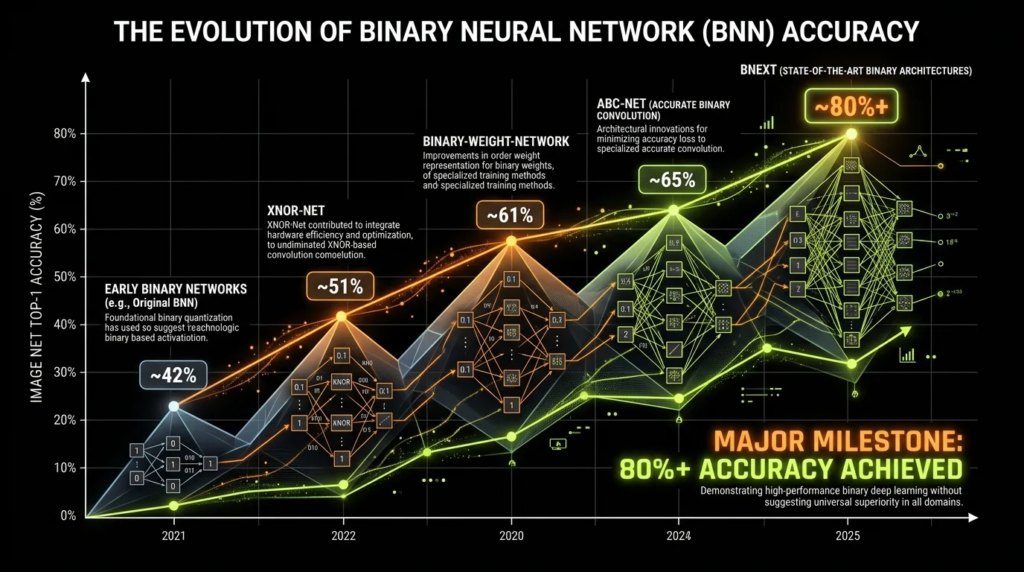
The field traces its modern roots to BinaryConnect and the subsequent fully binarized neural network work by Courbariaux and colleagues, which demonstrated that a neural network could be trained with binary weights (and later, binary activations too) using the straight-through estimator approach. On ImageNet with a ResNet-18 backbone, this original fully binarized approach reached roughly 42% Top-1 accuracy — a substantial gap from the roughly 69% achieved by the full-precision ResNet-18 baseline, but a proof that the concept was trainable at all.
XNOR-Net and Binary-Weight-Network (2016)
Rastegari and colleagues’ XNOR-Net introduced a meaningful refinement: adding scaling factors to the binarization process to better approximate the original full-precision weight and activation distributions. This pushed fully binarized accuracy on ImageNet/ResNet-18 to roughly 51% Top-1, while the binary-weight-only variant (binarizing weights but keeping activations full-precision) reached roughly 61% Top-1 — a clear illustration of the accuracy cost specifically attributable to binarizing activations, not just weights.
ABC-Net and Multi-Base Approaches
ABC-Net took a different strategy: instead of using a single binary approximation, it combines multiple binary weight bases (and, in some configurations, multiple binary activation bases) to more closely approximate full-precision behavior while retaining much of the computational benefit. With five binary weight bases and five binary activation bases, ABC-Net reached roughly 65% Top-1 accuracy on ImageNet/ResNet-18, and its weight-only-binarized variant with full-precision activations reached roughly 68% — closing in on the ~69% full-precision baseline while still using primarily binary computation.
Bi-Real Net and Later Architectural Refinements
Later work increasingly focused on architectural changes specifically designed to compensate for binarization’s information loss — adding shortcut connections that preserve more real-valued information through the network (an approach central to Bi-Real Net), along with refined training procedures and knowledge distillation from full-precision teacher models. These architectural refinements, layered on top of better binarization functions and training techniques, drove steady accuracy improvements through the following years of research.
BNext and the Push Toward 80% Top-1 Accuracy
More recent work has pushed accuracy in this field considerably further than the earlier results. BNext, for example, was designed around a systematic architectural search specifically for binary networks, combined with knowledge distillation techniques adapted for binarization’s specific overfitting behavior and modernized data augmentation. The result pushed fully binarized ImageNet Top-1 accuracy above 80% — a result that would have seemed implausible relative to the field’s original ~42% starting point, and one that meaningfully changes the practical calculus for when this kind of architecture is a viable choice versus a research curiosity.
Accuracy vs. Efficiency: What the Numbers Actually Show
Pulling these results together into one picture: the accuracy gap between these binarized models and full-precision networks has narrowed substantially since the field’s 2016 origins, but it hasn’t disappeared, and the specific gap depends heavily on which configuration (binary-weight-only vs. fully binarized) and which architecture is being compared.
| Method (ResNet-18, ImageNet) | Configuration | Approx. Top-1 Accuracy |
| Full-Precision ResNet-18 | 32-bit weights & activations | ~69.3% |
| Original BNN (Courbariaux et al.) | Binary weights & activations | ~42.2% |
| XNOR-Net (Rastegari et al.) | Binary weights & activations | ~51.2% |
| Binary-Weight-Network variant | Binary weights, full-precision activations | ~60.8% |
| ABC-Net (5 bases) | Binary weights & activations | ~65.0% |
| BNext | Binary weights & activations | ~80.6% |
These figures come from the original published papers introducing each method and are cited here for their historical and comparative value, not as a claim about any specific production system’s guaranteed performance — actual results vary by dataset, training recipe, and hardware target. The efficiency side of the tradeoff is more consistent across methods: fully binarized networks reliably deliver large memory reductions and can achieve multiple-times speedups on compatible hardware (particularly mobile CPUs and specialized accelerators like systolic arrays), which is the actual reason this accuracy tradeoff is worth considering in the first place for constrained-hardware deployment.
More recent research has continued pushing in two directions at once — squeezing more accuracy out of smaller backbones, and applying improved training recipes to deeper ones. Work on distribution-modulated binarization, for instance, has reported around 63% Top-1 accuracy on ImageNet with a ResNet-18 backbone alongside measurable gains on CIFAR-10 relative to earlier baselines, largely by addressing two specific failure modes in weight optimization: “dead” weights that stop receiving useful gradient signal, and “susceptible” weights that flip sign too easily during training. Separately, pruning-based approaches that binarize a network without ever updating most of the underlying weight values have reported binary-weight-network accuracy above 74% Top-1 on ImageNet and above 90% on CIFAR-10 — a reminder that architecture search and training strategy, not just the binarization function itself, are doing much of the work in closing the accuracy gap. None of these results should be read as a single settled number for “binary neural network accuracy” — the honest summary is that the achievable accuracy today depends heavily on backbone size, dataset, and training budget, and continues to improve as new papers are published.
Where Binary Neural Networks Are Used in Practice
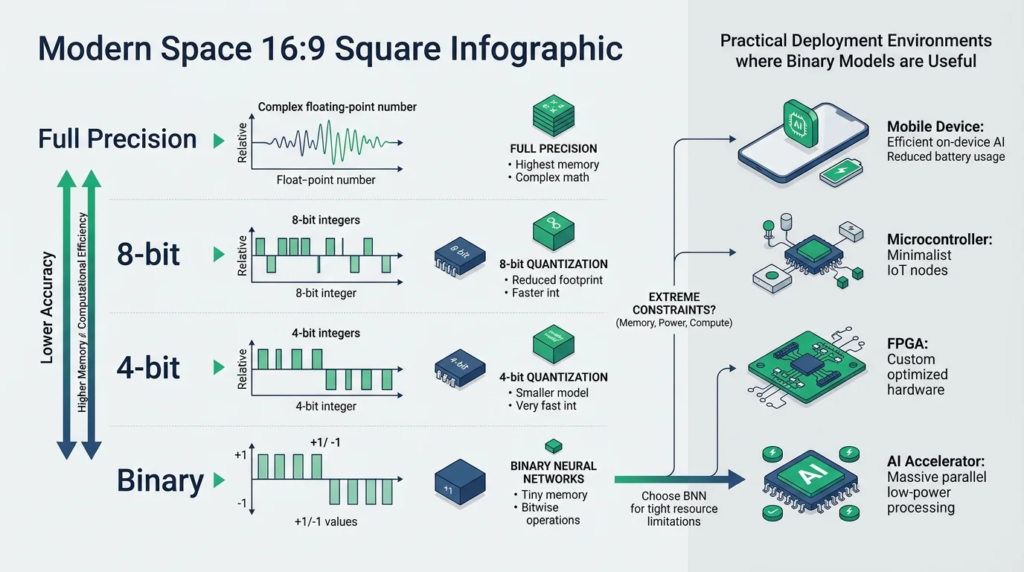
The practical use case is almost always the same underlying motivation: deploying a model where memory, power, or compute budget is the binding constraint, and some accuracy loss is an acceptable tradeoff for that efficiency. This shows up most commonly in mobile and embedded vision applications — on-device image classification or object detection where cloud inference isn’t available or desirable — and in specialized hardware contexts like FPGAs and custom accelerators, where binary operations map especially cleanly onto the underlying hardware logic.
In practice, a common approach is to reserve full binarization for the least accuracy-sensitive layers or tasks, and use binary-weight-only or mixed-precision approaches where accuracy matters more — a hybrid strategy rather than an all-or-nothing choice. This is one of the more frequently overlooked practical points in introductory coverage of the topic: these architectures aren’t typically deployed as a uniform, whole-network binarization in production settings where accuracy is a real concern; the tradeoff is usually tuned per layer or per use case.
Concretely, this tends to show up in always-on, battery-constrained scenarios — keyword-spotting on a smart speaker, basic gesture or presence detection on a wearable, or a first-stage filter that decides whether a more expensive full-precision model even needs to run. In these cases, the task itself is narrow enough that some accuracy loss is tolerable, and the power savings from avoiding constant full-precision inference are the entire point. A common mistake is expecting the same approach to work equally well for a broad, high-stakes classification task with dozens of fine-grained categories — the accuracy cost tends to bite hardest exactly where the task is least forgiving, which is worth weighing honestly before committing engineering time to a full binarization effort.
Limitations and Open Challenges for Binary Neural Networks
Even with the accuracy improvements of recent years, several open challenges remain central to this field. Training instability is a persistent issue — the straight-through estimator’s gradient mismatch tends to worsen in deeper or more complex architectures, which is part of why architectural innovation has been just as important as training-algorithm improvements in driving progress. Generalization to more complex tasks beyond image classification (object detection, segmentation, and especially domain-generalization scenarios where deployment conditions differ from training conditions) remains harder for these binarized models than for their full-precision counterparts, since the reduced representational capacity leaves less room to absorb distribution shift.
There’s also a practical hardware-support gap: achieving the theoretical efficiency gains requires hardware or software runtimes specifically optimized for binary/XNOR operations — running one of these models on generic hardware without that support often fails to realize the full speedup the architecture theoretically promises, which is a common and avoidable disappointment for teams evaluating this approach for the first time.
Binary Neural Networks vs. Other Quantization Approaches
Binary neural networks sit at the extreme end of a broader spectrum of model quantization techniques. 8-bit quantization — a far more common production technique — typically preserves accuracy very close to full-precision models while still delivering meaningful memory and speed improvements, making it the default choice for most teams that don’t have an extreme constraint pushing them toward full binarization specifically. 4-bit and other low-bit-width approaches (like DoReFa-Net’s mixed configurations) sit in between, trading some additional accuracy for further efficiency gains without going all the way to binary.
The practical decision-making question isn’t “which is theoretically best” — it’s how tight the actual deployment constraint is. If 8-bit quantization already meets your memory and latency budget, there’s rarely a reason to accept the larger accuracy risk that comes with full binarization. This extreme approach earns its place specifically in the small subset of cases where even 8-bit or 4-bit quantization isn’t sufficient — extremely constrained microcontrollers, specialized binary-optimized hardware, or applications where the efficiency ceiling itself is the primary design goal.
Common Misconceptions About Binary Neural Networks
“Binary neural networks are purely a research curiosity with no practical accuracy.” This was closer to true in 2016; it’s considerably less true today, given architectures like BNext reaching over 80% Top-1 accuracy on ImageNet.
“They all binarize both weights and activations.” Many practical and research configurations binarize only weights while keeping activations in higher precision specifically to preserve more accuracy, trading away some of the theoretical efficiency ceiling.
“This kind of model automatically runs faster on any hardware.” The efficiency gains depend on hardware or software support for binary/XNOR operations — without that support, the theoretical speedup often isn’t realized in practice.
“They’re basically the same idea as 1-bit large language models, just applied to a different domain.” They share the core insight of extreme weight quantization, but they’re distinct research threads with different training techniques, architectures, and maturity levels — conflating them tends to produce inaccurate expectations about either one.
How to Evaluate Whether a Binary Neural Network Fits Your Project
Before investing engineering time in binarization, it’s worth working through a few practical checks:
- Confirm the actual constraint. If your bottleneck is memory or power specifically, and 8-bit quantization already fits your budget, there’s usually no reason to go further — the added accuracy risk of full binarization should be reserved for cases where lighter quantization genuinely isn’t enough.
- Check hardware/runtime support first. Confirm your target deployment environment actually has an efficient binary/XNOR execution path before assuming the theoretical speedup will materialize — this is the single most common gap between paper results and real deployments.
- Match the task to the tolerance. Narrow, low-stakes classification or detection tasks tolerate binarization’s accuracy cost far better than broad, fine-grained, high-stakes ones.
- Start with binary-weight-only if accuracy is uncertain. It gives up some efficiency but preserves meaningfully more accuracy than full binarization, making it a reasonable middle ground to validate the approach before committing further.
- Budget for architecture-specific tuning. Based on the published research, treating binarization as a drop-in replacement for a standard architecture, without any accompanying architectural or training adjustments, tends to underperform relative to the field’s best reported results.
FAQs About Binary Neural Networks
What is a binary neural network? A binary neural network is a neural network where weights, activations, or both are constrained to binary values (typically +1/−1) rather than full-precision floating-point numbers, dramatically reducing memory usage and enabling fast bitwise computation in place of standard multiplication.
How accurate are binary neural networks compared to full-precision models? Early versions (2016) reached roughly 42% Top-1 accuracy on ImageNet with a ResNet-18 backbone, versus around 69% for the full-precision equivalent. More recent architectures like BNext have pushed fully binarized accuracy above 80%, substantially narrowing — though not fully closing — the historical gap.
What is the difference between a binary neural network and a quantized neural network? This is the most extreme case of quantization, constraining values to just two possible states. Broader quantization techniques (8-bit, 4-bit) constrain values to a larger but still reduced set of possible states, generally preserving more accuracy at the cost of a smaller efficiency gain than full binarization.
What is the straight-through estimator, and why do these networks need it? It’s the training technique that allows gradients to flow through the otherwise non-differentiable binarization (sign) function, by substituting a surrogate gradient during backpropagation. Without it, standard gradient-based training couldn’t optimize the binarized weights and activations at all.
What is XNOR-Net, and how is it different from the original BNN? XNOR-Net added scaling factors to the binarization process to better approximate original full-precision weight and activation distributions, improving on the original’s accuracy — roughly 51% versus 42% Top-1 on ImageNet/ResNet-18 in their respective original papers — while keeping the core binary-weight-and-activation approach.
Are binary neural networks used in real-world products? Yes, primarily in mobile and embedded vision applications and specialized hardware (FPGAs, custom accelerators) where memory and power constraints are severe enough to justify the accuracy tradeoff, often using binary-weight-only or hybrid/mixed-precision configurations rather than full binarization throughout.
What is the current state-of-the-art accuracy on ImageNet? As of recent published research, architectures like BNext have reached just over 80% Top-1 accuracy on ImageNet with fully binarized weights and activations — a substantial advance from the field’s original ~42% starting point, though figures continue to shift as new research is published.
What are the main limitations of this approach today? Training instability tied to the straight-through estimator’s gradient approximation, weaker generalization on more complex tasks and domain-shift scenarios, and a practical dependency on specialized hardware or software support to realize the theoretical efficiency gains.
Can this approach be used for tasks beyond image classification? Yes — research has extended binary neural networks to object detection, segmentation, and other vision tasks, though accuracy retention tends to be more challenging on these more complex tasks than on straightforward image classification.
Are binary neural networks the same as 1-bit large language models? No, though they share the underlying concept of extreme weight quantization. This is a longer-established research area primarily applied to vision tasks, while 1-bit and low-bit large language model research is a more recent, actively evolving thread with its own distinct training techniques and challenges.
Final Takeaway
Binary neural networks have come a long way from the roughly 42% ImageNet accuracy of the field’s earliest 2016 results — modern architectures now reach over 80% Top-1 accuracy while retaining the core memory and computational efficiency advantages that make this approach worth considering in the first place. The right takeaway isn’t that they’re now a universal replacement for full-precision models — for most applications, 8-bit quantization remains the more practical default — but that in genuinely constrained deployment scenarios, a well-chosen, modern binary neural network architecture is a far more credible option today than the accuracy figures from a decade of outdated citations would suggest. If you’re evaluating one for your own project, start by clarifying whether your actual constraint truly requires full binarization, or whether a binary-weight-only or standard low-bit quantization approach would meet your efficiency target with meaningfully less accuracy risk.

Hamad Arshad
SEO Specialist | SEO Manager | GEO Strategist
7+ Years of Experience in SEO, GEO, AEO, AI SEO, Local SEO, Technical SEO, PPC, Google Ads & Meta Ads.








Leave a Reply