
What Is Ziptie AI Search Analytics 2026
Last year, I was working on a content project for a mid-sized SaaS brand. We had solid rankings — top 3 for several competitive keywords. Traffic looked decent. The client was happy.
Then something weird started happening. Leads dropped. Not traffic — leads. People were still finding the site, but fewer of them were converting from organic search.
After a lot of digging, we figured out what was going on. Potential customers were skipping the blue links entirely. They were asking ChatGPT and Google AI Overviews things like “what’s the best tool for [problem]” — and our client’s brand wasn’t showing up in those AI answers. A competitor nobody had taken seriously was getting mentioned consistently.
That’s when I started paying serious attention to a tool called Ziptie AI Search Analytics.
So What Exactly Is Ziptie AI?
Here’s the simple version: Ziptie (ziptie.dev) is a cloud-based AI search monitoring and optimization platform that tracks, measures, and helps improve how your brand appears inside AI-generated search results.
Think of it like Google Search Console — but instead of showing you where you rank on Google’s blue-link results page, it shows you whether AI tools like ChatGPT, Perplexity, and Google AI Overviews are actually mentioning and citing your brand when users ask relevant questions.
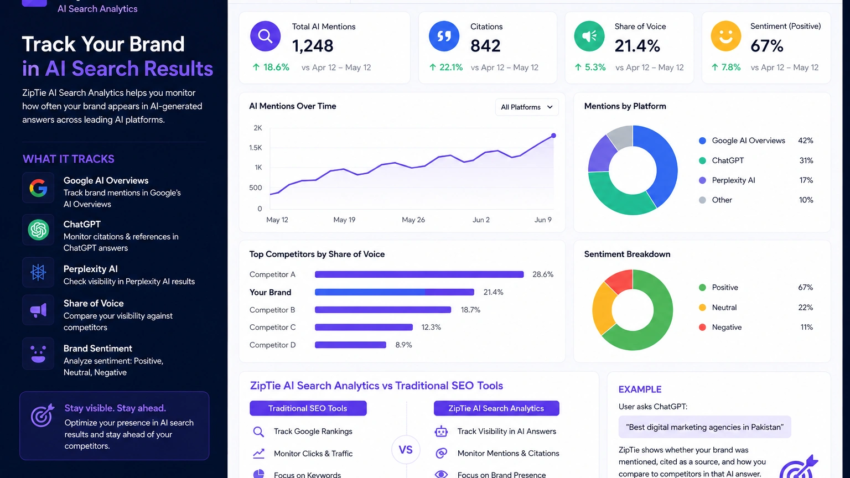
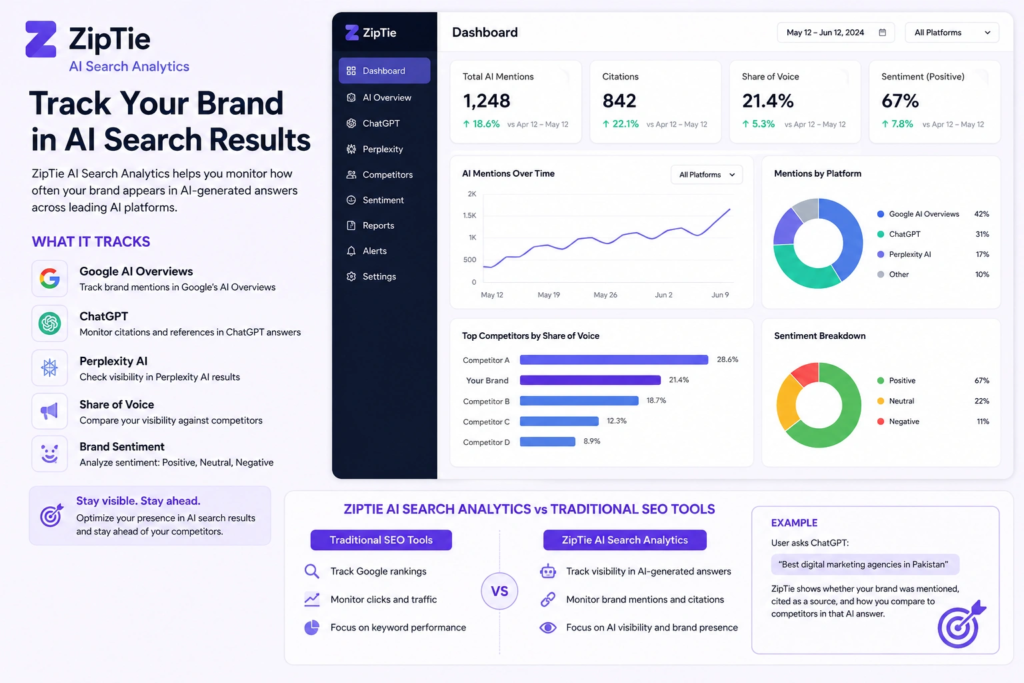
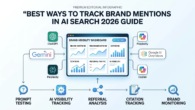
The tool monitors Google AI Overviews, ChatGPT, and Perplexity to show you when your brand gets mentioned, what sentiment those mentions carry, and whether AI tools cite your content as a trusted source.
That last part sentiment and citations is what makes this different from just a simple brand mention tracker.
Who Built This Thing?
Before trusting any new tool with client data, I always check who’s behind it. Ziptie passed that test easily.
It was launched by Tomasz Rudzki, Bartosz Góralewicz, and Sebastian Skowron — the team behind Onely, a respected technical SEO agency — which is why it’s trusted by SEO professionals who need accuracy over marketing fluff.
Onely has been doing deep technical SEO work for years. These aren’t startup founders pivoting from some unrelated industry — they understand crawling, indexing, and search infrastructure at a real engineering level. That background shows in how Ziptie is built.
The Problem Ziptie Is Actually Solving
To really understand why this tool matters, you have to accept something uncomfortable: the SEO playbook that worked from 2010 to 2022 is getting disrupted fast.
While Google shows ten blue links, AI tools synthesize answers and pick a few trusted sources to mention. When you’re not one of them, you become invisible to potential customers.
I’ve seen this firsthand. A brand can have a DA of 60+, hundreds of quality backlinks, perfect on-page SEO — and still be completely absent from AI-generated answers. Meanwhile, a smaller competitor with well-structured, authoritative content gets cited repeatedly.
Traditional SEO tools weren’t built to catch this gap. That’s exactly the problem Ziptie exists to fix.
How Ziptie Actually Works (Step by Step)
When I first logged in, I expected it to feel like a typical SaaS dashboard — dense, confusing, full of charts that look impressive but tell you nothing useful. Ziptie was more focused than that.
Here’s how the process actually flows:
Step 1: Define Your Queries
You start by setting up the prompts and questions your target audience is likely asking AI tools. These could be product categories, service descriptions, or comparison searches where customers evaluate options.
Ziptie also has an automated query generator that helps you expand your seed keywords. The automated query generation feature takes your seed keywords and expands them into dozens of conversational variations — the way real users ask AI tools. This alone saved me a ton of time. I’d been manually brainstorming query variations, which is tedious and easy to get wrong.
You can also import queries directly from Google Search Console, which speeds up setup significantly.
Step 2: Let It Monitor
ZipTie mimics real user behavior to track how AI tools answer your target queries. The platform captures the full AI response, identifies brand mentions, and logs whether your competitors appear instead.
This is important. Some tools scrape AI results in ways that can be unreliable or produce stale data. Ziptie uses real browser sessions to capture live, accurate responses — which is exactly what you need if you’re making content decisions based on this data.
Once configured, ZipTie monitors how AI tools respond to those queries across 14 countries.
Step 3: Check Your AI Success Score
This is the feature I kept coming back to. ZipTie’s AI Success Score blends mention frequency, citation presence, answer placement, and sentiment into a single ranking. Prompts where you get mentioned but never cited surface as authority gaps. Prompts where you get cited but buried low in the answer surface as structure problems.
That distinction matters a lot. Being mentioned and being cited are two very different things. A mention might be “some people use Brand X” — vague, unsupported. A citation means AI actually pulled from your content as a reference. The second one drives real traffic and trust.
Step 4: Understand Your Citation Share
ZipTie tracks your “Citation Share” — the percentage of relevant AI answers in which your domain is cited as a source. A Citation Share above 35% in your niche category is considered dominant in 2026. Below 15% signals high risk of competitor displacement.
When I ran this for the SaaS client I mentioned earlier, their Citation Share was sitting at 8%. Their top competitor? Around 42%. That number explained the lead drop instantly.
Step 5: Act on the Recommendations
Ziptie doesn’t just show you problems — it gives you specific content recommendations to improve your standing. In 2026, ranking isn’t just about keywords; it’s about RAG (Retrieval-Augmented Generation) Readiness. ZipTie uses Semantic Chunking to analyze if your content is digestible for AI scrapers.
Practically speaking, this often means restructuring content into cleaner Q&A formats, improving internal linking, and making sure your key claims are supported with citable data.
What I Actually Liked After Using It
A few things stood out:
The competitor intelligence is surprisingly good. You can see not just whether you’re missing from AI answers, but who’s showing up instead and which platforms they’re winning on. That’s actionable in a way that generic competitor analysis rarely is.
Technical SEO integration is smart. ZipTie recognized that poor AI citation often correlates with indexing problems — if Google can’t properly crawl your site, AI models also struggle to access your content. This feature now alerts you to crawl errors, sitemap issues, and technical problems suppressing both traditional and AI visibility.
So you’re not just getting AI visibility data — you’re also getting a heads-up when there are underlying technical issues that could be causing problems across the board.
Credibility matters here. ZipTie has earned strong endorsements from SEO industry leaders, including Lily Ray, Aleyda Solis, and Kevin Indig. Lily Ray specifically mentioned it as her go-to tool for monitoring AI Overview inclusion. When respected practitioners are publicly recommending a tool, that carries real weight.
What Ziptie Doesn’t Do Well (Be Honest With Yourself)
No tool is perfect, and Ziptie has real limitations worth knowing before you sign up.
It only covers three AI engines. Google AI Overviews, ChatGPT, and Perplexity. That’s the big three — but it doesn’t cover Gemini or Claude, which are growing in relevance. If your audience skews toward those platforms, you’ll need to supplement with other tools.
The credit-based model can get expensive for agencies. A credit-based model scales poorly for agencies running hundreds of client queries weekly. The math works fine for a single brand or a couple of clients, but it gets complicated fast at scale.
No built-in conversion tracking. Ziptie tells you whether you’re being cited — it doesn’t directly tie that to revenue or leads. You’ll still need to connect those dots manually using your own analytics stack.
Sentiment analysis is still maturing. An AI response saying “Brand X works well but has limited integrations” gets counted as a citation without heavily penalizing the criticism in scoring — this is being improved in 2026 updates. It’s not broken, but it’s not nuanced enough yet to fully trust without manual review.
Who Should Actually Use This?
Ziptie is a genuinely useful tool — but it’s not for everyone. Here’s my honest take:
You should probably use it if:
- You’re an SEO agency managing clients in competitive industries
- You’re a brand marketer responsible for organic visibility and lead generation
- You’re in content strategy and need to justify budget with actual data
- You’ve noticed traffic holding steady but lead quality declining (sound familiar?)
You can probably skip it if:
- You’re a solo blogger with a tight budget (the entry-level pricing starts around $69–$179/month depending on the plan)
- Your audience isn’t using AI tools to research purchases yet
- You’re still in early-stage content production and don’t have enough existing content to optimize
Common Mistakes People Make with This Kind of Tool
After watching a few teams adopt Ziptie (and making some of these mistakes myself), here’s what to avoid:
Setting it up and forgetting it. Ziptie gives you data — it doesn’t act on it for you. Teams that check their dashboard once a month don’t see results. The ones running weekly content sprints based on their AI Success Score do.
Tracking irrelevant queries. It’s tempting to monitor every keyword you care about. But if your target customers aren’t actually asking AI tools those questions, the data is noise. Start with 10–20 high-intent queries and expand from there.
Ignoring the technical alerts. A lot of brands focus entirely on the AI visibility metrics and overlook the crawl and indexing warnings. If your content isn’t being properly indexed, no amount of content optimization will fix your Citation Share.
Expecting instant results. Improving your AI visibility takes weeks, not days. Content changes need to be crawled, re-evaluated, and incorporated into AI responses. Set a 60–90 day timeline before judging whether your optimization efforts are working.
A Quick Note on Pricing
Ziptie’s Basic plan starts at $179/month for 1,000 AI search checks, with each check covering three platforms: AI Overviews, ChatGPT, and Perplexity. ZipTie also offers a 14-day free trial and roughly 15% off with annual billing. The free trial includes most features except GSC integration.
For a single brand with a focused keyword set, the math is reasonable. For agencies, you’ll want to model out how many queries you actually need to track before committing.

Hamad Arshad
SEO Specialist | SEO Manager | GEO Strategist
7+ Years of Experience in SEO, GEO, AEO, AI SEO, Local SEO, Technical SEO, PPC, Google Ads & Meta Ads.



Leave a Reply