
Geoffrey Hinton and the AI Jobs Crisis: What His Warnings Mean for the Future of Work
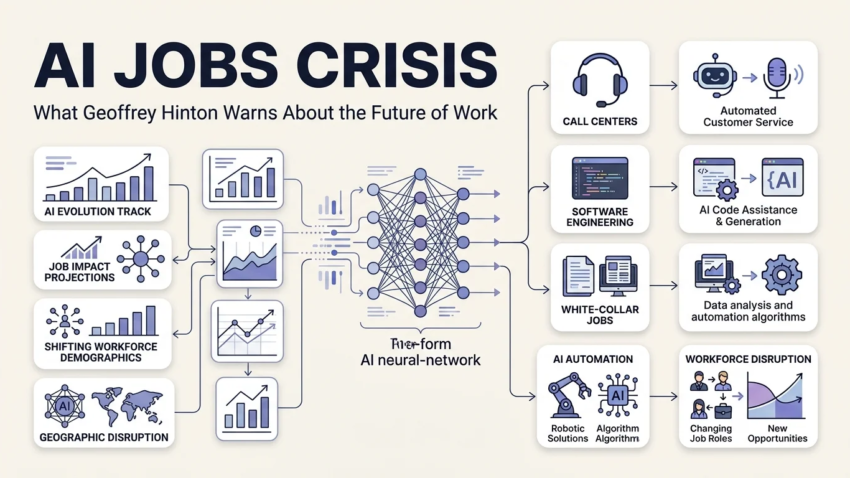
Geoffrey Hinton, the Nobel Prize–winning computer scientist known as the “Godfather of AI,” has shifted from cautious optimism to open warnings that artificial intelligence will displace large numbers of jobs, starting with call centers and routine cognitive work and moving into software engineering and other white-collar professions. He argues the disruption will concentrate wealth among the people who own AI systems, worsen inequality, and arrive faster than most economists expect. His views on the right fix have also evolved: he once endorsed universal basic income as a cushion, but now says a cash payment alone cannot replace the sense of dignity and purpose people get from work.
Who Is Geoffrey Hinton and Why His Opinion Carries Weight
Geoffrey Hinton spent decades building the foundations of modern neural networks, work that earned him the 2018 Turing Award (computing’s top honor) and a share of the 2024 Nobel Prize in Physics. He spent roughly a decade at Google, working on its Brain team, before leaving the company in 2023 specifically so he could speak more freely about AI’s risks without a corporate employer’s interests shaping what he could say publicly.
That combination — a scientist who helped invent the technology, rather than a commentator observing it from outside — is why his statements get so much attention. Hinton has also mentored a large share of the researchers now leading major AI labs, so his change in tone over the past two years has been read across the industry as a signal, not just an opinion.
How Geoffrey Hinton’s Views on AI and Jobs Have Changed
Earlier in the public debate about automation, a common reassurance was that AI would follow the pattern of past technology: it would reshape jobs the way the ATM reshaped bank teller work, without eliminating the role outright. Hinton has explicitly pushed back on that comparison. In his framing, the Industrial Revolution replaced human and animal muscle with machines; the current wave of AI is starting to replace cognitive labor — planning, writing, analyzing, coding — in the same broad, structural way.
In practice, this means Hinton no longer treats job disruption as a distant, hypothetical risk. In a series of interviews and talks over the past several months, he has described the pace of progress as startling even to him, at one point saying the changes are moving “faster than I thought.” That shift — from a researcher who once expected a gradual, manageable transition to one warning of an accelerating shock — is the throughline connecting his recent public comments.
Which Jobs Geoffrey Hinton Says Are Most at Risk
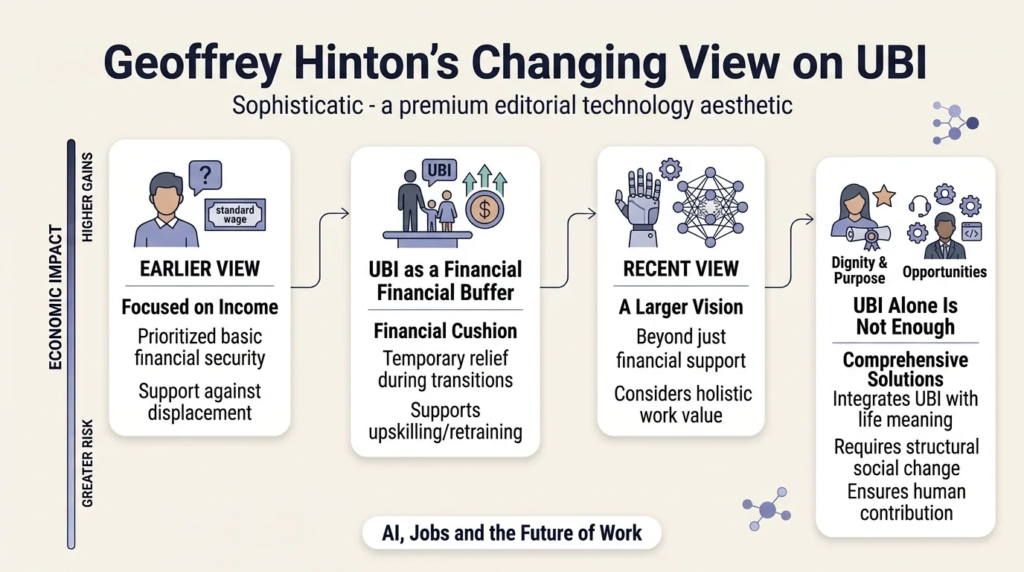
Hinton has pointed to a few categories repeatedly enough that they form a fairly consistent picture of where he expects the earliest and deepest impact.
Call Centers and Customer Support
This is the example Hinton returns to most often, in part because the disruption is already visible rather than projected. Customer-facing conversational AI has matured to the point that large volumes of routine support tickets, billing questions, and scheduling calls can be handled without a human agent. Corporate layoffs tied directly to this shift have already been announced by major companies, with executives citing both cost reduction and expanded AI-handled conversation volume as the rationale.
Entry-Level and Junior Roles
A theme that runs through Hinton’s commentary, and through broader labor-market analysis, is that entry-level and junior positions are disproportionately exposed. These roles have traditionally involved repetitive, well-defined tasks — first-pass drafting, basic research, routine coding, initial customer triage — which is exactly the kind of work current AI systems handle competently. That creates a secondary problem: junior roles are also how professionals traditionally build the experience needed to become senior ones, so shrinking that entry tier has knock-on effects for the talent pipeline in fields like law, journalism, consulting, and software development.
Software Engineering and Technical Work
Hinton has specifically flagged software engineering as vulnerable, not exempt. He has argued that within a few years, AI systems will be able to complete coding projects that currently take a team a month of work, and that this will sharply reduce the number of engineers needed on a given project. This is notable because software engineering has often been framed as a relatively “AI-safe” profession — highly paid, technically demanding, and assumed to require deep human judgment. Hinton’s point is that the judgment involved in writing and debugging code is still, at its core, a form of pattern-based cognitive work, which is the category he expects AI to keep encroaching on.
Mundane Intellectual Labor, Broadly
Beyond these named examples, Hinton’s general claim is broader: AI will likely replace most jobs that consist of routine intellectual labor — tasks that are cognitively demanding in the sense of requiring reading, writing, and reasoning, but that follow patterns a well-trained model can learn. Roles that combine physical presence, real-time human judgment under ambiguity, or high-stakes accountability tend to be further down his list of immediate concerns, though he has been careful not to declare any category permanently safe.
Why Hinton Thinks This Time Is Different: The Pace Argument
A large part of what separates Hinton’s warnings from earlier, more measured automation forecasts is speed. He has pointed to a pattern in which the practical capability of leading AI systems appears to double roughly every seven months — a pace that, if it continues, compounds into very large capability jumps within a small number of years, rather than the decade-plus horizon typically assumed in mainstream economic modeling.
That framing is not just theoretical. Analyses of job-posting volume since the launch of ChatGPT have found steep declines in listings for some categories of white-collar work, with some estimates putting the drop at around 30 percent in affected areas. Corporate announcements have reinforced the pattern: Salesforce’s CEO, for example, disclosed a round of customer-service layoffs in late 2025, explaining that AI agents were already handling a large share of consumer conversations and had meaningfully cut support costs. Hinton treats cases like this as early evidence that the disruption is not a future scenario but a process already under way in pockets of the economy.
The Inequality Problem: Who Wins and Who Loses
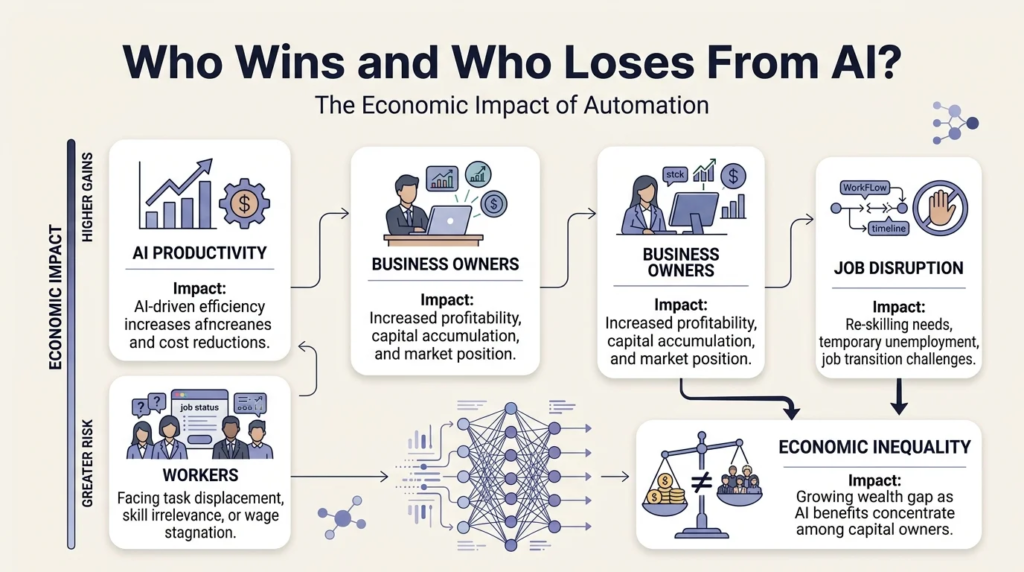
Hinton’s most pointed criticism is not really about the technology itself — it’s about who captures the economic value AI creates. He has argued that the likely outcome, without deliberate policy intervention, is that companies and investors who own AI systems capture most of the productivity gains, while the workers those systems displace bear most of the cost. In an interview with the Financial Times, he summarized the dynamic directly: “It will make a few people much richer and most people poorer.”
Notably, Hinton frames this as a problem with the economic system AI is deployed inside, rather than a problem inherent to the technology. He has said the outcome he describes is “not AI’s fault,” pointing instead to incentive structures under the current economic model, where firms that cut labor costs through automation are rewarded with higher margins regardless of the effect on displaced workers.
Universal Basic Income: Hinton’s Shifting Position
Hinton’s stance on how to respond to AI-driven job loss has itself evolved, and it’s worth tracking because it shows the difference between an early, hopeful policy fix and a more recent, more skeptical one.
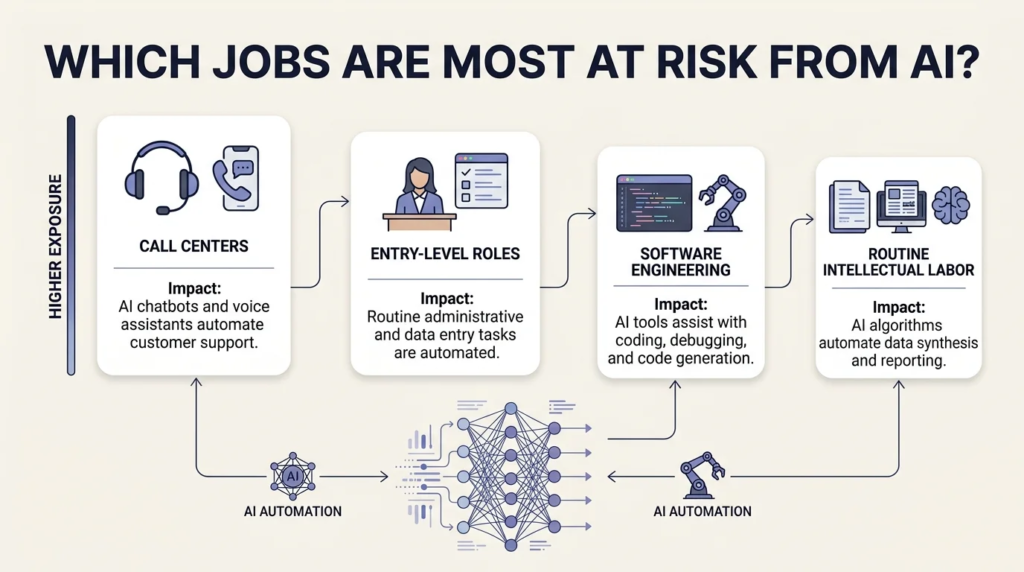
Earlier in the public debate, Hinton was a visible supporter of universal basic income as a buffer against job losses. He has said he was consulted by UK government officials and advised them that a UBI was a sound idea, framing it as a way to give displaced workers a basic floor of financial security while the economy adjusted.
More recently, in his Financial Times interview, Hinton distanced himself from treating UBI as a sufficient answer. His argument is that a cash payment addresses income but not the separate, harder problem of dignity: people derive a sense of worth and purpose from having a job, and a stipend does not replace that. This is a meaningful shift — from “UBI is a good idea” to “UBI alone won’t deal with human dignity” — and it puts Hinton at odds with some other prominent tech leaders who have championed UBI as the primary safety net for an AI-disrupted labor market.
Commentators responding to this gap in Hinton’s position have floated alternative or supplementary ideas, including UBI models tied to civic or learning contributions rather than a no-strings payment, wage subsidies for roles that combine human oversight with AI tools, and equity or co-ownership arrangements that give workers a stake in the automated systems replacing parts of their work. None of these are policies Hinton himself has fully endorsed; they represent the broader policy conversation his critique has helped provoke.
What Economists and Institutions Say: Where Forecasts Agree and Disagree
Hinton’s warnings sit inside a wider, and not fully consistent, body of labor-market forecasting. It’s useful to see where his view lines up with mainstream institutional research and where it goes further.
- McKinsey’s long-run scenario estimates that between 75 million and 375 million workers globally — roughly 3 to 14 percent of the workforce — may need to change occupations by 2030 because of automation, including AI.
- The World Economic Forum’s research leans toward a reshaping narrative rather than a purely destructive one, projecting that AI will eliminate some routine roles while expanding demand for AI-complementary skills and enlarging the addressable global talent pool.
- Gartner’s analysis suggests AI could touch nearly every IT role by 2030, displacing some functions while creating new ones focused on managing, auditing, and governing AI systems.
- Some broader employment-impact studies estimate roughly 85 million jobs displaced against 97 million new roles created by the mid-2020s — a net gain on paper, but one that assumes smooth reallocation of workers from declining roles into new ones, which rarely happens without friction, retraining costs, and regional mismatches.
The main point of disagreement is timeline, not direction. Most mainstream institutional forecasts place the heaviest disruption in the 2030s. Hinton’s more recent comments — including his suggestion that 2026 could be a turning point where AI’s capabilities noticeably widen the range of jobs it can replace — are notably more aggressive than that consensus. Whether his accelerated timeline proves accurate or the more gradual institutional forecasts hold up is not yet settled, and readers should treat both as informed projections rather than certainties.
Practical Implications: What This Means Depending on Where You Work
If You Work in Customer Service or a Call Center
This is the category with the most concrete, already-visible disruption. A practical response is to move toward roles that involve escalation handling, complex complaint resolution, or oversight of AI-handled interactions, since these require judgment calls that current systems still route to a human.
If You Work in Software Development
Hinton’s warning here is a signal to build skills adjacent to code generation rather than only inside it: system design, security review, integration across legacy systems, and the judgment to evaluate whether AI-generated code is actually correct and safe to ship. A common mistake is assuming seniority alone provides protection; the more durable protection tends to come from taking on responsibility for outcomes an AI system can’t yet be accountable for.
If You Are Early in Your Career
Because entry-level roles are a likely early casualty, it’s worth being deliberate about seeking out positions, internships, or projects that build judgment and client-facing skills quickly, rather than assuming years of routine task repetition will naturally lead to promotion the way it has for previous generations.
If You Manage People or Run a Business
A frequent implementation mistake is treating AI adoption purely as a headcount-reduction exercise. In practice, a more durable approach is redeploying staff toward the parts of the workflow that still need human judgment, and being transparent with teams about where automation is and isn’t planned, since ambiguity tends to do more damage to morale and retention than a clear (even difficult) plan.
Common Mistakes People Make When Thinking About AI and Job Loss
- Treating this as a distant, future problem. Hinton’s central argument is that measurable disruption — in call centers and customer support especially — has already started.
- Assuming only “low-skill” work is exposed. Hinton specifically includes software engineering, a highly paid, highly technical field, in his list of vulnerable jobs.
- Waiting until a layoff happens to think about reskilling. In practice, the roles disappearing fastest are also the roles that historically served as training ground for the next tier up, so waiting reduces the options available later.
- Treating universal basic income as a complete solution. Even Hinton, once a supporter, now argues that income support alone doesn’t address the loss of purpose and dignity tied to work.
- Underestimating the pace of change by benchmarking against past automation waves, which typically unfolded over a decade or more rather than in the compressed timeframe Hinton describes.
Expert Tips: How to Prepare for AI-Driven Labor Disruption
- Build skills in reviewing, verifying, and taking responsibility for AI output — this is where human accountability still matters most.
- Diversify income where possible rather than relying on a single employer or single skill set that maps closely to a task AI already handles well.
- For managers: invest redeployment budget into retraining before defaulting to layoffs, and communicate automation plans clearly rather than letting rumor fill the gap.
- For policymakers and organizations: treat income support (like UBI proposals) as one piece of a response, not the whole response — pair it with retraining access and, where feasible, mechanisms that give displaced workers some stake in the productivity gains.
- Track your own field’s job-posting trends, not just national averages — the disruption Hinton describes is uneven across industries and roles.
When Hinton’s Warnings Apply — and When They Don’t
It’s worth being precise about the scope of Hinton’s claims rather than generalizing them to every job. His examples cluster around routine cognitive and administrative work: support tickets, first-draft writing, boilerplate code, scheduling, and similar tasks with a learnable, repeatable pattern. Work that depends on physical dexterity in unpredictable environments, direct legal or regulatory accountability, or trust built through an ongoing human relationship — such as many roles in skilled trades, caregiving, and specialized clinical practice — has generally been treated as less immediately exposed in the broader labor literature, though few researchers, Hinton included, are willing to call any category permanently immune.
Frequently Asked Questions
What is Geoffrey Hinton’s prediction about AI and jobs in 2026?
Hinton has said 2026 could be a year when AI systems become capable enough to replace a significantly wider range of jobs than they already do, extending beyond call centers into other white-collar and technical roles.
Does Geoffrey Hinton think AI will cause mass unemployment?
Yes. He has said AI is likely to create “massive unemployment,” concentrating financial gains among a small group while leaving most workers worse off, unless policy changes intervene.
What jobs does Geoffrey Hinton say are most at risk?
He has repeatedly named call center and customer support work as already affected, and has also flagged entry-level roles and software engineering as vulnerable, alongside routine intellectual labor more broadly.
Does Geoffrey Hinton support universal basic income?
His position has shifted. He previously advised UK officials that UBI was a good idea, but more recently said a cash payment alone doesn’t address the loss of dignity people get from having a job.
Why did Geoffrey Hinton leave Google?
Hinton left Google in 2023 so he could speak more openly about the risks of AI without those comments reflecting on a corporate employer.
What does Hinton mean by AI capability doubling every seven months?
It refers to the pace at which the practical capabilities of leading AI systems appear to be improving, a rate of change he argues is faster than most economic and workforce planning currently assumes.
Is Hinton’s 2026 timeline more aggressive than other forecasts?
Yes. Most mainstream institutional forecasts, including from McKinsey and the World Economic Forum, place the heaviest labor disruption in the 2030s, while Hinton’s recent comments suggest meaningful disruption arriving sooner.
What does Hinton say about AI and inequality?
He argues AI will let a small number of people and companies capture most of the financial upside while displaced workers absorb most of the cost, describing this as a feature of the current economic system rather than of the technology itself.
Are all jobs equally at risk from AI, according to Hinton?
No. His warnings center on routine cognitive and administrative work. Jobs requiring physical dexterity in unpredictable settings, direct accountability, or ongoing trust-based human relationships are generally treated as less immediately exposed.
What can workers do to prepare for AI-driven job disruption?
Common recommendations include building skills in reviewing and taking responsibility for AI-generated work, diversifying income sources, and pursuing retraining proactively rather than waiting for a layoff to force the decision.
Final Takeaway
Geoffrey Hinton’s authority comes from having built the technology he’s now warning about, and his tone has hardened over the past two years — from cautious optimism to explicit warnings of massive unemployment and widening inequality. His specific claims are fairly narrow and checkable: call centers are already affected, entry-level and software engineering roles are next in his view, and the pace of change is faster than most institutional forecasts assume. His position on the right policy response has also shifted, from endorsing universal basic income to arguing it isn’t enough on its own. None of this amounts to a certainty — mainstream economic forecasts are more measured on timeline — but it’s a informed, insider warning worth weighing seriously rather than dismissing as hype. The most practical response, whether you’re an individual worker, a manager, or a policymaker, is to treat the disruption as already partially under way rather than a hypothetical for the next decade.

Hamad Arshad
SEO Specialist | SEO Manager | GEO Strategist
7+ Years of Experience in SEO, GEO, AEO, AI SEO, Local SEO, Technical SEO, PPC, Google Ads & Meta Ads.






Leave a Reply