

AI Tools Employee Work Product Ownership Copyright
An employee drafts a report with an AI assistant, a designer generates images with an AI tool, a developer ships code an AI helped write. Then someone asks the obvious question: who owns this work? The honest answer has four possible candidates — the employee, the employer, the AI company, or nobody at all — and which one is right depends on three separate layers of rules that stack on top of each other. This article walks through those layers in plain language: the employment rule, the copyright rule, and the contract rule.
One note before starting. This article explains how the rules work in the United States in general terms. It is general information, not legal advice, and specific situations can turn on state law and the exact contracts involved.
The Starting Point — Work Made for Hire
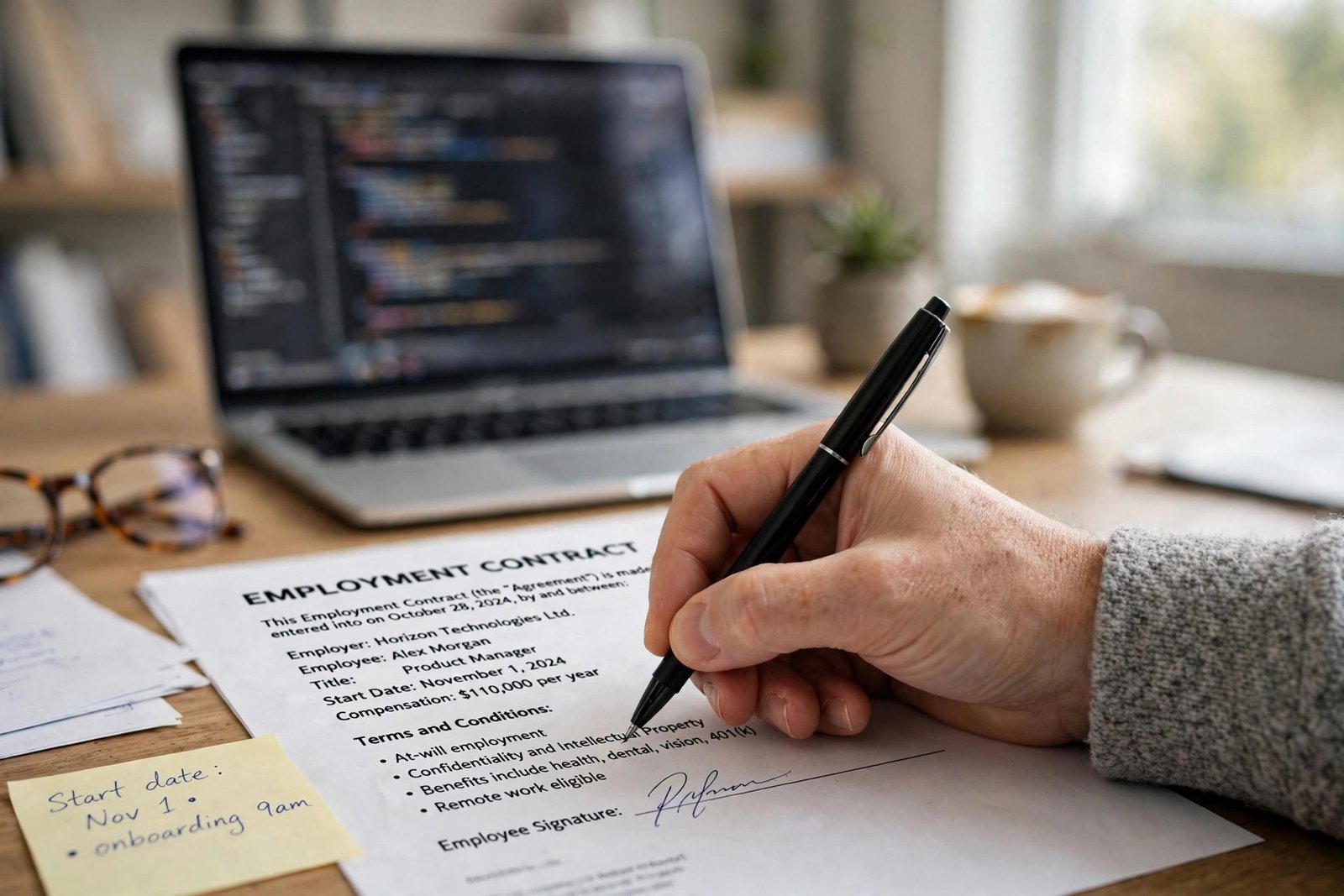
United States copyright law starts from a simple default: the person who creates a work owns its copyright. Employment law then carves out a large exception. Under the work-made-for-hire doctrine in the US Copyright Act, if an employee creates a work within the scope of their employment, the employer is treated as the author and owns the copyright from the moment the work is created. No separate transfer is needed, and this is true even if the employee never signed anything about it. The report you write at your desk, the code you commit during your shift, the presentation you build for your team — your employer owns it.
Two details matter. First, the work has to fall within the scope of employment. Something an employee creates entirely on their own time, unrelated to their job, may belong to the employee, although employment agreements often claim a broader reach and state laws differ on how far those claims can go. Second, the automatic rule applies to employees, not to independent contractors — a distinction that becomes important later in this article.
So the baseline answer to our question is straightforward. If you used a spellchecker, a template, or a search engine at work, nobody would ask who owns the result. The employer does. The question is whether AI tools change that answer — and they do, but not in the direction most people expect.
The AI Complication — Is There Anything to Own?
The twist is not about who owns AI-assisted work. It is about whether parts of it can be owned by anyone at all.
In the United States, copyright protects only material created by a human being. The US Copyright Office has applied that principle to AI in two key publications: registration guidance it issued in March 2023, and its report on the copyrightability of AI-generated material published in January 2025. The position across both is consistent. Material that an AI system generates by itself, with no creative human contribution, is not copyrightable. It belongs to nobody — not because someone else claimed it, but because copyright simply does not attach to it. Anyone could, in principle, copy that raw output without infringing a copyright in it.
What about the human’s role in prompting? The Copyright Office’s answer is that prompts alone generally do not make the user the author of the output, however detailed those prompts are. The Office compares a prompt to instructions given to a commissioned artist: the person giving instructions does not control the specific expressive choices — the exact words, images, or notes — that the system produces.
But that is only half the picture, because most real workplace output is a blend. The Copyright Office recognises that human contributions layered on top of AI material can be protected. Three patterns matter most:
- Selection and arrangement. A human who creatively chooses, orders, and combines AI-generated elements into a larger work can hold copyright in that compilation, even though the individual elements are unprotected.
- Modification. A human who substantially edits, rewrites, or builds on AI output contributes their own authorship, and that contribution is protectable.
- AI as an assistant. Where a human creates the expression and uses AI the way a photographer uses a camera or a writer uses editing software — to carry out their own creative decisions — the human-authored work keeps its protection.
This splits the ownership question in two. For the human-authored parts of an employee’s AI-assisted work, the work-made-for-hire rule applies as usual: the employer owns them. For the purely AI-generated parts, there is no copyright for the employer — or the employee, or anyone — to own. Understanding how AI is created helps explain why the law draws the line here: these systems generate new combinations from patterns rather than executing a person’s exact expressive choices.
There is a practical consequence for employers. When a company registers a copyright in a work containing more than a small amount of AI-generated material, the Copyright Office expects the application to disclose the AI content and describe the human contribution. Companies that want strong, enforceable rights in important work therefore have a real incentive to make sure a human genuinely shapes it — and to keep some record of how.
What the AI Tool’s Own Terms Say
The third layer is the contract nobody reads: the AI tool’s terms of service. Here the news is mostly reassuring. Major AI providers generally do not claim ownership of what their tools produce. OpenAI’s terms, for example, state that as between the user and OpenAI, the user owns the output, and OpenAI assigns to the user whatever right, title, and interest it might have in that output. Anthropic, Google, and other major providers take broadly similar positions.
Read that carefully, though, because three qualifications hide inside it.
First, the tool can only assign rights that exist. If raw output is not copyrightable under the human-authorship rule, the assignment transfers very little — the company is handing you its claim, and its claim may be empty. The terms solve the “AI company owns it” worry; they cannot manufacture a copyright the law does not recognise.
Second, output is not exclusive. The same terms typically warn that other users may receive identical or similar output, and the assignment does not cover theirs. Owning your output does not stop a competitor from generating something much like it.
Third — and this is the one that matters at work — the “user” in those terms is whoever holds the account. On a business or enterprise plan, the customer is the organisation: OpenAI’s business agreement, for instance, gives ownership of output to the customer company, not to the individual employee who typed the prompt. On a personal account, the user is the employee personally. Which brings us to the grey zone.
The Personal Account Grey Zone
Picture an employee who prefers their own AI subscription and uses it for company work — drafting client emails, polishing code, summarising meeting notes. Several problems stack up at once.
The output rights under the tool’s terms flow to the account holder, which is the employee, not the employer. The employer’s work-made-for-hire claim over the human-authored elements still exists, but the clean chain of title a company expects — vendor terms assigning output to the company, employment rules assigning employee work to the company — is broken in the middle. Add the copyrightability gap in raw output, and the company’s position is messier than anyone intended.
Consumer accounts also come with weaker data terms. Business and enterprise agreements typically promise that the provider will not use customer content to train its models; consumer tiers have historically allowed the provider to use inputs and outputs to improve its services, subject to settings and opt-outs. Company material processed through a personal account may therefore be handled under rules the company never agreed to.
This is why the rise of agentic AI systems raises the stakes further. As AI tools move from answering questions to carrying out multi-step work — researching, drafting, and assembling finished deliverables — the volume of work product flowing through whatever account an employee happens to use grows with it. Which account, and whose terms, matters more every year.

Why Companies Write AI Policies
This tangle is exactly why so many employers now publish an AI use policy. A typical policy does four jobs:
- It names the approved tools and accounts. Only company-provided accounts on vetted plans may be used for work, so output rights and data protections land with the company.
- It restates ownership. Work product created by employees in the course of their work, with or without AI assistance, belongs to the company, and employees assign any rights they might personally hold in it.
- It sets confidentiality rules. Certain categories of information may never be entered into AI tools, or only into approved enterprise tools with no-training guarantees.
- It sets quality expectations. Employees remain responsible for reviewing AI output for accuracy and errors before it goes anywhere — a natural extension of deciding what would be an appropriate task for using generative AI in the first place.
A policy cannot change copyright law — it cannot make uncopyrightable output copyrightable. What it does is remove ambiguity between the people involved, which is where most real disputes live.
The Confidentiality Problem Behind the Ownership Problem
Ownership is not the only thing at stake when an employee pastes work into an AI tool. The other stake is secrecy itself.
Trade secret protection under US law, including the federal Defend Trade Secrets Act, depends on the owner taking reasonable measures to keep the information secret. If employees feed source code, customer lists, pricing, or strategy documents into a public AI tool that may retain inputs, let provider staff review them, or use them for training, the company has weakened its own story. If that information later leaks or a competitor surfaces with something similar, the company may struggle to prove in court that it treated the material as a secret at all. Law firms advising on this point are blunt: unmanaged employee use of public AI tools can itself become evidence that reasonable measures were not taken.
So the risk runs in both directions. The company might end up owning less of the output than it assumed, while simultaneously protecting the input less than it needed to. That combination — not the headline question of who owns a chatbot’s paragraph — is what keeps general counsel awake.
Contractors and Freelancers Play by Different Rules
Everything above about automatic employer ownership applies to employees. Independent contractors start from the opposite default: the contractor owns the copyright in what they create, even work they were paid to produce, unless a written agreement says otherwise.
The work-made-for-hire label rarely rescues the hiring company here. For commissioned works, the doctrine only applies to certain categories of work listed in the Copyright Act — things like contributions to collective works, parts of audiovisual works, translations, and atlases — and only when both parties sign a written agreement calling the work a work made for hire. A freelance logo, a contractor’s codebase, or a consultant’s report usually falls outside those categories. What actually transfers ownership is an assignment clause: a signed agreement in which the contractor assigns the work product to the client.
AI adds two wrinkles to contractor arrangements. A good agreement now also states whether the contractor may use AI tools at all, which tools are approved, and who is responsible for the human contribution that makes the deliverable protectable. Without that, a client may pay for a polished deliverable, receive it in good faith, and discover later that large parts of it were raw AI output nobody can own — and that the contractor’s own AI account terms, which the client never saw, governed the output all along.
Practical Takeaways for Employees
- Assume work you create for your job, AI-assisted or not, belongs to your employer — and check your employment agreement, because it probably says so expressly.
- Use the company account and approved tools for company work, even if your personal subscription feels better. It keeps the ownership chain clean and your employer’s data protections in force.
- Never paste confidential material — code, customer data, unreleased plans — into a personal or public AI tool.
- Add real creative work of your own: structure, edit, rewrite, and combine. Your human contribution is what makes the result protectable at all, and it is also what makes it good.
- If you do freelance or side work, keep it clearly separate from your employer’s tools, accounts, and time, and get the ownership terms in writing.
Practical Takeaways for Employers
- Put AI use in writing: approved tools, company accounts only, and an express statement that AI-assisted work product belongs to the company.
- Choose business or enterprise plans whose terms assign output to the organisation and bar the provider from training on your content.
- Make sure employment and contractor agreements cover AI-assisted work explicitly — assignment clauses for contractors, not just work-made-for-hire labels.
- Encourage and document human authorship on work you need to own strongly: drafts, edit histories, and notes on who shaped what.
- Train staff on the confidentiality rule, not just the ownership rule: what may never be typed into an AI tool matters more day to day.
Frequently Asked Questions
In the United States, the human-authored parts generally belong to the employer under the work-made-for-hire doctrine, because work an employee creates within the scope of employment is treated as the employer’s from the start. The purely AI-generated parts are different: under US Copyright Office guidance they are not copyrightable at all, so nobody owns a copyright in them. The AI tool’s terms then assign whatever rights the provider might have to the account holder — which, on a company plan, is the employer.
Only the human-authored parts. The US Copyright Office’s March 2023 registration guidance and its January 2025 report on copyrightability both hold that copyright requires human authorship, so material an AI system generates on its own cannot be registered or protected. A work that mixes AI material with genuine human creativity — through selection, arrangement, or substantial modification — can be protected as to the human contribution, and registration applications are expected to disclose the AI-generated content.
It creates a grey zone. The tool’s terms assign output rights to the account holder — the employee personally — while the employer’s claim rests on employment law rather than a clean contract chain. Consumer accounts also tend to carry weaker data protections than enterprise plans, including possible use of inputs to improve the provider’s services. Most company AI policies therefore require work to be done on company accounts and prohibit personal accounts for work tasks.
Generally, no. Major providers’ terms state that the user owns the output and assign any rights the provider might have in it to the user; business agreements assign those rights to the customer organisation. The catch is that the assignment only transfers rights that actually exist — if the output is not copyrightable because it lacks human authorship, there may be little to own — and the output is not exclusive, since other users can receive similar results.
By default, the freelancer does. Independent contractors are not covered by the automatic work-made-for-hire rule that applies to employees, and commissioned works only qualify in limited categories with a signed writing. Ownership passes to the client only through an assignment clause in a written agreement. Even then, the purely AI-generated portions of the deliverable may not be copyrightable by anyone, which is why contracts increasingly spell out AI use and the human contribution expected.
At minimum, four things: that work product created by employees in the course of their work belongs to the company whether or not AI tools were used; that only approved tools and company accounts may be used for work, so vendor terms assign output to the organisation; that confidential information may only go into tools approved for it, if at all; and that employees must add and document their own creative contribution to important work, since human authorship is what copyright protects. A policy cannot override copyright law, but it removes the ambiguity where disputes start.

Hamad Arshad writes and edits AI Next Top from Rahim Yar Khan, Pakistan. He has worked in SEO and digital marketing for over 7 years and started this site to explain AI tools and news in plain language for non-technical readers. Every guide here is checked against the real tool before it is published.





Leave a Reply