
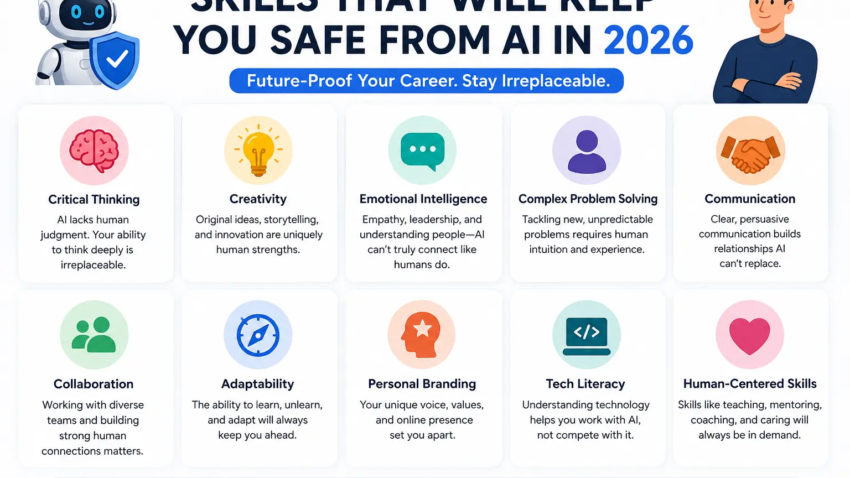
Skills That Will Keep You Safe From AI in 2026
Last spring, a guy I’ve known for years sharp, funny, ran his own graphic design shop for over a decade texted me at 11pm asking if I knew anyone hiring. His biggest client had just told him they were moving all their design work to Midjourney and an in-house intern who “knows how to prompt.” Fifteen years of skill, gone in one email.
I sat with that for a while. Not because I think AI is some unstoppable monster, but because it made something real to me: this isn’t a future problem anymore. It’s already sitting in people’s inboxes.
I’ve spent the last two years watching this play out in my own freelance work, in friends’ careers, in random Reddit threads at 2am. And I’ve noticed something that actually surprised me. The people getting hurt aren’t the ones in “creative” jobs necessarily. They’re the ones who never adjusted what they were offering. The people doing fine? They changed one thing: what they get paid for.
So this isn’t going to be one of those “AI will take your job, panic now” posts. It’s what I’ve actually seen work, including the stuff I got wrong.
The Mistake I Made First (And So Did Almost Everyone I Know)
For a solid year, my approach to “AI-proofing” myself was learning to use the tools better. ChatGPT, Claude, Midjourney I got genuinely good at prompting. I thought that was the skill.
It wasn’t.
Here’s the thing nobody tells you: prompting well is useful, but it’s not rare anymore. Every teenager on TikTok can write a decent prompt in six months. If your entire value is “I know how to talk to the AI,” you’re competing with millions of people who figured out the same trick, and the tools keep getting easier to use anyway.
The actual shift happened when I stopped asking “how do I use AI better” and started asking “what can I do that AI genuinely can’t fake.” That question changed everything for me.
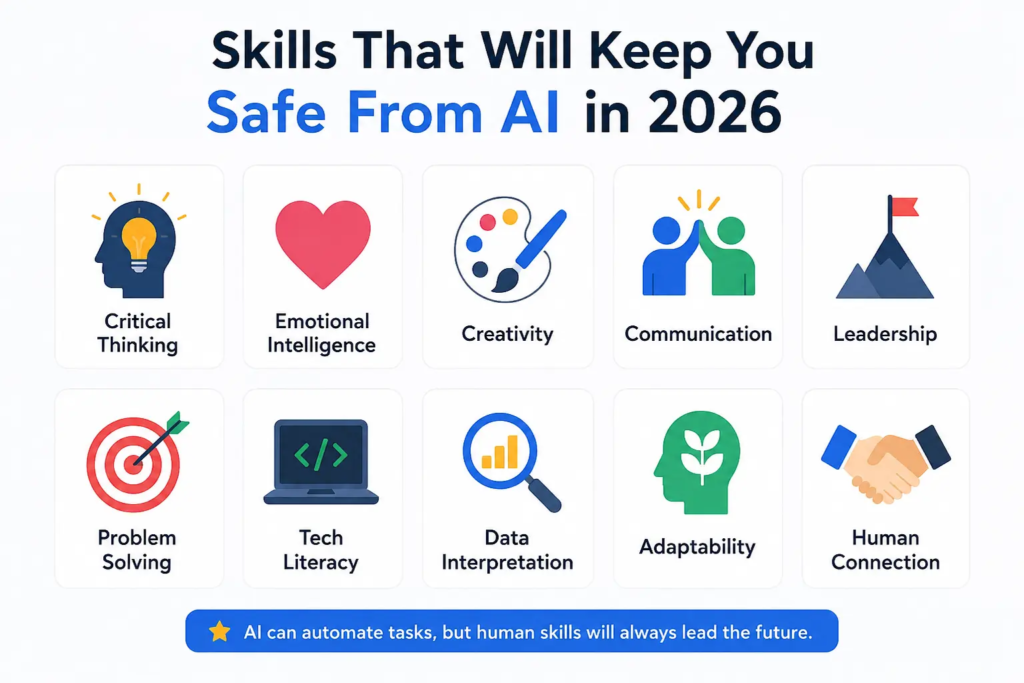
Skill #1: Knowing When the AI Is Wrong
This sounds simple. It isn’t.
I edit content for a small business client, and last year I almost let an AI-generated blog post go live that confidently stated a legal deadline that was completely wrong off by three months. It sounded so sure of itself. Clean sentences, professional tone, totally fabricated fact wrapped in confidence.
That’s the whole trap. AI doesn’t sound uncertain when it’s wrong. It sounds exactly as confident as when it’s right.
The skill here isn’t “distrust AI.” It’s building real domain knowledge deep enough that you catch the mistake before it costs you a client, a grade, or in worse cases, actual money or safety.
How I actually built this:
- I stopped using AI as my first source. I use it after I already have a rough answer in my head, so I’m checking its work instead of trusting it blind.
- I cross-check anything with numbers, dates, or laws using at least one non-AI source government sites, original research, actual humans who work in that field.
- I ask AI to explain its reasoning, not just give me the answer. If the reasoning is shaky, the answer usually is too.
Skill #2: Judgment The One Thing You Can’t Prompt Your Way Into
A friend of mine runs a small marketing agency. She told me something that stuck with me: “I can get AI to write me ten headline options in thirty seconds. What I can’t get it to tell me is which one my actual client, who hates anything that sounds salesy, will approve without an argument.”
That’s judgment. Knowing your audience, your context, your specific situation well enough to pick the right option out of a pile of “technically fine” ones.
AI generates options. Humans still make the call. Every industry I’ve looked into law, medicine, marketing, teaching, even plumbing quotes has this same gap. The tool gives you possibilities. Someone still has to decide.
If you want to protect your career, get better at the deciding part, not just the generating part.
Skill #3: Talking to Actual Humans (Yes, Really)
I know this sounds almost insultingly basic. But watch what’s happening.
I hired a contractor last year for a small home repair, and the guy who got the job wasn’t the cheapest quote. It was the one who showed up, looked me in the eye, asked good questions about what I actually needed, and didn’t try to oversell me. AI can write me a perfect quote email. It cannot build that ten-minute conversation where I decided I trusted this person.
Sales, therapy, teaching, healthcare, negotiation, customer service that actually resolves anger instead of escalating it — these all lean on something AI still fumbles: reading a room. Reading a person’s tone, their hesitation, the thing they’re not saying.
I started deliberately practicing this by doing more calls instead of emails with clients. It felt slower at first. It’s paid off more than any productivity hack I’ve tried.
Skill #4: Being Genuinely Good at One Narrow, Weird Thing
Generalists are getting squeezed the hardest right now. If you’re “pretty good at writing” or “decent with spreadsheets,” AI is decent at those too, and it’s free at 3am.
But I know a guy who does nothing but write onboarding emails for SaaS startups specifically the emails, specifically that industry. He’s booked out three months. Why? Because he’s seen 200 onboarding sequences fail and knows exactly why, in ways a general AI writer just hasn’t absorbed with the same depth or context.
Narrow expertise is harder to fake convincingly. The weirder and more specific your niche, the safer you are.
Skill #5: Adaptability (This One’s Boring But It’s the Real MVP)
Honestly, this is the skill that’s mattered most for me personally. Not any single tool or trick just being someone who tries the new thing instead of avoiding it.
Six months ago I didn’t know what an “AI agent” was. Now I use one weekly to handle scheduling grunt work. I didn’t master it overnight. I just didn’t refuse to learn it.
The people I’ve watched really struggle aren’t the ones lacking talent. They’re the ones who decided two years ago that “AI is a fad” and stopped paying attention. That decision is quietly the most expensive one I’ve seen people make in this whole shift.
A Few Things I’d Genuinely Avoid
Don’t just learn prompting and stop there. It’s a starting point, not a destination.
Don’t assume your industry is “safe.” I’ve heard doctors, lawyers, and teachers say this exact sentence right before something changed in their field. Nothing is fully immune. Complacency is the actual risk, not AI itself.
Don’t outsource your thinking entirely. I’ve caught myself, more than once, accepting an AI’s first draft of an argument without actually forming my own opinion first. That’s a muscle. If you stop using it, it weakens.
Don’t ignore the tools out of fear either. I know people who refuse to touch AI on principle. That’s not caution, that’s just falling behind quietly. Better to understand the thing that might change your industry than to pretend it isn’t happening.
Where I’d Actually Start If I Were You
If you want a genuinely practical first step, pick one:
- Go deep on your actual specialty for two weeks. Read the boring trade publications. Talk to three people who’ve been doing it longer than you.
- Have five real conversations this week you’d normally have handled over email or text.
- Pick a task AI does “okay” in your field, and figure out specifically why the output isn’t good enough. That gap is where you’re valuable.
None of this is dramatic. It’s not a hack. It’s just paying attention to what actually makes you useful versus what was always replaceable and you just hadn’t noticed yet.
That designer friend I mentioned? He’s doing fine now, for what it’s worth. Not because he beat the AI at making images. Because he started selling something the AI still can’t do: sitting with a client for an hour, understanding what they actually need before they know how to ask for it, and building trust one project at a time.
Turns out that was the valuable part all along. The software was just the easy 20%.

Hamad Arshad
SEO Specialist | SEO Manager | GEO Strategist
7+ Years of Experience in SEO, GEO, AEO, AI SEO, Local SEO, Technical SEO, PPC, Google Ads & Meta Ads.




Leave a Reply