
Will AI Take Your Job in 2026? Here’s the Truth
Last month, my cousin called me in a mild panic. She works in content writing for a mid-sized marketing agency, and her boss had just sent an email announcing “AI integration across all departments.” Her exact words to me were, “Am I about to lose my job to a chatbot?”
I get some version of this question a lot these days. From my aunt who does bookkeeping, from a friend who’s a junior graphic designer, from a guy I met at a coffee shop who does customer support for a living. Everyone’s asking the same thing in different words: is AI coming for me?
I’ve spent the last two years actually using these tools every single day not just reading headlines about them for writing, research, coding help, and even managing parts of my own freelance business. So I’m not going to give you a vague “it depends” answer and leave you hanging. Let me tell you what I’ve actually seen happen.
The Short Answer (Before We Get Into the Long One)
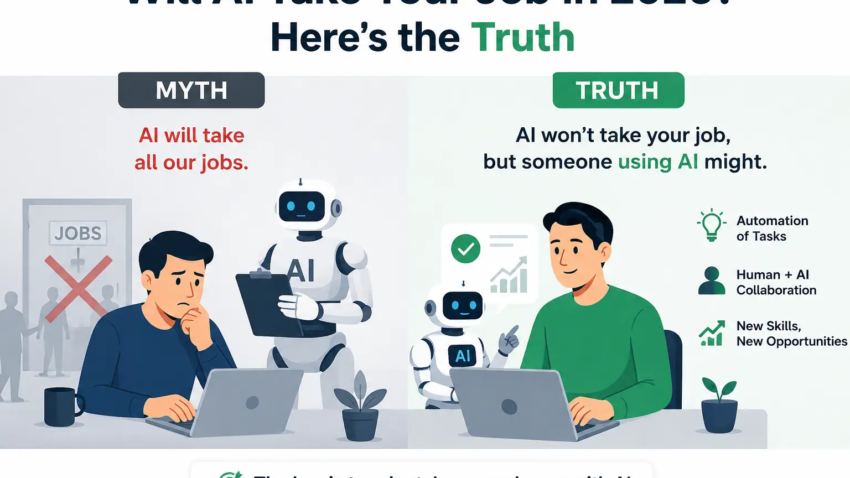
AI isn’t going to “take” most people’s jobs in 2026 the way a robot takes a factory position in a movie. What’s actually happening is messier, slower, and honestly more interesting than that.
It’s not AI vs. humans. It’s humans-who-use-AI vs. humans-who-don’t. That’s the real competition, and I’ve watched it play out up close.
What I Actually Saw Happen With My Cousin’s Job
Her agency didn’t fire the writers. What they did was cut the freelance writing budget by about 40% and expect the in-house team to produce more content using AI tools like ChatGPT and Jasper for first drafts.
So the job didn’t disappear. It changed shape. She now spends less time typing out first drafts from scratch and more time editing, fact-checking, and adding the personal insight and brand voice that AI genuinely can’t fake well. Her workload didn’t shrink either if anything, she’s expected to produce more output in the same eight hours.
The writers on her team who struggled were the ones who refused to touch the AI tools out of principle or fear. The ones who leaned in and figured out how to use AI as a first-draft machine, then applied their real expertise on top, actually became more valuable, not less.
That’s the pattern I keep seeing everywhere.
Where AI Is Genuinely Replacing Work
I won’t sugarcoat this part, because false comfort helps nobody.
Repetitive, rules-based tasks are getting automated fast. Basic data entry, simple transcription, template-based image editing, first-pass code debugging, generating boilerplate legal or HR documents I’ve watched these shrink in demand. A friend who ran a small transcription side-business on Rev.com told me her monthly earnings dropped noticeably once tools like Otter.ai and Whisper-based apps got good enough for most everyday use cases.
Customer support is shifting hard toward AI chatbots for tier-1 questions (password resets, order status, basic FAQs). Companies like Zendesk and Intercom have built AI agents directly into their platforms. Human agents are increasingly reserved for complicated, emotional, or high-stakes conversations.
Basic graphic design and stock content work is under real pressure from tools like Midjourney, Canva’s AI features, and Adobe Firefly. If your entire value was “I can make a decent logo,” that’s a tougher sell in 2026 than it was in 2020.
If your job is mostly repetitive and rule-based with little judgment involved, I’d be lying if I told you not to worry at all. You should be actively upskilling right now, not later.
Where I’ve Seen AI Actually Create More Work For Humans
Here’s the part that surprised me most when I started paying closer attention.
Every company I’ve worked with or talked to that adopted AI tools ended up needing MORE people to manage, review, and fix the AI’s output not fewer.
A small e-commerce brand I did freelance work for used AI to generate product descriptions in bulk. Sounds efficient, right? Except about 1 in 5 descriptions had a factual error or an awkward phrase that would’ve embarrassed them if published as-is. They ended up hiring someone specifically to review and edit AI output. That’s a job that didn’t exist three years ago.
Same story with a local business that used AI-generated code snippets for their website. The code worked, mostly. But “mostly” isn’t good enough for a live website, so they still needed a developer to catch the edge cases and security issues the AI missed.
This is the pattern nobody talks about enough: AI is really good at producing a fast 80% version of something. Getting that last 20% right, reliably, and safely that’s still very much a human job.
Real Talk: The Mistake I Made Early On
When I first started using AI tools for client work back in 2023, I got a little too confident. I let an AI tool draft an entire blog post for a client without editing it carefully, figuring it was “good enough.”
It wasn’t. The post had a factual mistake about a competitor’s pricing, and the client caught it before it got published. Lucky for me. That was an embarrassing wake-up call.
Lesson learned: AI is a fast, tireless intern not a replacement for judgment, fact-checking, or accountability. Treat its output as a first draft, always, no exceptions.
Jobs That Are Holding Up Well (And Why)
From what I’ve observed, roles that involve these things are staying resilient:
- Trust and relationship-building sales, therapy, teaching, healthcare, consulting. People still want to work with people for anything emotionally or personally significant.
- Physical, hands-on skills plumbing, electrical work, nursing, skilled trades. Robots aren’t fixing your leaking pipe anytime soon.
- Complex judgment calls senior engineering, strategic business decisions, legal reasoning in nuanced cases.
- Creative direction and taste knowing what will actually resonate with an audience is still a very human skill, even when AI does the execution.
Practical Steps If You’re Worried About Your Job
I’m not going to tell you “just learn to code” like it’s 2015. Here’s what’s actually working for people I know:
1. Start using AI tools in your current job, today. Not to replace your work, but to speed up the boring 60% of it. Try ChatGPT, Claude, or Gemini for drafts, summaries, or brainstorming. The goal is fluency, not fear.
2. Figure out which 20% of your job is “the hard part.” That’s usually the part AI struggles with judgment, relationships, quality control, creative decisions. Get better at that specific part.
3. Learn to review and edit AI output critically. This is quietly becoming one of the most valuable skills in almost every industry. Being the person who catches the AI’s mistakes is genuinely valuable.
4. Diversify your skills sideways, not just upward. My cousin started learning basic SEO and light video editing alongside her writing. It made her more useful, not because AI forced her out of writing, but because it freed up time for her to add more.
5. Don’t panic-quit your field. Most industries aren’t disappearing. They’re changing shape. Jumping ship entirely based on fear alone often means starting from zero somewhere else.
A Few Common Mistakes People Make Right Now
- Ignoring AI completely out of principle. This is the single biggest risk I’ve seen. Avoidance doesn’t protect your job; it just means you fall behind colleagues who adapted.
- Trusting AI output blindly. It hallucinates facts confidently. Always verify anything that matters.
- Assuming AI understands your specific industry nuances. Generic AI tools often miss context that someone with real experience would catch immediately.
- Waiting for “the perfect moment” to learn these tools. There isn’t one. Start small, this week, with one task.
Where This Actually Leaves Us
I don’t think 2026 is the year robots take over every office. What I think is happening is quieter and, honestly, more manageable: the bar for what counts as “good work” is rising, and the tools available to hit that bar are changing fast.
The people I’ve seen struggle aren’t losing to AI directly. They’re losing to people who figured out how to work alongside it a little earlier.
If you’re reading this wondering whether you should be worried, let that worry turn into curiosity instead. Open up one of these tools this week. Use it on something small in your actual job. See what it’s good at and, just as importantly, see where it falls flat. That gap the place where you’re still clearly better than the machine that’s exactly where your job security lives right now.

Hamad Arshad
SEO Specialist | SEO Manager | GEO Strategist
7+ Years of Experience in SEO, GEO, AEO, AI SEO, Local SEO, Technical SEO, PPC, Google Ads & Meta Ads.








Leave a Reply