
ZipTie AI Search Performance Tool: My Honest, Hands-On Experience
A few months back, one of my clients messaged me in a bit of a panic. Their website had been sitting comfortably at position 2 for a big money keyword for over a year. Steady traffic, steady leads, everything normal. Then leads dropped almost 30% in about six weeks — with rankings barely moving.
Why I Finally Switched to ZipTie AI for Tracking Search Performance (And What Nobody Tells You Before You Sign Up)
I checked Google Search Console. I checked Ahrefs. Everything looked “fine” on paper. That’s when it clicked: the client wasn’t losing rankings. They were losing visibility inside Google’s AI Overviews, where a competitor had quietly taken over the answer box. Google was still showing their page at position 2 — just nobody was scrolling down to see it anymore.
That’s the exact moment I started looking seriously at AI search visibility tools, and ZipTie is the one I ended up sticking with. Here’s my honest, hands-on take on why it’s worth considering, where it genuinely helped me, and where it fell short.
The Problem Traditional SEO Tools Don’t Solve Anymore
For years, “how am I ranking” meant one thing: where does my page sit in the ten blue links. Ahrefs, SEMrush, Search Console — all built around that assumption.
But that assumption is quietly breaking down. AI Overviews now show up for a big chunk of Google searches, and a growing number of buyers are asking ChatGPT or Perplexity directly instead of typing into Google at all. You can rank #1 and still watch an AI assistant confidently recommend your competitor instead of you.
None of my usual tools could answer the question that actually mattered anymore: when an AI engine talks about my client’s industry, does it mention them at all — and if it does, what does it actually say?
That gap is what pushed me toward ZipTie.
What ZipTie Actually Does (In Plain English)
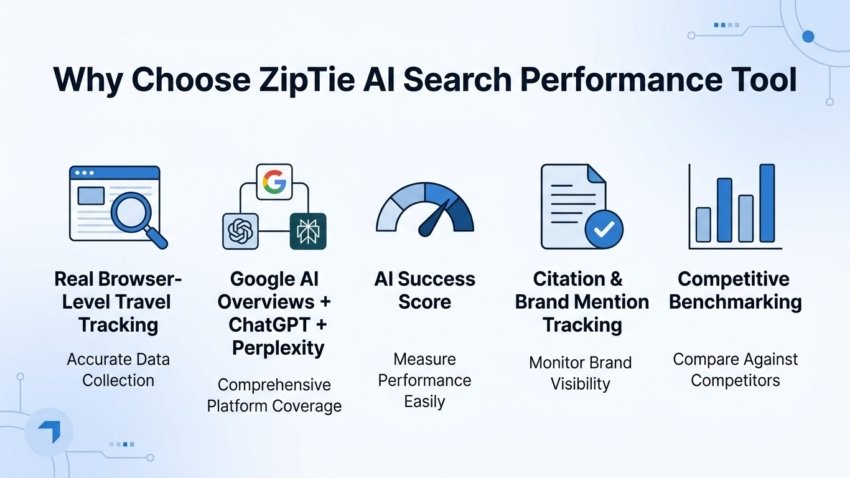
Strip away the marketing language and ZipTie is basically a monitoring and diagnostic tool built specifically for the AI search era. It watches how your brand shows up across three places: Google AI Overviews, ChatGPT, and Perplexity.
It’s not just checking “are you mentioned, yes or no.” It’s tracking a handful of things I actually care about as someone producing content for clients:
- Whether your brand gets mentioned at all in an AI-generated answer
- Whether the mention is positive, neutral, or negative in tone
- Whether your domain gets cited as an actual source
- How you stack up against competitors on the same queries
- The full text of the AI answer, so you can see exactly what’s being said
- A list of every domain the AI engine pulled from to build its answer
All of that gets rolled into what ZipTie calls an AI Success Score for each query, which honestly is the single most useful number in the whole dashboard. It tells you, at a glance, which queries are worth your time and which ones aren’t.
The One Thing That Actually Impressed Me
Here’s the part that made me trust the data rather than just glance at it: ZipTie doesn’t rely on API guesswork to detect AI Overviews. It uses real browser sessions with real Google accounts, which means it’s capturing what an actual person would see on their screen, screenshots included.
That matters more than it sounds. A lot of the cheaper AI-tracking tools rely on API calls that miss a huge chunk of AI Overviews because they simply don’t render the same way through an API as they do in a live browser. In independent testing published by ZipTie’s own team, their browser-based method picked up AI Overviews on around 28% of tracked keywords, compared to roughly 1.6% for some API-based competitors. That’s not a small gap — that’s the difference between having real data and having almost none.
When I ran this on my client’s account, it confirmed what I suspected: their competitor was showing up in the AI Overview for three of their top five keywords, and my client wasn’t showing up at all, despite ranking higher in the traditional results.
How I Actually Use It — Step By Step
If you’re thinking about trying it, here’s roughly the workflow I settled into after a few weeks of trial and error.
Step 1: Connect Google Search Console. ZipTie leans on GSC to auto-suggest queries worth monitoring. It’s a quick setup, but keep reading — this has a real limitation I’ll get to below.
Step 2: Build your query list. You can let ZipTie’s AI assistant generate a list automatically, or add your own. I do both. I let it suggest queries first, then manually add the conversational, long-tail phrases my clients’ customers actually type into ChatGPT — things like “best budget laptop for university students UK” instead of just “budget laptop UK.”
Step 3: Check the Queries tab first, not the overview. The main dashboard looks impressive but it’s the individual query breakdown where the real insight lives. Sort by AI Success Score and start with the lowest-scoring, highest-value queries.
Step 4: Read the full AI response text. Don’t just look at whether you’re mentioned — read what’s actually being said about you and your competitors. This is where you find the content gaps.
Step 5: Act on the optimization briefs. ZipTie tells you whether a query needs more brand mentions or more citations. Those are two very different fixes, and the tool is pretty clear about which one applies.
Step 6: Re-check after two to three weeks. AI answers don’t update instantly. Give your content changes time to actually get crawled and re-processed before you judge results.

Where I Actually Ran Into Trouble
I’m not going to pretend this tool is perfect, because it isn’t, and a couple of things caught me off guard.
Mistake #1 — trusting GSC blindly. Since ZipTie pulls a lot of its query suggestions from Search Console, newer websites or smaller microsites with thin GSC history basically get nothing useful auto-generated. I had to manually build the entire query list for one client’s newer site, which ate up more time than I expected going in.
Mistake #2 — underestimating the credit system. Pricing is credit-based, and it’s genuinely tricky to estimate your usage in advance, especially once you’re tracking multiple client accounts. I burned through my monthly allowance faster than planned in the first cycle because I was checking queries far more often than necessary.
Mistake #3 — expecting it to fix things automatically. ZipTie diagnoses. It does not write your content, publish it, or fix anything on its own. If your team doesn’t have the bandwidth to actually act on the optimization briefs, you’re paying for a very detailed report that gathers dust.
Real Example From My Own Work
For the laptop retail content I write regularly, one query — something along the lines of “best laptop for video editing under budget” — was pulling an AI Overview that cited three sources, none of them my client. The full response text showed the AI leaning heavily on pages with specific benchmark numbers and comparison tables, not general buying guides.
That single insight changed how I structure product-focused blog posts now. I started adding concrete spec comparisons and real numbers instead of vague descriptions, and within a few weeks that same query started showing my client’s domain as one of the cited sources. It’s a small win, but it’s a measurable one — and I never would have known where to focus without seeing the actual AI response text.
Is It Worth Choosing Over Other Options?
For the specific job of tracking Google AI Overviews accurately, alongside basic ChatGPT and Perplexity monitoring, ZipTie does that better than most tools I’ve tested. The browser-level accuracy alone is worth the price of entry if AI Overview visibility is a real concern for your niche.
It won’t replace Ahrefs or SEMrush, and it doesn’t cover every AI engine out there — no Gemini, no Copilot, no Claude tracking as of now. If your business needs that broader coverage, you’ll want to look at enterprise-level alternatives alongside it.
But for content teams and SEO folks who are tired of guessing whether their pages even exist inside AI-generated answers, it fills a blind spot that traditional rank trackers were never built to see in the first place. And honestly, once you see your competitor sitting inside an AI Overview where you should be, you stop caring what your traditional ranking says — you just want to fix it.

Hamad Arshad
SEO Specialist | SEO Manager | GEO Strategist
7+ Years of Experience in SEO, GEO, AEO, AI SEO, Local SEO, Technical SEO, PPC, Google Ads & Meta Ads.






Leave a Reply