
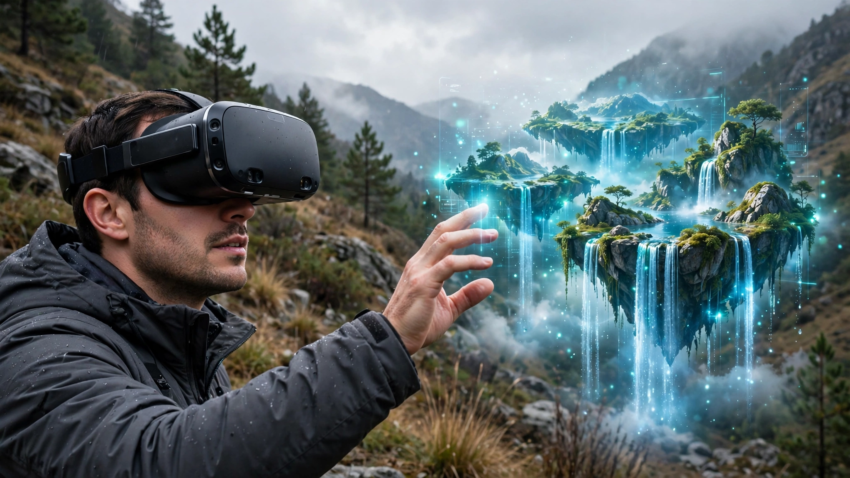
Google Genie 4 World Model
Most AI generates things you look at. A world model generates a place you can walk into — and Google DeepMind‘s newest one now comes with sound, better realism, and the ability to steer the world while it is being created around you. Genie 4, released in research preview on October 27 and covered by TechCrunch, is DeepMind’s latest step toward AI that does not just describe worlds but simulates them, a little over a year after Genie 3 first showed the trick.
Because if models can generate explorable worlds in real time, the boundary between “video,” “game” and “simulation” starts to dissolve — and a lot of industries are built on that boundary.
In short: Google DeepMind released Genie 4, its newest world model, in research preview on October 27. Compared with Genie 3, it adds audio, more realistic generated worlds, and real-time steering, so a user can explore and direct a world interactively as the model creates it. Gemini is more closely integrated, acting as the “director” of the generated world, and Google frames the future of the line as hybrid world models that combine generation with interaction. Pitched uses include gaming, interactive learning and other interactive experiences, with the wider field also aiming at simulation for robotics and self-driving testing. Access at launch is limited to trusted testers, with developers and Google AI Ultra subscribers expected in the coming weeks — a stated plan, not a confirmed date. DeepMind stresses Genie 4 is early research, not a finished consumer product.
What a world model actually does
The term needs one clean explanation. A language model predicts the next word; an image model produces a still picture; a world model predicts the next moment of an environment — what the scene looks like after you step forward, turn left, or push a door — fast enough that you can live inside its predictions. Genie 4’s headline additions attack the three weakest points of earlier versions. Audio, because silent worlds feel like tech demos. Realism, because drifting, melting geometry breaks the illusion that the place obeys physics. And real-time steering, because a world you can only watch is a video, while a world you can direct is a medium.
The steering piece is where Gemini comes in. DeepMind says Gemini is now more closely integrated, acting as the world’s “director” — interpreting intent and guiding what the simulation generates next, the generative counterpart to the agentic direction of models like the google gemini 4 carbon model. Underneath both sits the same machinery explained in what is a neural network — except here the network has learned not text or images, but how places behave.

Why games are only the first stop
The obvious market is play: prototypes a designer can walk through the hour they are imagined, levels that extend themselves, educational worlds a teacher can steer mid-lesson. DeepMind pitches gaming and interactive learning first, and the timing lands in the middle of the industry’s argument about AI-made games — the same week as the valve steam ai games cloning policy debate, Steam’s platform is filling with static AI-assisted content while DeepMind demos worlds generated live, per player, per second. Those are different leagues of the same technology.
The second market is less visible and possibly bigger: simulation for training things that must not fail in reality. Robots and self-driving systems need millions of hours of practice in environments that are varied, cheap and safe to crash in. Hand-built simulators are expensive and finite; a world model promises infinite, steerable variety. That is the wider field’s pitch, and Genie 4’s improved realism and controllability are aimed squarely at it — a generated street that behaves correctly is worth more to a driving lab than a beautiful one that does not.
What stands between preview and product
Honesty about the limits matters, and DeepMind itself supplies it: Genie 4 is a research preview, early days, not a consumer product. Access starts with trusted testers; developers and Google AI Ultra subscribers are expected in the coming weeks, on Google’s stated plan rather than a fixed date. The known hard problems of world models have not been announced away — long-term memory of places you left an hour ago, consistent physics under stress, and the sheer compute cost of simulating a world at interactive speed all remain the field’s open questions. These production hurdles are covered in AI Model Deployment Challenges Production.
But the direction is unmistakable, and Google has now stated it plainly: hybrid world models, where a frontier model directs and a world model renders, are the roadmap. Genie began as a party trick — type a prompt, wander a dream. Four versions in, with sound, steering and a director model attached, it reads less like a trick and more like the first draft of a new kind of software: environments themselves, generated on demand. The industries built on fixed, hand-made worlds — games first, training and simulation behind them — should plan accordingly. Choosing among frontier chat models is covered in Best ChatGPT Model in 2026: Which One You Should Actually Use.

Frequently asked questions
Genie 4 is Google DeepMind’s newest world model, released in research preview on October 27, a little over a year after Genie 3. A world model generates an interactive environment moment by moment — predicting what the world looks like as you move through it — rather than producing a fixed image or video.
Three headline additions: audio, so generated worlds have sound; more realistic worlds, with better visual coherence; and real-time steering, so the user can direct and explore the world interactively as it is generated. Gemini is also more closely integrated, acting as the “director” of the generated world.
It is a model trained to simulate an environment — to predict how a place looks and behaves from one moment to the next, including the effects of the user’s actions. That makes it possible to generate explorable, interactive worlds instead of static media, and to create training simulations for robots and self-driving systems.
DeepMind pitches gaming, interactive learning and other interactive experiences — worlds generated live around the player or student. The wider world-model field also targets simulation: cheap, varied, safe practice environments for robotics and autonomous vehicles, where hand-built simulators are expensive and limited.
At launch, access is limited to trusted testers. Google says developers and Google AI Ultra subscribers are expected to get access in the coming weeks — that is a stated plan reported by TechCrunch, not a confirmed general-availability date. Genie 4 remains a research preview, not a finished consumer product.
Gemini acts as the “director” of the generated world — interpreting the user’s intent and guiding what the simulation produces next, with Gemini more closely integrated than in earlier versions. Google frames this as the shape of future hybrid world models: a frontier model directing, and a world model rendering the environment in real time.

Hamad Arshad writes and edits AI Next Top from Rahim Yar Khan, Pakistan. He has worked in SEO and digital marketing for over 7 years and started this site to explain AI tools and news in plain language for non-technical readers. Every guide here is checked against the real tool before it is published.







Leave a Reply