
Valve Steam AI Games Cloning Policy
Steam is being flooded with AI-made game clones, developers are reporting extortion threats from copycats — and Valve’s answer is that it will not play police. At the Steam Indie Connect event in Busan, South Korea, members of Valve’s business team addressed the cloning wave directly, in comments reported by PC Gamer and Eurogamer on October 28. Their position sent searches for Valve’s stance past 10,000 on Google Trends, up 200%: Valve does not want to be a gatekeeper telling developers which tools they may use, AI included — even knowing some low-quality games will slip through. A related Google world-model launch for games is covered in Google Genie 4 World Model.
For indie developers, this is now the most important policy question in PC gaming: if the platform will not stop clones, what will? Valve’s answer puts the burden — and a surprising amount of the power — back on developers themselves.
In short: Valve business team members Tom Giardino and Marc Wilkinson told Steam Indie Connect that Valve will not ban AI tools: “we don’t want to be gatekeepers telling developers which tools they should or shouldn’t use.” The problem they were answering is real — Steam Next Fest has been flooded with thousands of low-effort, hastily made demos, developers increasingly fear that sharing a concept invites rapid AI-assisted cloning, and at least one developer reported extortion threats along the lines of “if you don’t pay, we’ll copy your game.” Valve’s suggested defence is not legal or technical: build an active community and trust, and avoid relying on a single easily copied mechanic. One caveat: Eurogamer noted the comments reached English-language media second-hand, via InvenGlobal and machine translation, so the precise wording is reported rather than verbatim-confirmed.
The flood Valve is refusing to dam
Context first: cloning is not new, and Valve’s speakers said so. Hit indie games have been copied within weeks for as long as digital storefronts have existed. What changed is speed and cost. Generative AI collapses the time between “that demo is getting attention” and “a lookalike is listed,” and the same generation of tools behind the different types of ai now used across game development — art, code, text, audio — is available to the copier as readily as to the creator.
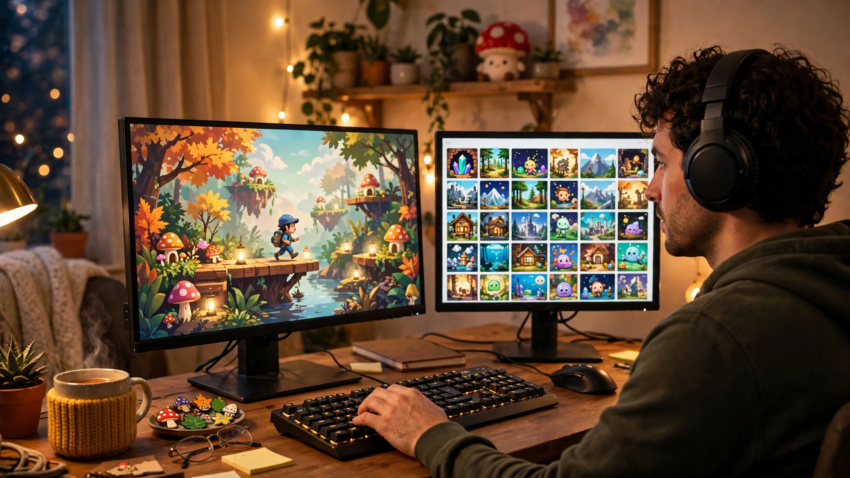
The visible symptom is Steam Next Fest, the platform’s big demo showcase, which developers told the event has been flooded with thousands of low-effort demos. The darker symptom is behavioral: developers described growing wary of showing concepts early at all, because a public demo is also a blueprint. One data point frames the scale of the haystack everyone’s searching: SteamDB figures cited by PC Gamer put releases on Steam this year alone at nearly 23,000 games before November. In a store that crowded, being copied is bad; being copied and out-shouted is fatal.
Most alarming is the extortion report: at least one developer described threats to the effect of “if you don’t pay, we’ll copy your game,” relayed by InvenGlobal. That turns cloning from plagiarism into a protection racket, and it is the part of the story Valve’s hands-off stance answers least comfortably.
Why Valve will not ban AI tools
Valve’s reasoning, as reported, is a philosophy it has held across many fights: the platform’s job is to connect developers and players, not to license creativity by approving tools. Banning “AI” would require defining it — does a game with AI-upscaled textures count? AI-assisted code? An AI-generated main menu song? — and every definition would be gamed by the cloners while burdening honest developers. The company’s stated position accepts the trade explicitly: some low-quality games will be exposed to players, and that is preferable to Valve as gatekeeper. Another frontier Google model is covered in Google Gemini 4 Carbon Model.
There is also a harder-edged reading. Policing AI use at Steam’s scale means review teams, appeals, false positives — the machinery of a platform like the app stores Valve has always positioned Steam against. The cloning problem sits inside the wider fight over who owns ai output and ideas: copyright law protects expression, not mechanics or concepts, which is exactly what clones copy. A legal system that struggles to define ownership of an idea leaves a platform three choices — over-police, under-police, or push the defence onto creators. Valve chose the third.
The defence Valve actually recommends
So what does Valve tell a developer whose game is about to be cloned? Two things, per the reports. Build an active community and genuine trust with players — a clone can copy your mechanic by Friday, but it cannot copy two years of Discord conversations, devlogs and goodwill; players buy the original because they know its makers. And do not build a game that rests on a single easily copied mechanic, because a one-idea game is a one-week clone job. For how agent systems behave in a game world, see How AI Agent Swarms Behave in Minecraft.
The cautionary example from Eurogamer’s coverage is the unreleased indie “Needle in a Haystack Simulator,” copied so many times that telling the original from the clones has become genuinely difficult — a fate Valve’s advice is designed to prevent: community and depth are the moat, since the technology of copying, built on the same how do llms work generation pipeline available to everyone, is not going away.
Whether developers find this empowering or exasperating will depend on their size. A solo developer now has to be a community manager, marketer and trust-builder on top of making the game — while the platform that takes its revenue cut declines to moderate the flood. But Valve’s stance is at least honest about the new physics of the industry: when creation tools make everything copyable, the uncopyable things — reputation, community, a living body of work — become the product. Steam has decided developers must build those themselves. The developers at Busan, and everywhere else, now have to decide how they feel about that. For career advice in this shifting landscape, see Sam Altman Advice for Young Workers in the AI Age.

Frequently asked questions
What is Valve’s stance on AI games on Steam?
Valve will not ban AI tools or AI-assisted games. As reported by PC Gamer from the Steam Indie Connect event in Busan, Valve business team members Tom Giardino and Marc Wilkinson said the company does not want to be a gatekeeper telling developers which tools they should or should not use — accepting that some low-quality games will reach players as the trade-off.
What is the AI cloning problem on Steam?
Developers say Steam Next Fest has been flooded with thousands of low-effort, hastily made demos, and that AI tools have made cloning dramatically faster: a promising concept shown publicly can be copied and listed before the original even launches. One developer reported extortion threats — pay up, or your game gets copied. The indie title “Needle in a Haystack Simulator” was cited as a game copied so often the original is hard to identify.
Did cloning exist before AI?
Yes — Valve’s speakers acknowledged cloning long predates AI. What AI changed is speed and cost: generating art, code and text for a lookalike used to take a team weeks; generative tools compress that into days, and lower the skill needed to attempt it.
What does Valve advise developers to do about clones?
Build an active community and trust with players, and avoid resting a game on a single easily copied mechanic. The logic: clones can copy features but not an established community, a developer’s reputation or a deep body of work — so those become the real defence.
How many games are released on Steam?
SteamDB figures cited by PC Gamer put the count at nearly 23,000 games released on Steam this year alone, before November. That volume is why discoverability — and being distinguishable from clones — has become such a pressure point for indie developers.
Are Valve’s comments officially confirmed word for word?
Treat the substance as reported and the exact wording with care. Eurogamer explicitly noted that the comments reached English-language coverage second-hand, via InvenGlobal and machine translation, from the event in Busan, South Korea. The position itself — no AI tool ban, community as defence — is consistent across PC Gamer’s and Eurogamer’s reporting.
Valve will not ban AI tools or AI-assisted games. As reported by PC Gamer from the Steam Indie Connect event in Busan, Valve business team members Tom Giardino and Marc Wilkinson said the company does not want to be a gatekeeper telling developers which tools they should or should not use — accepting that some low-quality games will reach players as the trade-off.
Developers say Steam Next Fest has been flooded with thousands of low-effort, hastily made demos, and that AI tools have made cloning dramatically faster: a promising concept shown publicly can be copied and listed before the original even launches. One developer reported extortion threats — pay up, or your game gets copied. The indie title “Needle in a Haystack Simulator” was cited as a game copied so often the original is hard to identify.
Yes — Valve’s speakers acknowledged cloning long predates AI. What AI changed is speed and cost: generating art, code and text for a lookalike used to take a team weeks; generative tools compress that into days, and lower the skill needed to attempt it.
Build an active community and trust with players, and avoid resting a game on a single easily copied mechanic. The logic: clones can copy features but not an established community, a developer’s reputation or a deep body of work — so those become the real defence.
SteamDB figures cited by PC Gamer put the count at nearly 23,000 games released on Steam this year alone, before November. That volume is why discoverability — and being distinguishable from clones — has become such a pressure point for indie developers.
Treat the substance as reported and the exact wording with care. Eurogamer explicitly noted that the comments reached English-language coverage second-hand, via InvenGlobal and machine translation, from the event in Busan, South Korea. The position itself — no AI tool ban, community as defence — is consistent across PC Gamer’s and Eurogamer’s reporting.

Hamad Arshad writes and edits AI Next Top from Rahim Yar Khan, Pakistan. He has worked in SEO and digital marketing for over 7 years and started this site to explain AI tools and news in plain language for non-technical readers. Every guide here is checked against the real tool before it is published.








Leave a Reply