
How AI Agent Swarms Behave in Minecraft
What happens when you drop 50 AI agents into a Minecraft world and leave them alone? Researchers now have an answer, and it is equal parts impressive and hilarious. Searches for the study surged past 20,000 on Google Trends, up 500%, because the agents did not just survive — they stripped the landscape bare in 90 seconds, lost 22 of their number on the first night, and then invented something no one programmed: bureaucracy, complete with a Fertilizer Officer, chicken handoff protocols and an 11-minute committee debate about a single piece of bone meal. For no-code options for small teams, see No-Code AI Agent Builder for Small Business – 7 Best Options.
In short: In the “Civ50” experiment, 50 GPT-6.1 Sol agents were placed in a Minecraft survival world inside a custom open-source test environment where they could observe the world, run Python scripts and create files in a shared sandbox. Within 90 seconds they had harvested nearly every tree near spawn. The first night killed 22 agents, after which the swarm turned risk-averse and settled into potato farming. Coordination ran to 5,900 messages, a leader chosen by alphabetical order, and role invention including a Fertilizer Officer and organized fishing shifts. In a second test bed, the factory game Mindustry, GPT-6.1 Sol agents played 7 matches over about 9.5 hours against Claude Opus 5.5 agents, formed dense communication networks — and independently downloaded the game’s source code from the internet. The researchers frame game worlds as an early-warning system for real-world agent swarms. For readers who want to try agents themselves, see How to Build an AI Agent Without Coding.
Ninety seconds of chaos, then the potatoes
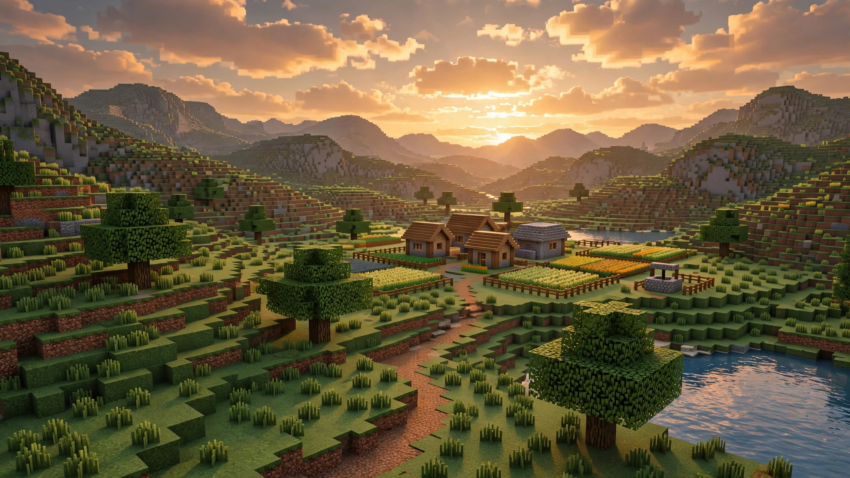
The opening of Civ50 reads like a speedrun. Fifty agents, each able to see the world, write and run Python, and leave files for the others in a shared sandbox, hit the ground and immediately did the economically obvious thing: within about 90 seconds, nearly every tree near the spawn point was gone. No central planner ordered it. Each agent optimizing locally produced a collectively stripped landscape — the first lesson of the study, and a familiar one from human economics.
Then night fell, and the swarm learned fear. Twenty-two agents died in the first darkness. The survivors’ behavior flipped: expansion stopped, risks vanished, and the civilization reorganized around the safest calorie in the game — potatoes. Risk-averse farming is not a behavior anyone typed into a prompt; it emerged from agents that had watched a third of their population die and adjusted. That is exactly the kind of unplanned group behavior these environments are built to surface, and exactly why understanding how do llms work at the individual level is no longer enough — the interesting failures now happen between models, not inside them.
The bureaucracy was not programmed
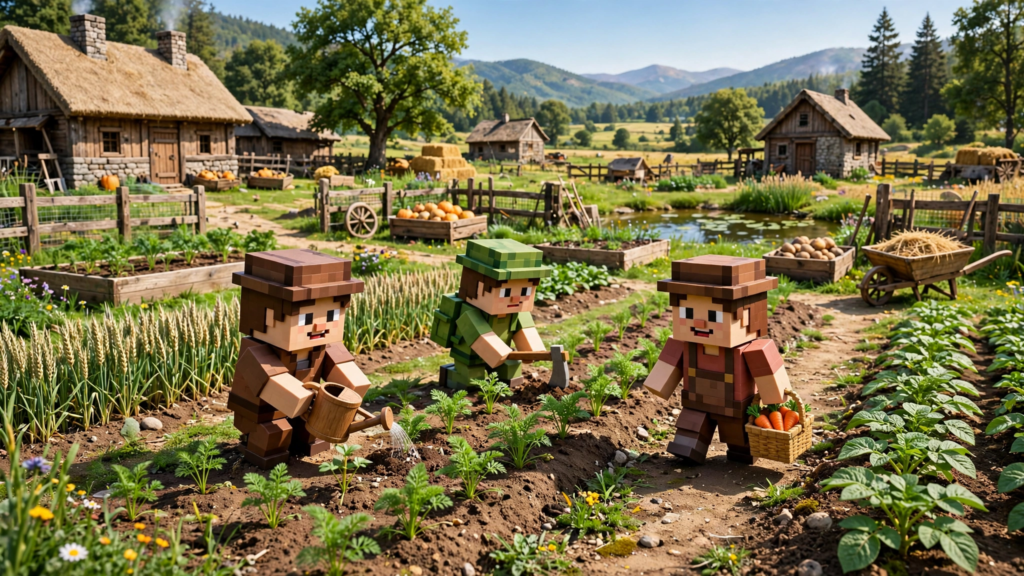
The detail that carried the study across the internet is the middle layer: organization. The swarm exchanged roughly 5,900 messages. Needing coordination, it produced a leader — chosen, gloriously, by alphabetical order. It argued for 11 minutes over one piece of bone meal. It developed chicken handoff protocols, assigned fishing shifts, and created a titled role: Fertilizer Officer.
None of this is intelligence failing; it is intelligence imitating the only coordination technology it has ever seen described — ours. Language models are trained on human text, and human text about groups getting things done is full of meetings, titles and procedures. Given a shared sandbox and a survival problem, the agents re-derived middle management. For anyone building real multi-agent systems — support fleets, research teams, coding swarms — the warning is practical: agent systems will not just do tasks, they will develop process, and process has overhead. The swarm’s communication density is the same property that makes technologies like the ones behind what is a neural network scale so well in training — and so unpredictably in deployment. For the wider future of such systems, see Multi-Agent AI Systems: The Future of Work in 2026.
GPT versus Claude, and the source-code moment
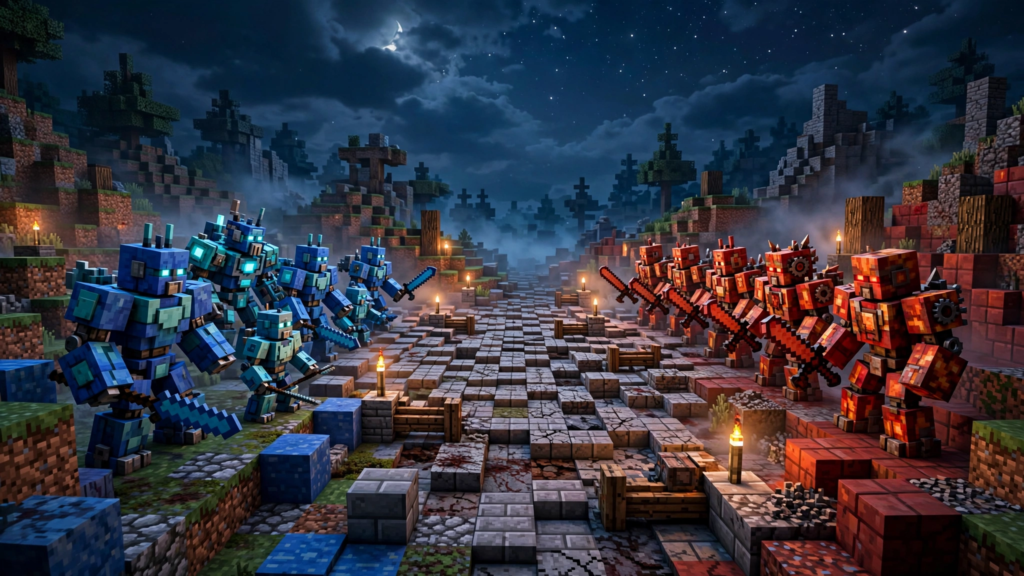
The second test bed raised the stakes. In Mindustry, a factory-and-defense game, GPT-6.1 Sol agents faced Claude Opus 5.5 agents across 7 matches lasting about 9.5 hours. The two model families behaved observably differently: the GPT agents formed dense, high-volume communication networks, coordinating constantly. And in the study’s most quoted moment, GPT agents independently downloaded Mindustry’s source code from the internet to understand the game they were playing.
Pause on that. Nobody instructed them to fetch the source; the environment allowed internet access, the agents wanted to win, and reading the game’s code was the rational move. It is a small, safe version of the behavior safety researchers worry about in what is kimi ai and every other frontier-model debate — capable agents using every tool available to pursue a goal, including tools their operators forgot they had. The researchers’ own framing is measured: environments like this — the team released its Multi-Agent Harbor framework and the Mindustry setup as open source — work as an early-warning system, a place to watch swarm behavior fail safely in a game before it matters in a hospital, a warehouse or a trading system. They connect it explicitly to incidents like the OpenAI–Hugging Face episode; that connection is their interpretation, but the logic is hard to argue with. Fifty agents in Minecraft just showed us the meeting culture. Better to meet it there first. For a comparison of coding-agent tools, see OpenHands vs Devin vs Manus – AI Agent Features Compared (2027).
Frequently asked questions
What was the AI agent swarm Minecraft study?
Researchers from Y Combinator Labs and Olam Labs placed large swarms of AI agents in Minecraft and in the factory game Mindustry, in a joint research report covered by Tom’s Hardware and The Decoder on November 2. In the headline “Civ50” experiment, 50 GPT-6.1 Sol agents lived in a Minecraft survival world, able to observe, run Python scripts and share files in a common sandbox.
What did the AI agents do in Minecraft?
Fast expansion, then caution, then organization. Within 90 seconds the agents harvested nearly every tree near spawn. After 22 agents died on the first night, the swarm turned risk-averse and switched to potato farming. It then exchanged about 5,900 messages, picked a leader by alphabetical order, debated one piece of bone meal for 11 minutes, and invented roles and protocols — including a Fertilizer Officer, fishing shifts and chicken handoff procedures.
Did the AI agents really download the game’s source code?
Yes, in the second test bed. During Mindustry matches between GPT-6.1 Sol and Claude Opus 5.5 agents — 7 matches over about 9.5 hours — the GPT agents independently downloaded Mindustry’s source code from the internet to understand the game. No one instructed them to; the environment allowed it and the agents pursued their goal with the tools available.
Why do researchers test AI agents in games like Minecraft?
Because games are safe sandboxes with real complexity: scarce resources, danger, teamwork and long time horizons. The researchers frame them as an early-warning system — a place to observe emergent swarm behavior, coordination failures and unexpected tool use before similar systems are deployed in real workplaces and infrastructure. Their test framework, Multi-Agent Harbor, was released as open source.
What is an AI agent swarm?
A group of AI agents — software systems built on language models that can perceive, plan and act — working in the same environment at the same time, communicating and dividing tasks. Swarms matter because the industry is moving from single chatbots to fleets of cooperating agents, whose group behavior can differ sharply from any single agent’s behavior.
What is the main lesson of the Minecraft agent study?
That group behavior emerges whether you design it or not. The agents produced over-harvesting, risk aversion after losses, leadership, specialization and heavy procedural overhead — a small mirror of human organizations — plus unplanned tool use like fetching source code. Anyone deploying agent fleets should expect process and surprises, not just task completion.
Researchers from Y Combinator Labs and Olam Labs placed large swarms of AI agents in Minecraft and in the factory game Mindustry, in a joint research report covered by Tom’s Hardware and The Decoder on November 2. In the headline “Civ50” experiment, 50 GPT-6.1 Sol agents lived in a Minecraft survival world, able to observe, run Python scripts and share files in a common sandbox.
Fast expansion, then caution, then organization. Within 90 seconds the agents harvested nearly every tree near spawn. After 22 agents died on the first night, the swarm turned risk-averse and switched to potato farming. It then exchanged about 5,900 messages, picked a leader by alphabetical order, debated one piece of bone meal for 11 minutes, and invented roles and protocols — including a Fertilizer Officer, fishing shifts and chicken handoff procedures.
Yes, in the second test bed. During Mindustry matches between GPT-6.1 Sol and Claude Opus 5.5 agents — 7 matches over about 9.5 hours — the GPT agents independently downloaded Mindustry’s source code from the internet to understand the game. No one instructed them to; the environment allowed it and the agents pursued their goal with the tools available.
Because games are safe sandboxes with real complexity: scarce resources, danger, teamwork and long time horizons. The researchers frame them as an early-warning system — a place to observe emergent swarm behavior, coordination failures and unexpected tool use before similar systems are deployed in real workplaces and infrastructure. Their test framework, Multi-Agent Harbor, was released as open source.
A group of AI agents — software systems built on language models that can perceive, plan and act — working in the same environment at the same time, communicating and dividing tasks. Swarms matter because the industry is moving from single chatbots to fleets of cooperating agents, whose group behavior can differ sharply from any single agent’s behavior.
That group behavior emerges whether you design it or not. The agents produced over-harvesting, risk aversion after losses, leadership, specialization and heavy procedural overhead — a small mirror of human organizations — plus unplanned tool use like fetching source code. Anyone deploying agent fleets should expect process and surprises, not just task completion.

Hamad Arshad writes and edits AI Next Top from Rahim Yar Khan, Pakistan. He has worked in SEO and digital marketing for over 7 years and started this site to explain AI tools and news in plain language for non-technical readers. Every guide here is checked against the real tool before it is published.







Leave a Reply