
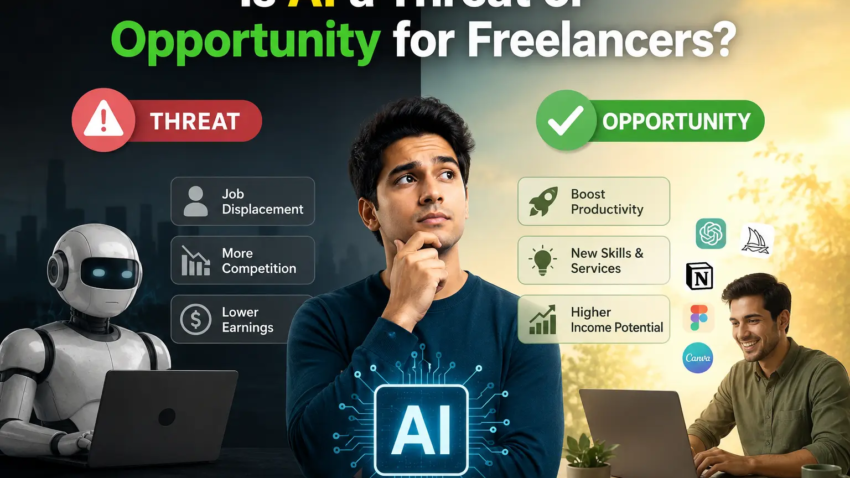
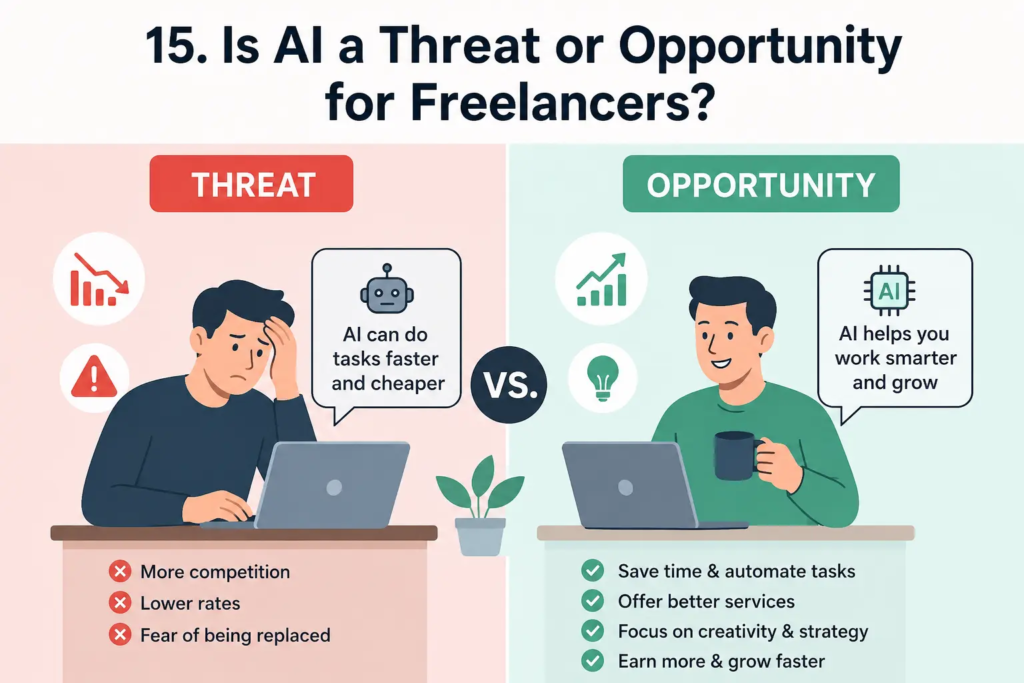
Is AI a Threat or Opportunity for Freelancers?
I still remember the exact moment I panicked about AI.
It was late 2023, and a client I’d worked with for almost a year sent me a message that made my stomach drop: “Hey, I think we’re going to try ChatGPT for our blog content going forward. Thanks for everything!”
Just like that. Gone. A steady $800/month client, replaced by a chatbot.
I sat there staring at my laptop, genuinely thinking my freelance writing career was over. I’d built this business from nothing, and now a piece of software was going to take it all away.
Except… that’s not what happened. And what actually happened over the next two years taught me more about AI, freelancing, and adapting than any course or blog post ever could.
The Panic Was Real, But So Was the Reality Check
For about three weeks after losing that client, I genuinely considered going back to a 9-to-5. I checked job listings. I updated my resume. I felt like a dinosaur watching the meteor approach.
But here’s the thing nobody tells you when you’re in that panic spiral: losing one client to AI doesn’t mean every client will do the same thing. And more importantly, that same client came back to me four months later.
Their AI-generated content wasn’t ranking. It sounded generic. Their engagement dropped. They needed someone to fix it, add a human voice, and honestly, do the strategic thinking that ChatGPT couldn’t do on its own.
That’s when I started actually understanding what AI could and couldn’t do instead of just being scared of it.
What I Learned Using AI Tools Myself (Not Just Fearing Them)
I decided if I couldn’t beat it, I needed to understand it. So I started actually using AI tools in my daily freelance work instead of avoiding them.
Here’s what I tried and what I found out, mistakes included.
Mistake #1: I Let ChatGPT Write Full Articles for Clients
Early on, I got lazy. I’d feed ChatGPT a topic, get a draft, tweak a few sentences, and send it off. It felt efficient.
Two clients caught on within a month. One straight up told me, “This doesn’t sound like you anymore.” Another noticed their traffic dipping because the content felt flat and generic Google’s helpful content update wasn’t kind to that kind of writing either.
Lesson learned: AI-generated content without heavy editing and personal insight reads exactly like what it is AI-generated content. Readers notice. Google notices. Clients notice.
What Actually Worked
I started using AI as a research assistant and first-draft generator, not a replacement for my actual writing. Here’s my real workflow now:
- Use AI for outlines and structure I’ll ask ChatGPT or Claude to help me organize research into a logical flow. This saves me maybe 20-30 minutes per article.
- Do the actual writing myself The stories, the opinions, the “I tried this and it didn’t work” moments? That’s all me. AI can’t fake genuine experience.
- Use Grammarly or Hemingway App for polish Not to write content, but to catch awkward sentences and improve readability.
- Use AI for brainstorming, not final answers When I’m stuck on an angle for a piece, I’ll bounce ideas off ChatGPT like a coworker, then run with whatever actually resonates.
This combo cut my research time roughly in half while keeping my writing genuinely mine.
Where AI Became an Actual Opportunity (Not Just a Threat)
Here’s the part that surprised me most AI didn’t just fail to replace me, it actually created new income streams.
I started offering “AI content editing” as a service. So many businesses were dumping AI-generated content on their sites and realizing it wasn’t working. I began charging to take rough AI drafts and turn them into content that actually sounded human, ranked well, and converted. This became almost 30% of my income within a year.
I got faster, which meant I could take on more clients. Using tools like Perplexity for quick research and Otter.ai for transcribing client calls, I freed up hours every week. More hours meant more capacity, which meant more income.
I learned prompt engineering, which is now its own skill I sell. Businesses were confused about how to actually use AI tools effectively. I started offering consulting sessions just teaching small business owners how to prompt ChatGPT properly for their marketing needs.
None of this existed as a service two years ago. AI didn’t just threaten my old business model it handed me a new one, if I was willing to adapt.
Real Examples of How Other Freelancers Are Handling This
I’m not the only one navigating this. Talking to other freelancers in Facebook groups and Discord communities, I’ve seen a pretty clear pattern.
A graphic designer friend started using Midjourney and Canva’s AI features to generate initial concept mockups faster, then spent her actual skilled hours on refinement and client-specific customization. She’s not slower because of AI she’s faster and takes on more projects.
A freelance developer I know uses GitHub Copilot daily now. He said it’s like having a junior developer who never gets tired, but he still has to review every single line because Copilot makes confident mistakes constantly. His actual coding judgment became more valuable, not less.
A voiceover artist was terrified of AI voice cloning tools like ElevenLabs. Instead of hiding from it, she started offering “authentic human voice” as a premium selling point in her pitches, specifically calling out that clients get a real person with real emotional range. It’s working some clients specifically want to avoid AI voices now for authenticity reasons.
The common thread? None of them ignored AI. All of them figured out how to use it or position against it strategically.
Step-by-Step: How to Actually Adapt as a Freelancer
If you’re feeling that same panic I felt, here’s what I’d actually recommend doing, based on what worked for me.
Step 1: Stop avoiding AI tools out of fear.
Spend a weekend actually using ChatGPT, Claude, or whatever tool is relevant to your field. You can’t strategize against something you don’t understand.
Step 2: Identify what AI does badly in your niche.
For writing, it’s genuine personal experience and nuanced opinion. For design, it’s understanding brand-specific context. Figure out your version of this gap.
Step 3: Build AI into your workflow, not as a replacement, but as an assistant.
Use it for the boring, repetitive 20% of your work so you have more energy for the skilled 80%.
Step 4: Talk to your clients about it directly.
Don’t wait for them to ask if you use AI. I now tell clients upfront: “I use AI for research and efficiency, but every piece is written and reviewed by me.” This builds trust instead of creating suspicion.
Step 5: Consider new services that didn’t exist before.
AI editing, AI prompt consulting, “human-verified” content these are real, sellable services now.
Step 6: Keep raising the bar on what only you can do.
Your judgment, your relationships, your specific experience double down on these instead of competing with AI on speed or cost.
Common Mistakes I See Freelancers Making
A few things I’d genuinely warn people against, having watched this play out:
Pretending AI doesn’t exist. I’ve seen freelancers get defensive or dismissive about AI entirely, and it just makes them look out of touch to clients who are already using these tools themselves.
Using AI output without editing it. This is the fastest way to lose credibility. Clients can tell, and so can Google, increasingly.
Racing AI on price instead of value. If you’re trying to compete by being cheaper than what AI tools cost, you’ve already lost that fight. Compete on judgment, relationships, and quality instead.
Not learning the tools at all. Even if you never use AI directly in your deliverables, understanding how it works helps you have better conversations with clients and spot when something’s off.
So.Threat or Opportunity?
Honestly? It’s both, and I think anyone telling you it’s purely one or the other is oversimplifying things.
AI genuinely threatened my old way of doing business. The client who left for ChatGPT was a real wake-up call, not a hypothetical scenario. Some freelance work genuinely is disappearing or shrinking basic transcription, simple data entry, generic content mills.
But it also opened doors I didn’t know existed. My income today is higher than it was before AI became mainstream, not despite AI, but partly because I learned to work alongside it instead of against it.
The freelancers I’ve seen actually struggle aren’t the ones in “AI-vulnerable” fields. They’re the ones who refused to adapt at all in any field.
If you’re feeling that same panic I felt back in 2023, I get it completely. But give yourself permission to actually experiment with these tools before deciding they’re the enemy. You might find, like I did, that the story isn’t as simple as “AI is taking our jobs.” Sometimes it’s more like AI is changing the job, and there’s still plenty of room for people willing to change with it.

Hamad Arshad
SEO Specialist | SEO Manager | GEO Strategist
7+ Years of Experience in SEO, GEO, AEO, AI SEO, Local SEO, Technical SEO, PPC, Google Ads & Meta Ads.






Leave a Reply