
AI for Integrated ISO Audits: A Practical Guide for Auditors
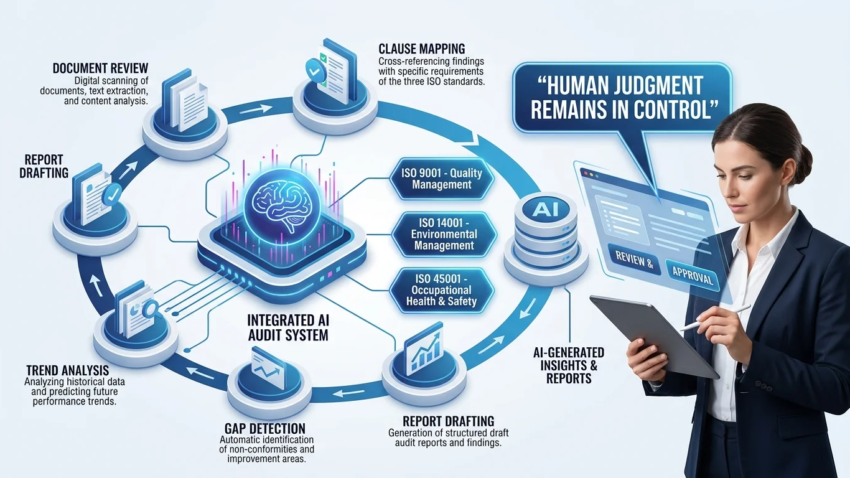
Running an audit against one ISO standard is manageable. Running it against three at once — say ISO 9001 (quality), ISO 14001 (environment), and ISO 45001 (health and safety) — is where most internal audit teams start to feel the strain. Clauses overlap but aren’t identical, evidence lives in different systems, and a single auditor is expected to hold all of it in their head while interviewing staff and writing findings in real time.
This guide is for internal auditors, QHSE managers, and compliance leads who are curious about using AI tools to make integrated audits more manageable — without pretending AI can replace the judgment an audit actually requires. You’ll learn where these tools genuinely help, a practical step-by-step workflow, common mistakes to avoid, and where you should keep AI out of the process entirely.
Quick Answer
AI tools are most useful in integrated ISO audits for pre-audit document review, mapping requirements across overlapping standards, and drafting findings for auditor review — not for making judgment calls, interviewing people, or deciding whether evidence constitutes a nonconformity. Used this way, teams typically cut document-review time significantly while keeping the auditor firmly in control of conclusions.
What an Integrated Audit Actually Involves
An integrated management system (IMS) audit checks conformance against two or more ISO standards in a single audit cycle, rather than running separate audits for quality, environment, and safety. The appeal is obvious: one audit schedule, one set of interviews, fewer disruptions to operations. The difficulty is also obvious: ISO 9001, 14001, and 45001 share a common high-level structure (Annex SL) but diverge in the specific evidence each clause requires.
A competent auditor already handles this by cross-referencing requirements manually — checking, for example, whether a single training record satisfies competence requirements under all three standards, or whether one risk register needs separate entries for quality risk, environmental aspect, and safety hazard. That cross-referencing is exactly the kind of structured, repetitive, pattern-matching task that language-model-based tools are reasonably good at supporting, provided a human still makes the final call.
ISO 19011, the guideline standard for auditing management systems, doesn’t prohibit or specifically endorse AI tools — it simply requires audits to be evidence-based, conducted with due professional care, and independent in judgment. That’s the test any AI-assisted step in this guide has to pass.
Where This Technology Genuinely Helps
Evidence Review and Document Cross-Checking
Before an audit, teams typically gather policies, procedures, training records, incident logs, calibration certificates, and risk assessments — often scattered across shared drives and different formats. A language model can scan this document set and flag likely gaps: a procedure that references a risk assessment that isn’t in the folder, a training matrix that’s twelve months out of date, a corrective action log missing closure evidence. This doesn’t replace the auditor’s own review — it triages it, so time in the room goes to verifying flagged items rather than reading everything cold.
Clause Mapping Across Standards
One of the more tedious parts of integrated auditing is tracking which clause in each standard a piece of evidence actually satisfies. AI tools can maintain a working map — for example, showing that a single “context of the organization” document plausibly covers ISO 9001 Clause 4, ISO 14001 Clause 4, and ISO 45001 Clause 4 simultaneously — and highlight where a standard has an additional requirement the others don’t (ISO 45001’s worker consultation requirements, for instance, have no direct equivalent in 9001). This turns a manual cross-reference exercise into something an auditor can review and correct rather than build from scratch each time.
Drafting Findings and Nonconformity Reports
Writing a nonconformity statement that’s specific, evidence-linked, and clause-referenced takes practice, and inconsistent NC wording is a common source of certification body pushback. AI can draft a first pass — objective evidence, clause reference, and a plain description of the gap — based on the auditor’s raw notes, which the auditor then edits and approves. The auditor still decides whether something is a nonconformity; the tool just removes the blank-page problem of writing it up cleanly afterward.
Trend Analysis Across Past Audits
Because integrated audits generate a lot of historical data — prior findings, corrective actions, repeat issues — AI tools are useful for spotting patterns a single auditor might miss across audit cycles: a department with recurring documentation gaps, a clause that fails disproportionately at one site versus another, or corrective actions that keep getting closed without addressing root cause. This kind of longitudinal pattern-spotting is genuinely hard to do by hand across years of PDF reports.
Building an AI-Supported Audit Workflow, Step by Step
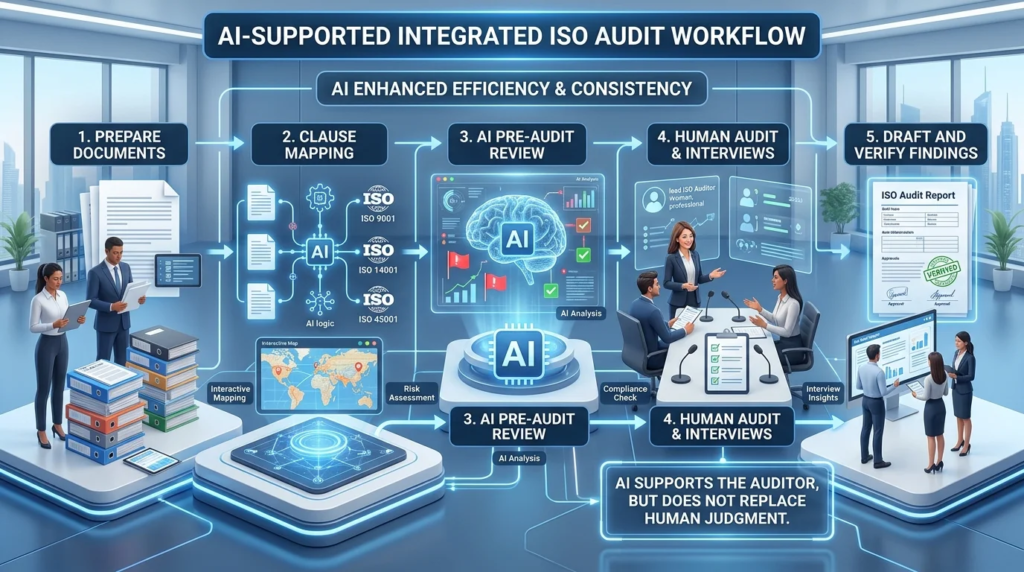
1. Prepare your document set. Centralize the policies, procedures, records, and prior audit reports relevant to the audit scope. AI tools are only as useful as the documents you feed them — incomplete input produces confidently wrong summaries.
2. Set up clause mapping. Before the audit, have the tool build (or update) a cross-reference table linking your document set to specific clauses across all standards in scope. Review this table yourself; don’t audit from it blind.
3. Run an AI-assisted pre-audit review. Let the tool flag likely gaps, outdated documents, and missing links between procedures and evidence. Treat every flag as a lead to verify, not a confirmed finding.
4. Conduct the on-site or remote audit as normal. Interviews, observations, and physical verification remain entirely human tasks. Bring the flagged items into your interview questions so you’re not starting from zero.
5. Draft and verify findings. Use the tool to draft NC and observation write-ups from your notes, then personally check every clause reference and every factual claim before it goes into the report. The auditor’s sign-off is the actual point of accountability — the draft is just a starting point.
Real-World Scenarios
A mid-size manufacturer running combined ISO 9001/14001/45001 surveillance audits typically spends several days before the audit just organizing evidence across departments. Feeding that evidence set into an AI tool for a first-pass gap review, ahead of the on-site visit, commonly surfaces the obvious misses — an expired calibration certificate, a missing hazard assessment for a new production line — before the auditor ever walks the floor, letting the actual audit time focus on verification and interviews rather than document hunting.
A services company managing a leaner IMS often uses AI mainly for the write-up stage: turning handwritten or typed audit notes into properly clause-referenced findings, saving the hours that used to go into formatting reports after the fact, while the auditor still owns every conclusion.
Mistakes Teams Commonly Make
- Treating AI output as a finding rather than a lead. A flagged gap is a prompt to investigate, not evidence of nonconformity on its own.
- Feeding outdated or incomplete document sets. The tool can only cross-reference what it’s given; stale inputs produce misleading gap analysis.
- Skipping human verification of clause references. AI-generated clause citations can be plausible-sounding but wrong; every reference needs a manual check against the actual standard text.
- Using AI during interviews or observations. These require real-time judgment, tone-reading, and follow-up questioning that current tools don’t reliably replicate.
- Assuming certification bodies automatically accept AI-touched evidence. Some accreditation bodies have specific expectations around technology-assisted auditing; check current IAF and your certification body’s guidance rather than assuming.
Practical Recommendations From Experienced Auditors
A common approach is to start small: use AI for document triage and report drafting on one audit cycle before expanding its role. Keep a clear internal record of which parts of the process were AI-assisted versus fully manual — this matters if a certification body ever asks how findings were developed. And treat AI-flagged items the same way you’d treat a colleague’s tip: worth checking, not worth citing as fact.
When Not to Use It
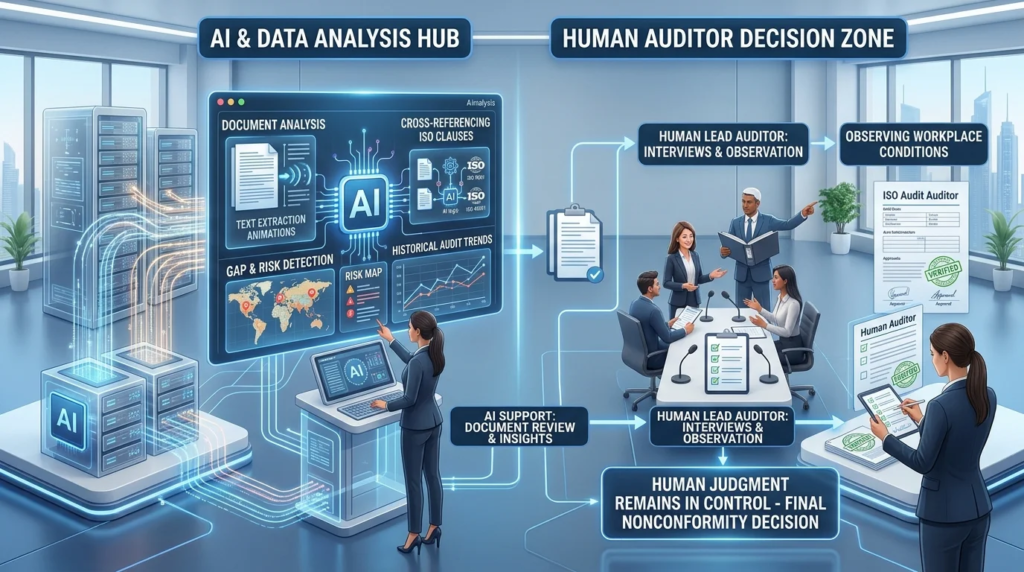
Avoid relying on AI for anything that requires reading a room — interviews, worker consultations, and judgment calls about whether evidence is “sufficient” for a given risk context. Also avoid it for confidential or sensitive evidence (medical records tied to safety incidents, for example) unless your tool and data-handling setup meet your organization’s confidentiality requirements under ISO 19011’s independence and confidentiality principles. If a finding could lead to disciplinary action or a major certification decision, the write-up should be fully auditor-authored, even if a draft was AI-assisted.
Frequently Asked Questions
It can recognize and cross-reference clause language reasonably well when given the standard text and your documents, but it doesn’t apply professional judgment — that step stays with the auditor.
Not inherently. ISO 19011 requires evidence-based, independent judgment; AI use is fine as a support tool as long as conclusions remain the auditor’s own, verified decisions.
Interviews, on-site observations, and the final determination of whether something is a nonconformity should stay fully human.
Practices vary by certification body; it’s worth confirming current expectations directly with yours rather than assuming, since guidance in this area is still evolving.
Teams commonly report the biggest time savings in document review and report drafting stages, not in the audit itself, since interviews and site verification take the same time regardless.
GRC (governance, risk, compliance) platforms manage the broader compliance program — policies, risk registers, corrective actions — while AI audit tools typically focus narrowly on document review, clause mapping, and report drafting; some GRC platforms now include both.
Yes — many teams start with general-purpose AI assistants for document review and drafting before investing in dedicated audit software, though data privacy settings should be checked before uploading sensitive records.
Pick one low-risk stage — document triage or report drafting — for your next audit cycle, verify everything the tool produces, and expand only once you trust the output on that stage.
Final Takeaway
AI doesn’t remove the hard parts of integrated ISO auditing — judgment, interviewing, and deciding what counts as a nonconformity are still entirely the auditor’s job. What it does well is take the tedious cross-referencing and drafting work off your plate, so more of the actual audit time goes toward verification and conversation rather than document hunting. Start with one stage, verify everything, and let the tool earn a bigger role from there.

Hamad Arshad
SEO Specialist | SEO Manager | GEO Strategist
7+ Years of Experience in SEO, GEO, AEO, AI SEO, Local SEO, Technical SEO, PPC, Google Ads & Meta Ads.




Leave a Reply