
Top Ranked Customizable Worksheets for Educators
Top Ranked Customizable Worksheets for Educators: What the Reviews Actually Show
Plenty of articles claim to rank the “top” worksheet tools for educators without saying where that ranking actually comes from. This one works from the other direction: what do verified reviews on G2, Capterra, Common Sense Education, and TeachersFirst actually say, and how much evidence backs each tool’s reputation? “Educators” here means more than K-12 classroom teachers — tutors, corporate trainers, and homeschool parents all show up in this same tool landscape, and the review evidence is broken down honestly rather than treated as uniform across every tool.
Quick Answer: Which Tools Have the Strongest Review Evidence
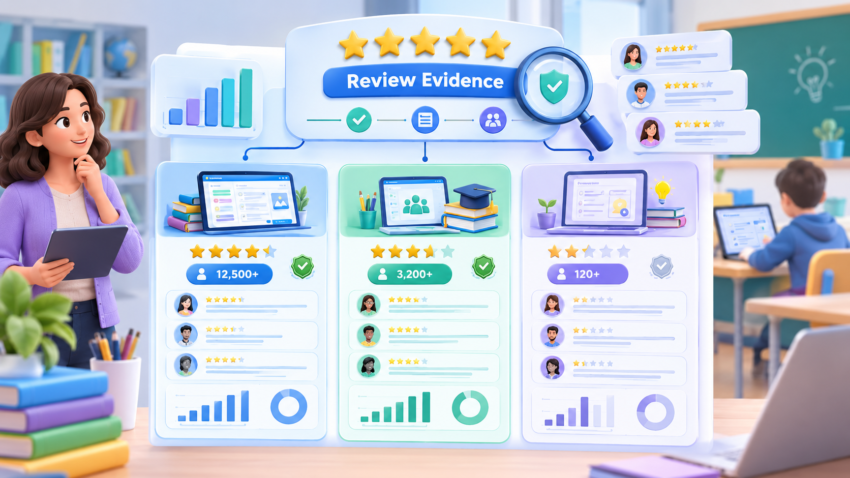
Canva has by far the deepest, most verified rating data in this category — around 4.7 out of 5 on both G2 (roughly 6,000–7,000 reviews) and Capterra (over 13,000 reviews), which is a genuinely large and reliable sample size. Wizer.me has strong, specific praise from educators on Common Sense Education and TeachersFirst, though these are community/editorial reviews rather than large-scale star-rating aggregators. MagicSchool AI has positive G2 reviews but on a much smaller sample — 7 reviews at the time of this research — so treat its rating as an early signal, not the same strength of evidence as Canva’s.
Why “Top Ranked” Should Mean Verified Reviews, Not Just an Opinion
A “top ranked” list is only as good as what’s behind the ranking. Many articles using that phrase are really just the author’s opinion, sometimes influenced by affiliate relationships with the tools listed. Verified review platforms — where reviewers are confirmed users, not anonymous commenters — give a more honest signal, but even then, the sample size matters enormously. A tool with a 5.0 rating from 3 reviews tells you far less than a tool with a 4.6 rating from 3,000 reviews. Most competing content treats every star rating as equally trustworthy regardless of sample size, which is a meaningful gap this article tries to close.
Defining “Educators” Beyond K-12 Classroom Teachers
Worksheet and interactive-content tools aren’t used only by classroom teachers. Tutors building materials for one-on-one sessions, corporate trainers creating onboarding quizzes, and homeschool parents assembling a curriculum all show up in the same review data on these platforms — Wizer’s own reviewers, for instance, include language teachers, general classroom teachers, and instructors describing very different use cases. Keeping “educator” broad here matches how these tools are actually used, not just how K-12-focused marketing describes them.
Top Ranked Customizable Worksheets for Educators, by Review Evidence
Deepest, Most Verified Rating Data
Canva stands apart specifically on the strength of its review evidence: roughly 4.7/5 on G2 across thousands of reviews, and a similar 4.7/5 on Capterra with over 13,000 reviews. Reviewers consistently praise the drag-and-drop editor and template library, with criticism concentrated on advanced features being paywalled behind Canva Pro and some billing-related complaints on separate platforms like Trustpilot. For worksheet customization specifically, this depth of evidence is unmatched by any other tool in this category.
Strong Educator Community Reviews, Smaller Sample Size
Wizer.me doesn’t have a large presence on G2 or Capterra under its own name — importantly, a “Wizer” listing that does appear on G2 is an unrelated cybersecurity training company, not this tool, so don’t mistake the two. Wizer.me’s real review presence is on educator-specific platforms: TeachersFirst calls it a strong option for integrating technology into lessons, and Common Sense Education’s teacher reviews specifically praise its video-embedding and interactive question types for checking comprehension. This is genuine, specific educator feedback, just not aggregated into a single large star rating the way Canva’s is.
Newer Tools Without Much Public Rating Data Yet
MagicSchool AI has real G2 reviews, but at only 7 reviews at the time of this research, that’s a small sample — reviewers describe a large tool library that can feel overwhelming, with one noting most teachers end up sticking to just one or two tools rather than using the full platform. Independent reviews elsewhere describe it more thoroughly (one detailed write-up scored it 8.5/10 after testing several features), but the aggregated star-rating evidence specifically is still thin compared to Canva. StudyGlen and TeacherMade likewise don’t yet have a large public review footprint on major platforms — worth trying directly rather than weighing heavily on star ratings that don’t yet exist in volume.

What the Reviews Actually Praise and Criticize
Across the tools with meaningful review volume, a few patterns repeat. Ease of use for non-technical educators is the most consistently praised quality, especially on Canva and Wizer.me. Criticism tends to cluster around paywalled advanced features (Canva Pro) and tool overwhelm on platforms with very large feature sets (MagicSchool AI). Almost no reviewer across any platform complains about core reliability — the friction is mostly about pricing tiers and feature discoverability, not the tools failing to do their basic job.
Common Mistakes When Trusting “Top Ranked” Lists
Not checking the review count behind a star rating. A 5-star rating from 5 reviews and a 4.6 from 5,000 reviews are not comparable evidence, even though both look impressive at a glance.
Confusing similarly named products. The Wizer/Wizer.me mixup found during this research is a real example — always confirm you’re looking at reviews for the actual product you’re considering.
Treating a vendor’s own “top rated” badge as independent verification. Check the actual source platform (G2, Capterra, Common Sense Education) rather than taking a badge on the vendor’s own site at face value.
Where Star Ratings Don’t Tell the Whole Story
A high aggregate rating doesn’t tell you whether a tool fits your specific subject, grade level, or use case — a language teacher and a math teacher may rate the same tool very differently depending on which question types they actually need. Review platforms also skew toward users motivated enough to leave a review, which isn’t necessarily representative of the average user’s experience. Treat ratings as a starting filter, not a final verdict.
Expert Tips for Evaluating a Worksheet Tool Yourself
- Read a handful of the actual written reviews, not just the star average, since the specific praise or complaints are more informative than a single number.
- Check the review count before weighing a rating heavily — a handful of reviews is a signal to try the free tier yourself, not a verdict.
- Search the exact product name plus “review” to catch name collisions before trusting a rating.
- Prioritize reviews from educators in your specific context (subject, grade level, or training setting) over a general average.

Frequently Asked Questions
Canva has by far the largest verified review base for this category, with roughly 4.7/5 across thousands of reviews on both G2 and Capterra.
Not always — many are the author’s opinion or influenced by affiliate relationships; checking the actual source platform behind any ranking claim is worth doing.
No — the “Wizer” product on G2 is an unrelated cybersecurity training platform. Wizer.me’s real reviews are on Common Sense Education and TeachersFirst.
At the time of this research, 7 — a small sample that should be treated as an early signal rather than strong statistical evidence.
Approximately 4.7 out of 5 on both platforms, with thousands of reviews on G2 and over 13,000 on Capterra.
Common Sense Education and TeachersFirst both host educator-specific reviews; G2 and Capterra host broader verified user reviews, though not every education tool has a large presence there yet.
Not necessarily — it reflects average satisfaction across a broad user base, which may not match your specific subject or teaching context.
The review count, the specific written feedback (not just the number), and whether reviewers match your own use case (grade level, subject, or training setting).
Final Takeaway
A genuinely “top ranked” worksheet tool should be backed by evidence you can check yourself, not just a badge or a writer’s opinion. Right now, Canva has by far the deepest verified review base in this category; Wizer.me has strong, specific educator praise on community platforms even without a large aggregated star rating; and newer entrants like MagicSchool AI show real early promise but thinner public review data. Read the actual reviews, check the sample size, and confirm you’re looking at the right product before trusting any ranking — including this one.

Hamad Arshad
SEO Specialist | SEO Manager | GEO Strategist
7+ Years of Experience in SEO, GEO, AEO, AI SEO, Local SEO, Technical SEO, PPC, Google Ads & Meta Ads.