
Make Good Solutions Australia
Make Good Solutions Australia: How Tenants Actually Meet Their Lease Obligations
This article provides general information about make good obligations in Australian commercial leases. It is not legal advice. Every lease is worded differently, and you should get advice from a solicitor experienced in commercial leasing about your specific situation.
Nearly every commercial and retail lease in Australia includes a “make good” clause, but the obligation it creates often only becomes real years later, at the end of the lease, when the tenant has the least leverage to negotiate. This guide explains what make good actually requires, why it’s one of the most disputed parts of a commercial lease, and the practical solutions tenants use to meet the obligation without unnecessary cost or conflict.
Quick Answer: What Counts as a Make Good Solution
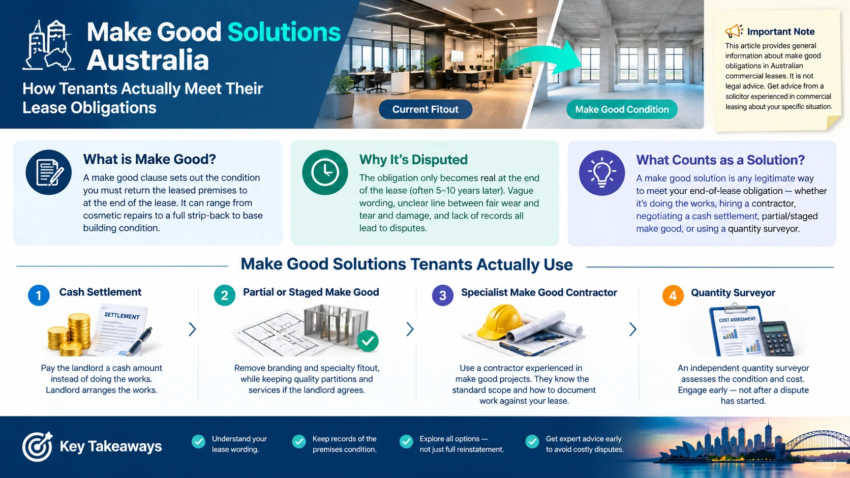
A make good solution is any legitimate way a tenant satisfies their end-of-lease restoration obligation under the lease terms. This can mean physically carrying out the works themselves, hiring a contractor to do it, negotiating a cash settlement with the landlord instead of doing physical works, agreeing to a partial or staged make good, or engaging a quantity surveyor to independently assess the cost and scope. There is no single correct solution — the right one depends entirely on the specific wording of the lease and what both parties are willing to agree to.
What “Make Good” Actually Means in an Australian Lease
A make good clause sets out the condition a tenant must return leased premises to when the lease ends. There’s no fixed legal definition in Australia — this is determined by the specific wording in each lease, and can range from light cosmetic repairs to a full strip-back to “base building” or bare shell condition. Typically, make good involves removing tenant-installed fitout, repairing damage, reinstating any alterations made during the tenancy, and leaving the space in a “handover-ready” state. Fair wear and tear is usually excluded, meaning a tenant generally isn’t responsible for ordinary deterioration from normal use, though damage from negligence or misuse is a separate matter and usually is the tenant’s responsibility.
Why Make Good Disputes Are So Common
Make good is one of the most frequently disputed provisions in Australian commercial leases, for a structural reason: the obligation crystallises at the very end of the lease term, which might be five or ten years after signing, by which point neither party may clearly remember what condition the premises were in at the start. Vague lease wording compounds this — generic make good clauses are often included without either party thinking through what they’ll actually mean in practice years later. The line between “fair wear and tear” and damage is also genuinely unclear in many cases, since there’s no fixed legal test, and this ambiguity is where a large share of disputes originate.

Make Good Solutions Australia Tenants Actually Use
Negotiating a Cash Settlement Instead of Physical Works
Rather than carrying out the physical works themselves, a tenant can negotiate to pay the landlord a cash amount instead, with the landlord then arranging any works themselves. This is often attractive to landlords planning to re-let or redevelop the space anyway, since they may prefer control over the works rather than inheriting a tenant’s contractor’s finish. For tenants, this can reduce the hassle of managing a make good project directly, though it requires agreement on the dollar figure, which is itself a common point of negotiation.
Partial or Staged Make Good
Not every make good obligation requires full reinstatement. A partial make good — for example, removing branding and specialty fitout while leaving quality partitions and services in place, if the landlord agrees this benefits a future tenant — can reduce cost and scope for both parties. This solution depends heavily on what the landlord actually wants for the space next, so it’s worth raising the possibility directly rather than assuming full reinstatement is the only option.
Engaging a Specialist Make Good Contractor
For tenants who do need to carry out physical works, engaging a contractor experienced specifically in make good projects (rather than general construction) tends to produce a cleaner outcome, since these contractors are familiar with the standard scope items landlords typically expect — services decommissioning, lighting reinstatement, cleaning and waste removal — and how to document completed work against the lease’s specific wording.
Bringing in a Quantity Surveyor Early
When a make good’s scope or cost is disputed, an independent quantity surveyor can assess the condition of the premises against the lease terms and provide a binding or advisory determination of cost. Some retail leases specifically provide for this as a dispute-resolution mechanism when landlord and tenant can’t agree. Engaging a quantity surveyor early well before lease expiry, not after a dispute has already started is generally far more useful than waiting until both sides have already taken firm positions.
A Practical Timeline for Managing Make Good
- At lease signing: Have a solicitor review the make good clause specifically, and insist on a condition report documenting the premises’ state at commencement — this becomes your baseline reference years later.
- Well before expiry (12+ months out): Re-read the actual lease wording, not just your memory of what was agreed, and start budgeting realistically for potential make good costs.
- 6–12 months before expiry: Get quotes from make good contractors against the specific lease obligations, and raise any partial make good or cash settlement discussions with the landlord at this stage, while there’s still time to negotiate.
- At expiry: Complete agreed works (or settlement) with clear documentation, and get written confirmation from the landlord that obligations have been satisfied.
Common Mistakes Tenants Make With Their Obligations
Not reading the make good clause until near lease expiry. By then, there’s little room to negotiate scope or cost, and the tenant has the least leverage.
Assuming “fair wear and tear” excludes more than it actually does. Since there’s no fixed legal definition, assuming broad exclusions without checking the specific lease wording is a common and costly mistake.
Skipping the condition report at lease commencement. Without a baseline record, it becomes much harder to prove what condition existed before the tenancy began.
Waiting for a dispute before getting professional input. Engaging a quantity surveyor or solicitor only after a disagreement has hardened positions makes resolution slower and more expensive than addressing it proactively.
Where Careful Planning Still Isn’t Enough
Even a well-managed make good process can run into disagreement, because the underlying wording often has genuine ambiguity that careful planning alone can’t remove — two reasonable people can read the same clause differently. High market vacancy doesn’t reduce a tenant’s make good liability either, so a soft leasing market isn’t automatically leverage in a make good negotiation. In these cases, the dispute-resolution mechanism in the lease (often quantity surveyor determination or mediation) becomes the practical path forward, rather than informal negotiation alone.

Expert Tips for Reducing Make Good Risk
- Negotiate the make good clause before signing, not after — this is the point of maximum leverage, far more than at lease expiry.
- Keep the condition report and any variations to the lease together in one place, so they’re easy to find years later.
- Get contractor quotes against the actual lease wording, not a generic scope, since costs vary significantly depending on what the specific clause requires.
- Raise partial make good or cash settlement early, since landlords are often more open to these options with enough lead time to plan around them.
Frequently Asked Questions
It’s any legitimate way a tenant satisfies their end-of-lease restoration obligation, including physical works, a cash settlement, partial make good, or a quantity surveyor’s determination — the specific lease wording governs which options apply.
Yes, if the landlord agrees — this is a common negotiated alternative, particularly where the landlord plans to re-let or redevelop the space themselves.
Generally no — most make good clauses exclude ordinary deterioration from normal use, but there’s no fixed legal definition, so the line between wear and tear and damage is often disputed.
Ideally at lease signing, with a condition report, and again seriously 6–12 months before lease expiry to get quotes and raise any negotiated alternatives with the landlord.
The lease wording itself is the primary source; where it’s ambiguous or disputed, a quantity surveyor or another dispute-resolution mechanism specified in the lease may make the determination.
Yes — this is the point of maximum leverage for a tenant, and having a solicitor review and negotiate the clause before signing is far more effective than trying to negotiate scope at lease expiry.
The landlord can generally claim damages for breach of the lease, typically equivalent to the cost of completing the required works themselves.
This depends on the specific lease terms and applicable law; generally, damages relate to the cost of the works required to bring the premises to the standard the lease specifies, though the exact basis can vary and is worth confirming with a solicitor for a specific situation.
Final Takeaway
There’s no single correct make good solution in Australia — the right approach depends entirely on the specific wording of the lease, and the earlier a tenant engages with it, the more options and leverage they have. Reading the clause carefully at signing, keeping a condition report, and starting practical planning well before lease expiry consistently produce better outcomes than waiting until the end of the term, when negotiating room has mostly disappeared. For anything beyond general understanding, a solicitor experienced in commercial leasing is the right next step for a specific lease.

Hamad Arshad
SEO Specialist | SEO Manager | GEO Strategist
7+ Years of Experience in SEO, GEO, AEO, AI SEO, Local SEO, Technical SEO, PPC, Google Ads & Meta Ads.





Leave a Reply