

Will Cybersecurity Be Replaced by AI? The Honest Answer for 2027
If you searched “will cybersecurity be replaced by AI,” you’re probably asking one of two things: is my security job safe — or is it still worth entering this field? Here is the direct answer: no, AI is not replacing cybersecurity. It is changing how the work gets done, and changing it quickly.
The professionals who do well over the next few years won’t be the ones competing against AI. They’ll be the ones who know how to direct it. This article breaks down what AI already handles, where it falls short, how roles are shifting, and which skills actually hold their value.
The Short Answer: Augmentation, Not Replacement
Every few years, the security industry predicts a technology will eliminate jobs. Firewalls, intrusion prevention, automated response platforms — each one absorbed a layer of manual work, and each time the total amount of security work grew anyway. AI follows the same pattern, with one real difference: it reaches further into judgment-heavy tasks than previous tools did.
The dynamic, though, is still augmentation. AI is exceptional at scale — scanning millions of events, correlating weak signals, drafting documentation. It is weak at the things security ultimately depends on: deciding what matters to a specific business, out-thinking a creative adversary, and owning the consequences of a wrong call. Companies aren’t buying AI to fire their security teams. Most are buying it because there was never enough team to begin with.
What AI Already Handles in Security Operations
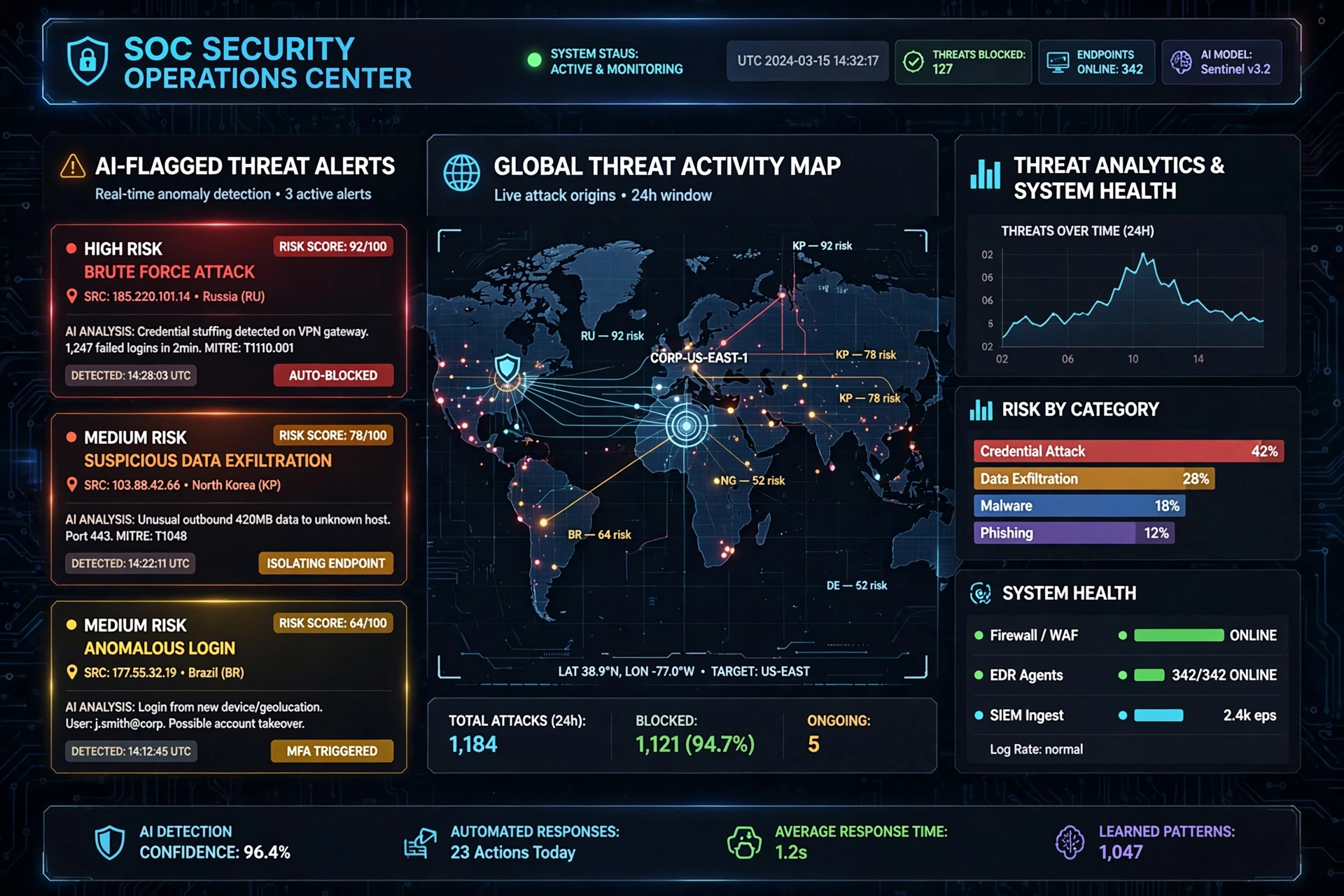
Threat detection at machine speed
Modern detection tools use machine learning to flag anomalies across networks, endpoints, and cloud workloads. No human team could watch that volume of telemetry. Models can — around the clock, without fatigue, and they keep improving as they see more data.
Alert triage and prioritization
The SOC analyst’s oldest enemy is alert fatigue: thousands of low-quality alerts burying the few that matter. AI now clusters related alerts, suppresses duplicates, and scores risk so analysts start their shift with the most dangerous items first instead of drowning in noise.
Phishing and fraud detection
Email filtering, login anomaly detection, and transaction monitoring all lean heavily on trained models. This is one of AI’s clearest wins in security — machines spot subtle deviations in message headers, language patterns, and user behavior far faster than any human reviewer.
Drafting reports and documentation
Incident summaries, compliance evidence, ticket notes — AI drafts them from raw logs in seconds. Analysts review and correct instead of writing from scratch. The output still needs a human eye, but the blank-page problem is gone.
What AI Still Can’t Do
Think like an attacker
Offense is creative. Attackers chain unlikely weaknesses, exploit human trust, and adapt the moment a defense appears. Models trained on past attacks struggle with genuinely novel tradecraft — and attackers know it. Red teaming remains a deeply human discipline.
Understand business context
A model can flag “unusual database access at 2 a.m.” Only someone who knows the business can say whether that’s the finance team closing the quarter or an intruder staging data for theft. Context is what turns alerts into decisions, and context lives with people.
Take responsibility
When a breach unfolds at 3 a.m., someone has to decide: shut down production or risk the spread? That call carries career and legal weight. No executive accepts “the model decided” as an answer. Accountability stays human, which means authority stays human too.
Handle the truly novel
Zero-days, supply-chain compromises, and targeted social-engineering campaigns don’t look like training data. First-of-kind attacks still require human investigation — forming hypotheses, chasing dead ends, and recognizing the pattern nobody has named yet.
How Cybersecurity Roles Are Changing
Roles aren’t disappearing so much as splitting. High-volume, pattern-based work consolidates into machines, while adversarial, contextual, and architectural work concentrates in fewer, more skilled humans — alongside entirely new specialties that only exist because of AI.
| Shrinking / automating | Growing |
|---|---|
| Manual log review | AI security engineering (securing AI systems themselves) |
| Signature-only detection tuning | Detection engineering with machine learning |
| Tier-1 alert triage | Threat hunting and adversary emulation |
| Generic compliance checklists | AI governance, risk, and policy |
| Basic malware analysis | AI red teaming and prompt-injection defense |
Skills That Stay Valuable in an AI-Driven Field
- Security fundamentals. Networking, operating systems, how attacks actually work. AI cannot compensate for missing foundations — it amplifies whatever understanding you bring.
- Adversary mindset. Red-team thinking and understanding attacker incentives. This is the skill AI is worst at replicating.
- AI literacy. Knowing what models can and can’t do, directing them well, and validating their output instead of trusting it blindly.
- Data skills. Reading logs, querying datasets, and writing basic scripts to verify what the AI claims happened.
- Communication. Translating technical risk into business language for executives. Rare, valuable, and not automatable.
- Incident leadership. Calm, decisive action under pressure — the thing nobody wants a model doing alone.
Practical Advice: What to Do Right Now
If you’re already in security: pick one AI-assisted workflow this month — triage, report drafting, detection tuning — and learn to supervise it well. Document what you check and why. That oversight judgment is your moat.
If you’re entering the field: don’t skip fundamentals to chase AI hype. Employers still hire for networking, Linux, and security basics first. Layer AI tooling on top of that foundation, not instead of it. Our AI tool reviews can help you evaluate which tools are worth learning.
If you’re choosing a specialty: look where AI creates new attack surface. AI red teaming, model security, and AI governance are growing precisely because AI exists — demand created by the technology itself. See our AI tools comparisons for side-by-side evaluations.
What to Watch Next
Three developments deserve attention: agentic AI capable of executing multi-step attacks (and defenses), AI-generated phishing with unprecedented personalization, and incoming regulation around AI in critical infrastructure. Authoritative guidance is already emerging — see CISA’s resources on AI and cybersecurity and the World Economic Forum’s cybersecurity outlook. None of these developments reduce the need for security people. They change what those people must understand — which is exactly why the field rewards continuous learners.
Conclusion
So, will cybersecurity be replaced by AI? No — but “cybersecurity” as a set of daily tasks will keep changing, and professionals who refuse to change with it will feel the squeeze. The durable bet is the one that has always worked in this field: deep fundamentals, an attacker’s curiosity, and the judgment to use new tools well. For a broader look at practical AI tooling, see our guide to free AI automation tools. AI is the most powerful tool security has ever had. Tools don’t replace the craft. They reward the craftsmen who master them.
Frequently Asked Questions
Tier-1 alert triage is being heavily automated, which puts pressure on purely repetitive analyst roles. But analysts are moving up the stack into threat hunting, investigation, and incident leadership — demand is shifting toward higher-skill roles, not disappearing.
Yes. The attack surface keeps growing — cloud, IoT, and now AI systems themselves all need defending. The entry bar is rising, but the door is not closing. Fundamentals plus AI literacy is the winning combination.
AI assists attackers with phishing, reconnaissance, and malware drafting, but fully autonomous, novel hacking remains limited. Importantly, defenders use the same technology — it’s an arms race, not a one-sided takeover.
AI security engineer, machine-learning detection engineer, AI red teamer, and AI governance/risk specialist are all growing roles that barely existed a few years ago — created by AI itself.
AI literacy is becoming table stakes: understanding what models can and can’t do, directing them well, and validating their output. You don’t need to become a machine-learning researcher.
The easiest entry-level tasks are the most automated, which makes the first rung harder to grab. Newcomers should build strong fundamentals and learn AI-assisted workflows to stay competitive from day one.

Hamad Arshad
SEO Specialist | SEO Manager | GEO Strategist
7+ Years of Experience in SEO, GEO, AEO, AI SEO, Local SEO, Technical SEO, PPC, Google Ads & Meta Ads.



Leave a Reply