
What Is the Riemann Hypothesis
It is not every week that a maths problem from 1859 leads the technology news. But that is what happened when Levent Alpöge, a mathematician who works at Anthropic, announced that he had proved the Riemann hypothesis while working with Claude, the company’s AI assistant. If the claim holds up, it would close the most famous open question in mathematics, a problem that has resisted some of the sharpest minds on Earth for over 165 years.
That “if” is doing a lot of work, and this article will keep it in place. What follows is a plain-language explanation of what the Riemann hypothesis actually says, why mathematicians care so deeply, what exactly has been claimed this week, and what would have to happen before anyone can call it solved.
The Hypothesis in Plain Language
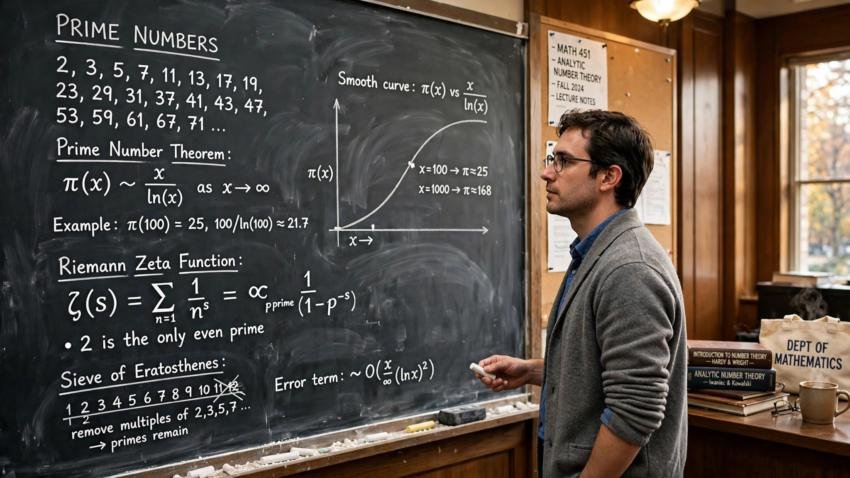
Prime numbers are the whole numbers that can only be divided by 1 and themselves: 2, 3, 5, 7, 11, 13, and so on. They look almost random. No simple formula tells you where the next one will appear, and the gaps between them jump around without any obvious rhythm.
And yet, underneath that apparent randomness, mathematicians have long suspected a hidden pattern. In 1859, the German mathematician Bernhard Riemann published a short paper, only about ten pages long, with a bold guess about where that pattern lives. His guess became known as the Riemann hypothesis, and it can be stated in one sentence: a certain function, called the Riemann zeta function, hits zero only at a specific set of special points, and every one of its interesting zeros sits on a single straight line. Riemann himself never proved it. He wrote that it was “very probable,” and moved on. Generations of mathematicians have been trying to finish the job ever since.
Primes, Counting, and a Very Old Puzzle
To see why anyone cares about a function hitting zero, start with the primes. Mathematicians like to ask a simple question: if you count all the primes up to some large number, how many are there? A formula exists that estimates this count, and it works surprisingly well, but it is not exact. The estimate is always a little off, sometimes high, sometimes low.
The Riemann hypothesis is, at heart, a statement about how far off that estimate can ever be. If it is true, the error stays tightly controlled, within a known and rather small bound. The primes would still look scattered, but their scatter would follow strict rules. Think of weather versus climate: you cannot predict the temperature on a specific Tuesday next year, but you can say a lot about the range it will fall in. Riemann’s claim is that the primes have a climate, and he described its exact boundaries.
That is why the hypothesis matters far beyond one equation. Hundreds of published results are proved “assuming the Riemann hypothesis is true”: if this one guess is ever confirmed, they all become solid facts overnight, and if it were shown false, a large shelf of mathematics would need rethinking.
The Zeta Function and the Critical Line
Now for the function itself. The zeta function starts as a simple idea. Take a number, call it s. Add up 1, plus 1 divided by 2 raised to the power s, plus 1 divided by 3 raised to the power s, and keep going forever. That endless sum is the zeta function, written ζ(s). Euler studied it in the 1700s, and one of its beautiful properties is that it secretly encodes all the prime numbers at once.
Riemann’s genius move was to feed the function complex numbers, numbers with both a real part and an imaginary part, which you can picture as points on a map rather than points on a line. On that map, the zeta function equals zero at certain points, called its zeros. Some are boring and fully understood, the trivial zeros. The rest, the nontrivial zeros, are the interesting ones, and they all live inside a vertical strip of the map, between real part 0 and real part 1.
Here is the hypothesis, visually. Draw a vertical line straight down the middle of that strip, at real part exactly one-half. That is the critical line. Riemann claimed that every single nontrivial zero lies precisely on that line. Not near it. On it. Computers have checked the first trillions of zeros, and every one sits exactly on the line. But checking trillions of cases is not a proof, because there are infinitely many zeros, and a proof has to cover every one, forever.
The Claim That Started This Week’s Frenzy
According to reporting by The Verge and TechCrunch, Levent Alpöge says he found a proof of the Riemann hypothesis while working with Claude, and that the same approach also settles the even stronger generalized version of the problem. Alpöge is no random internet claimant; he is a professional number theorist on Anthropic’s technical staff, one reason the announcement got serious attention instead of being waved away.
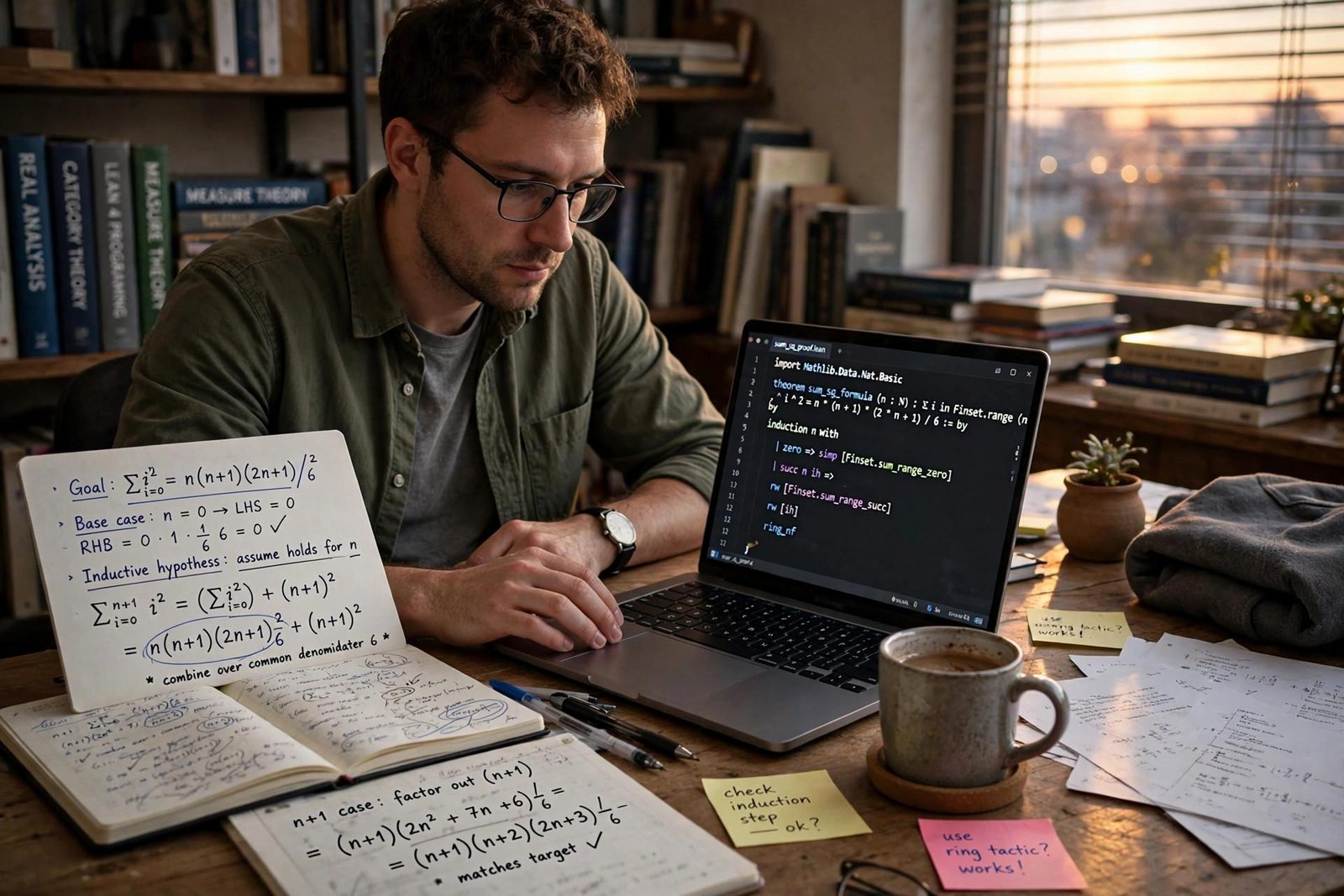
The form of the claim is unusual. There is no traditional paper to read. The proof is written in Lean, a proof assistant described below, and Alpöge published it only on his own website, alongside a short note. Written out as ordinary text, he has said, it would run to hundreds of thousands of pages, because the formal version spells out every tiny logical step. A human-readable write-up does not exist yet.
Two caution flags matter, and both come straight from the reporting. First, per The Verge, the proof has not been independently verified, and Anthropic itself has not commented on it or involved itself in the announcement; this is Alpöge’s claim, not his employer’s. Second, TechCrunch later updated its story to say the Lean proof has been checked by independent sources, meaning the code runs and the machine verification passes. Both can be true at once, and the difference between them is the whole story: a machine can confirm that a formal proof is logically valid, but it cannot persuade the mathematical community that the statement proved is exactly the statement Riemann made, with no subtle mismatch in definitions. That part is human work, and it has barely begun.
What Is Lean, and Why Does It Matter?
Lean is a proof assistant, software built for exactly this situation. You write a proof in Lean’s language, step by step, and the software checks every step against the rules of logic. If one step does not follow, the whole thing is rejected. There is no hand-waving, no gap a tired reader might skim past. Either the chain of reasoning is complete, or the computer refuses to accept it.
This is why AI claims involving Lean get taken more seriously than an AI simply announcing an answer in a chat window. Anyone who has read about how AI is created knows a language model’s raw output can sound confident and still be wrong. A Lean proof is different in kind: the model can propose and explore, but the final artifact either passes the checker or it does not. The machine acts as a referee that cannot be charmed.
There is still a catch. Lean checks the proof of whatever statement was typed into it. If that statement differs even slightly from the real Riemann hypothesis, a perfectly valid Lean proof could prove the wrong theorem. Checking that the formal statement matches the famous problem is a job for human experts, and one of the first things they will do.
Claude’s reported role is worth describing accurately. By Alpöge’s account, this was no case of pasting a question into a chatbot. It was weeks of collaboration, with the model working through proof strategies, generating and testing formal steps, and at points moving faster than he could near the end. That kind of long, tool-using teamwork is what researchers mean by AI systems acting as collaborators rather than simple question-answerers, a shift explored in our guide to what agentic AI is and how it works. Nor is this an isolated episode: Alpöge said in July that he had solved the Jacobian conjecture with Claude, and OpenAI said in September that it had made progress on a Navier-Stokes problem.
A Second Claim, From the Opposite Direction
Almost as remarkable, a completely separate claim appeared the same week. Alessandro Masullo, a postdoctoral researcher at Stanford, announced a proof of the General Riemann Hypothesis, the broader version covering a whole family of related functions. His work, shared publicly by Stanford mathematician Ravi Vakil, is the product of twelve years of his own effort, with no AI involved.
Two claims about the same legendary problem landing within days of each other is extraordinary. It might mean the problem’s time has genuinely come, or that excitement is running ahead of verification. Masullo’s draft faces the traditional process: experts reading line by line, hunting for the quiet mistake that has sunk so many attempted proofs before. It is far too early to judge his claim as well.

Why Experts Are Cautious
Skepticism here is not rudeness; it is the system working as designed. The history of this problem is littered with announced proofs that collapsed under scrutiny, some from amateurs and some from respected mathematicians. A claim this large earns belief slowly, through checking, not through announcements.
There is also a formal process behind the informal one. The Riemann hypothesis is one of the seven Millennium Prize Problems named by the Clay Mathematics Institute, each carrying a prize of one million dollars. The rules are strict: a proposed solution must be published in a refereed mathematics journal, and then survive roughly two years of scrutiny by the worldwide mathematical community before the prize can be awarded. By those rules, nothing that happened this week settles anything on its own, and the Institute still lists the problem as unsolved.
The stakes explain the care. Deciding what would be an appropriate task for using generative AI usually comes down to scale and risk, and proving the deepest open problem in mathematics is as high-stakes as a task gets. If the claim survives, it changes what the world believes AI can do; if it collapses, it becomes a case study in how even a machine-checked proof can miss the point. Either way, the checking is the story now. The primes have waited 167 years; they can wait a little longer for a verdict.
Frequently Asked Questions
It is a guess about a hidden pattern in the prime numbers. Riemann proposed that a function called the zeta function, which encodes the primes, equals zero at infinitely many special points, and that every one of the interesting zeros lies exactly on a single straight line called the critical line. If true, the primes, which look random, follow strict rules about how they are spread out.
A mathematician at Anthropic, Levent Alpöge, says that he and Claude found a proof, published as machine-checkable code. That is a claim, not an accepted result. The proof passing computer checks is a strong start, but the wider mathematical community has not confirmed it, Anthropic has not endorsed the announcement, and the problem is still officially unsolved.
Lean is a proof assistant, software that checks a proof step by step against the rules of logic and rejects anything that does not follow. It matters because it removes the usual weak point of AI announcements: instead of trusting a model’s confident-sounding text, anyone can run the code and see whether the logic holds. The remaining human job is confirming the statement proved in Lean is exactly the statement Riemann made.
The Millennium Prize Problems are seven famous unsolved problems chosen by the Clay Mathematics Institute, each with a prize of one million dollars, and the Riemann hypothesis is one of them. To win, a solution must be published in a refereed mathematics journal and then withstand about two years of examination by the global mathematical community. An announcement on a personal website is only the first step.
Because it is the deepest known statement about how prime numbers are distributed. Proving it would lock down exactly how accurate our formulas for counting primes can be, and instantly confirm hundreds of other results that were proved assuming it is true. Primes also underpin much of modern cryptography, which is why a problem from 1859 still makes headlines today.
Experts will independently rerun the Lean verification, check that the formal statement matches the real hypothesis, and push for a readable version of the argument they can study and teach. If it survives all of that, the work goes through journal peer review and the Clay Institute’s roughly two-year scrutiny period before the problem could officially be called solved or the prize awarded.

Hamad Arshad writes and edits AI Next Top from Rahim Yar Khan, Pakistan. He has worked in SEO and digital marketing for over 7 years and started this site to explain AI tools and news in plain language for non-technical readers. Every guide here is checked against the real tool before it is published.








Leave a Reply