
Droven.io AI Automation Tools What the Site Actually Is and How to Use It
If you searched “Droven.io AI automation tools” expecting to find a piece of software you can sign up for and start automating with, you’re not alone — and you’re also not going to find that, at least not in the way the phrase suggests. A number of articles online describe Droven.io as if it were a SaaS automation platform complete with features and pricing tiers. Based on how the site actually describes itself, that’s not accurate. This guide clears up what Droven.io actually is, why the confusion exists, and — since most people searching this term ultimately want to automate something in their business — walks through how to actually evaluate real automation tools once you know where Droven.io fits.
Quick Answer: Is Droven.io a Software Tool or Something Else?
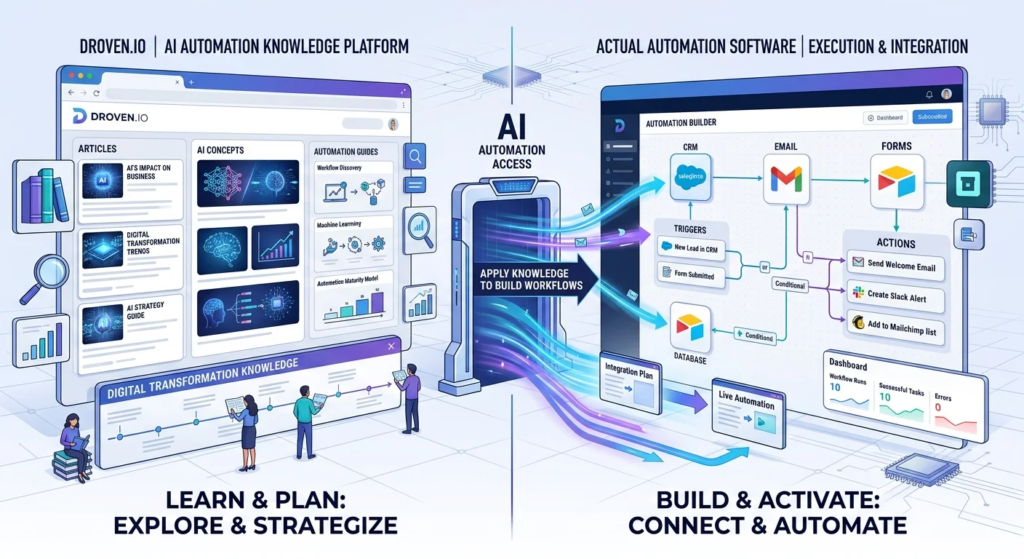
Droven.io is an editorial knowledge platform focused on AI, automation, machine learning, and digital-transformation topics — not a software product. It doesn’t run automations, connect your apps, or offer an account where you build workflows. Instead, it functions as a research and educational resource, helping readers understand automation concepts and categories before they choose an actual tool like Zapier, Make, n8n, UiPath, or Microsoft Power Automate. If you’re looking for something to actually automate a task, Droven.io is a useful starting point for research, not the destination for implementation.
Why This Search Term Confuses So Many People
The confusion here is understandable, and worth naming directly rather than glossing over. “AI automation tools” as a phrase strongly implies software — most sites people search for using that language (Zapier, Make, UiPath) are exactly that. When a content site uses similar language to describe the topics it covers, it can easily read, at a glance, like it’s describing its own product features rather than its editorial coverage. On top of that, a cluster of thin, likely AI-assisted articles have been published that describe “Droven.io AI automation tools” with specific-sounding feature lists and pricing language, which reinforces the misconception further the more those articles get indexed and repeated. None of that changes what the site actually is — but it does explain why so many search results currently disagree with each other.
What Droven.io Actually Covers
Based on the site’s own description of itself, its content spans a fairly wide range of applied AI and automation topics: workflow automation concepts, no-code and low-code automation approaches, machine learning use cases across industries like healthcare, finance, and marketing, and broader digital-transformation topics including cloud infrastructure and data security. It’s positioned as a vendor-neutral explainer — helping readers understand a technology category and its trade-offs before they spend money on a specific tool, rather than promoting any single platform. That’s a genuinely useful function; it’s just a different function than “AI automation software,” even though the phrase used to search for it doesn’t make that distinction obvious.
Droven.io AI Automation Tools Explained for Buyers
For anyone specifically trying to decide whether Droven.io is worth their time, here’s the practical breakdown.
What You’ll Actually Find on the Site
Educational and explanatory content about automation concepts, AI tool categories, and digital-transformation topics, generally written to be understandable without a technical background. This is genuinely useful if you’re early in researching automation and want a conceptual foundation before comparing specific products.
What You Won’t Find There (and Why That Matters)
An account signup to build and run automations, a pricing page for automation software, or direct integrations connecting your business apps. If your goal is to actually automate a task — say, moving leads from a form into your CRM — Droven.io itself won’t do that for you, no matter how the content is phrased. This matters because time spent looking for a “get started” button on an editorial site is time not spent evaluating a tool that could actually do the job.
Who Droven.io Is Genuinely Useful For
Someone who’s early in exploring what AI automation even means for their business, wants a conceptual map of the landscape before committing budget to a specific platform, or is a student, developer, or professional trying to understand automation-adjacent career skills. It’s less useful for someone who already knows what they want to automate and just needs to pick and configure a tool — that person should move straight to evaluating actual platforms.
How to Actually Choose an AI Automation Platform
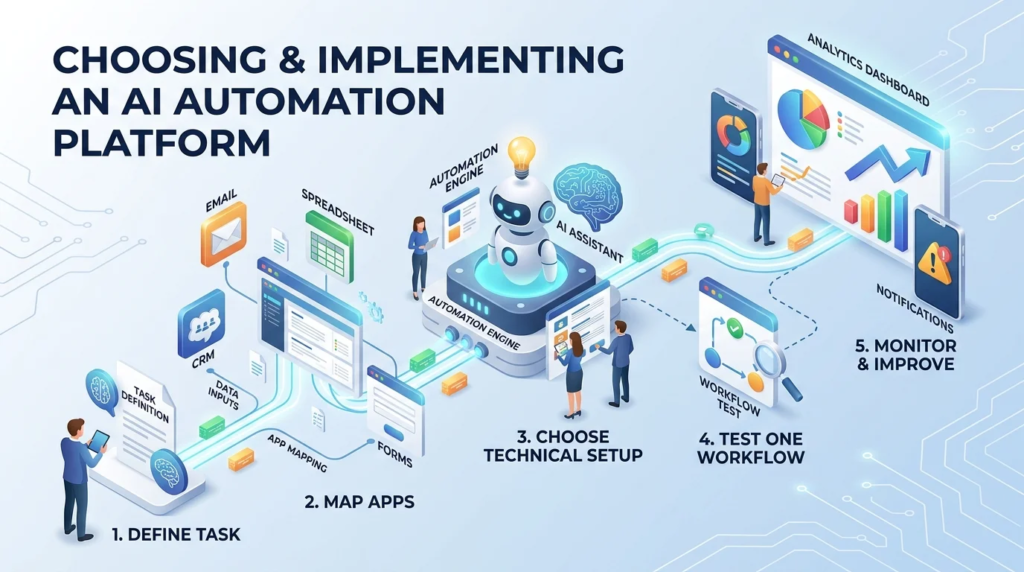
If Droven.io (or a resource like it) has given you a conceptual foundation, the next step is choosing an actual tool. A practical way to approach that:
- Define the specific task first, not the tool. “Automate lead follow-up” is specific enough to evaluate platforms against; “get AI automation” is not.
- Map the apps involved. Most real automation platforms are built around connecting specific software (CRMs, email, spreadsheets, forms) — checking that your key tools are supported natively narrows the field quickly.
- Decide how much technical setup you’re willing to do. No-code platforms (Zapier, Make) get you running faster; developer-oriented options (n8n self-hosted, custom agent frameworks) offer more control at the cost of setup time.
- Start with a free tier or trial on one specific workflow rather than trying to automate your entire operation at once — this surfaces real limitations before you’ve committed budget.
- Check what happens when something breaks. Error handling, notifications, and logs matter more in practice than most buyers expect going in, since automations that fail silently can cause bigger problems than the manual process they replaced.
Categories of Real AI Automation Tools Worth Knowing
Since Droven.io itself sits outside this category, it’s worth understanding the actual landscape it’s describing:
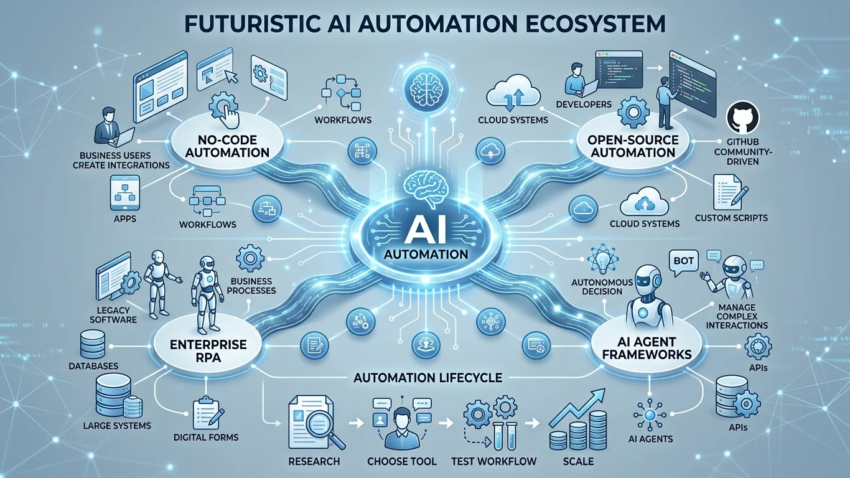
- No-code integration platforms (Zapier, Make) — connect apps through triggers and actions without writing code; strong for straightforward, event-based workflows.
- Open-source / self-hosted automation (n8n and similar) — offer more flexibility and no per-task pricing, at the cost of needing to host and maintain the platform yourself.
- Enterprise RPA platforms (UiPath, Microsoft Power Automate) — built for larger organizations automating structured, often legacy-system-heavy processes, typically with more governance and audit features.
- AI agent frameworks — a newer category where an LLM-driven agent makes decisions and takes multi-step actions rather than following a fixed trigger-action chain, useful for less predictable, more judgment-based workflows.
Each category solves a different kind of problem, and the “best” one depends entirely on the specific task, technical resources, and scale involved — which is exactly the kind of decision an educational resource can help you think through, even if it isn’t the tool doing the automating.
Common Mistakes People Make While Researching Automation Tools
Assuming every site using “AI automation tools” in its content is itself a tool. Reading a site’s own “About” or “What we are” page directly is the fastest way to avoid this mix-up.
Trusting secondhand descriptions of a product or platform without checking the source. Several articles about Droven.io repeat feature and pricing claims that don’t match how the site describes itself — a pattern worth watching for with any lesser-known name, not just this one.
Researching indefinitely without ever testing a real tool. Understanding the category matters, but at some point moving to a free trial on an actual platform is what turns research into results.
Picking a platform based on brand recognition alone. The most well-known tool isn’t automatically the best fit for a specific task or technical setup — matching the platform to the actual workflow matters more.
Where Editorial Resources Like This One Fall Short
Educational content — including this article — is useful for building understanding, but it can’t replace hands-on evaluation of a specific tool against your specific workflow. Reading about automation platforms won’t reveal how a particular integration behaves with your exact CRM setup, how reliable a specific trigger is in practice, or how support responds when something breaks. At some point, the research phase needs to end and a real trial needs to start — treating an explainer resource as a substitute for that step, rather than a preparation for it, is the main limitation worth being honest about.
Expert Tips for Evaluating Any Automation Platform
- Check a site’s own “About” page before assuming what it is, especially for a name you haven’t heard of before — a five-minute check avoids a lot of confusion.
- Treat pricing and feature claims from secondary articles skeptically until confirmed on the official source, particularly in a space with as much thin SEO content as automation and AI tools currently has.
- Start any real evaluation with one narrow, well-defined workflow, not a broad “automate everything” goal.
- Budget time for troubleshooting, not just setup — most automation platforms take longer to get fully reliable than the initial demo suggests.
- Revisit your tool choice periodically, since this category changes quickly and a platform that was the best fit a year ago may not be anymore.
Frequently Asked Questions
Is Droven.io a real automation software tool? No — based on how the site describes itself, Droven.io is an editorial and educational resource about AI and automation topics, not a platform you sign up for to build or run automations.
What is Droven.io actually used for? Learning about automation concepts, AI tool categories, and digital-transformation topics before choosing a specific software platform to implement.
Does Droven.io have pricing plans? Not in the sense of software subscription tiers — it’s described as a free, editorially independent content resource rather than a paid product.
Can I build an automation workflow directly on Droven.io? No — for actually building and running automations, you’d need a dedicated platform like Zapier, Make, n8n, or an enterprise RPA tool.
Is Droven.io free to use? Yes, as an editorial content resource, reading its content doesn’t require payment or a software subscription.
What’s the difference between Droven.io and platforms like Zapier or Make? Zapier and Make are software platforms that actually connect your apps and execute automated workflows; Droven.io is content explaining automation concepts and categories, without doing the automation itself.
Is the information on Droven.io reliable? That depends on the specific content and should be evaluated the way you’d evaluate any educational resource — but it’s worth noting that several secondary articles describing Droven.io itself contain claims that don’t match how the site describes its own nature, which is a useful reminder to verify specifics directly at the source.
What should I use instead if I want to actually automate something? A dedicated automation platform matched to your specific need — no-code tools like Zapier or Make for straightforward app-to-app workflows, or more advanced options like n8n or enterprise RPA tools for more complex or large-scale needs.
Who is Droven.io actually useful for? Someone early in exploring what AI automation means for their business or career, who wants conceptual grounding before committing to a specific tool — less useful for someone ready to implement a specific automation right now.
How do I choose a real AI automation tool for my business? Start with a specific task rather than a general goal, check which platforms natively support the apps you already use, decide how much technical setup you’re willing to take on, and test with a free tier on one workflow before expanding further.
Final Takeaway
Droven.io is best understood as a knowledge resource, not a software tool — useful for building a conceptual foundation in AI and automation topics, but not the place to actually build or run a workflow. If you landed on this search because you want to automate something real in your business, the practical next step is picking a dedicated platform that matches your specific task and technical comfort — Zapier or Make for straightforward no-code workflows, n8n for more flexible self-hosted setups, or enterprise RPA tools for larger, more complex operations — and testing it on one narrow use case before expanding further.

Hamad Arshad
SEO Specialist | SEO Manager | GEO Strategist
7+ Years of Experience in SEO, GEO, AEO, AI SEO, Local SEO, Technical SEO, PPC, Google Ads & Meta Ads.







Leave a Reply