
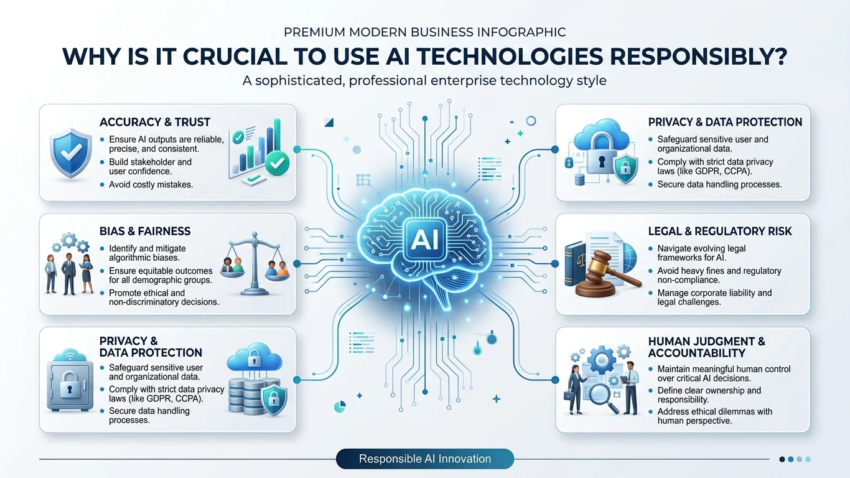
Why Is It Crucial to Use AI Technologies Responsibly?
AI tools have moved from novelty to daily infrastructure faster than almost any technology before them. Teams use generative AI to draft content, summarize documents, screen candidates, answer customer questions, and increasingly, to help make decisions that affect real people. That speed is exactly why responsible use matters — the tools got powerful and widely available before most organizations built the habits, policies, and judgment needed to use them well.
This guide is for business owners, professionals, and teams adopting AI tools who want a clear, practical answer to one question: why does using these technologies responsibly actually matter, beyond it sounding like the right thing to say? We’ll walk through the concrete reasons, what irresponsible use tends to look like in practice, and a framework you can apply without needing a legal or data science background.
Quick Answer: Why Responsible AI Use Matters
Using AI technologies responsibly matters because these systems can produce confident, plausible-sounding output that is inaccurate, reflect and amplify bias present in their training data, handle sensitive information in ways users don’t expect, and create legal or reputational exposure when deployed without oversight. Responsible use — meaning human review, transparency about AI involvement, awareness of a tool’s limitations, and clear accountability for outcomes — is what prevents these risks from becoming real harm to customers, employees, or the business itself.
What Does “Using AI Technologies Responsibly” Actually Mean?
The phrase gets used often enough that it risks becoming background noise, so it’s worth being specific. In practice, responsible AI use tends to mean: knowing what a given AI tool is actually good at and where it’s unreliable; keeping a human reviewing outputs that affect real decisions, rather than treating AI output as final; being transparent with customers or users when AI is involved in something that affects them; protecting the privacy of any data fed into AI systems; and taking ownership of outcomes rather than treating “the AI did it” as an excuse.
None of this requires a dedicated compliance team to start. It requires treating AI output the way you’d treat a draft from a junior team member — useful, often good, but not something you’d publish or act on without checking.
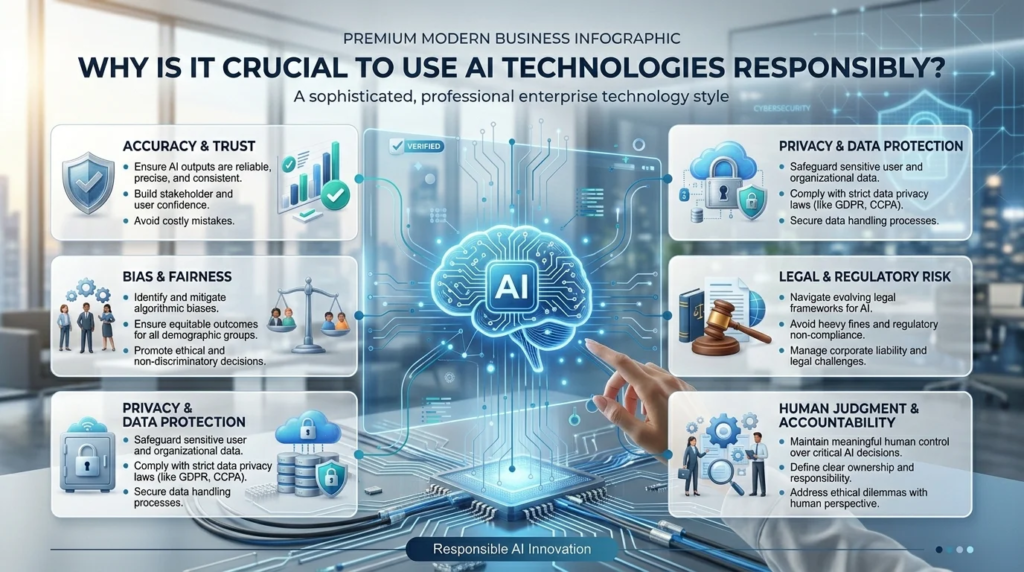
Responsible AI vs. “Ethical AI” vs. “AI Governance”
These terms are frequently used interchangeably, which causes confusion. “Ethical AI” usually refers to the broader principles a system or organization aims to uphold — fairness, transparency, harm avoidance. “AI governance” refers to the formal structures — policies, review processes, accountability chains — an organization puts in place to enforce those principles. “Responsible AI use” is the practical, day-to-day behavior of the people actually using the tools. You can have strong governance on paper and still see irresponsible use if individual employees aren’t applying it — which is part of why this needs to be a practical habit, not just a policy document.
Reason 1: Protecting Accuracy and Trust in What You Publish or Decide
Generative AI systems are built to produce fluent, confident-sounding text — that’s a different goal from producing accurate text, and the two don’t always align. A model can generate a wrong statistic, a fabricated quote, or an incorrect explanation with exactly the same tone of confidence it uses for something correct. This is often described as “hallucination,” and it’s a known, structural characteristic of how these systems work, not an occasional glitch.
The consequence for a business is direct: content, reports, or decisions built on unverified AI output can be wrong in ways that are hard to catch precisely because they read as plausible. A common approach that works well in practice is treating AI-generated content as a first draft that gets fact-checked before it’s published or acted on — especially for anything involving numbers, dates, names, quotes, or claims about competitors or third parties.
Reason 2: Avoiding Bias and Unequal Outcomes
AI systems learn patterns from the data they’re trained on, and that data reflects the real world — including its historical inequalities. When a model is used for tasks like screening resumes, evaluating creditworthiness, or generating marketing content aimed at different demographics, it can reproduce or amplify those patterns without anyone explicitly intending it to.
Where Bias in AI Systems Comes From
Bias typically enters at one of a few points: the training data itself may underrepresent certain groups or reflect historical discrimination baked into past decisions; the way a task is framed can implicitly favor certain outcomes; and the way outputs are used downstream (e.g., an AI-generated shortlist treated as final rather than as one input) can turn a mild statistical skew into a consequential decision. None of these are usually intentional, which is exactly why deliberate checking matters — bias in AI output tends to be invisible unless someone is specifically looking for it.
For most small businesses, the practical takeaway isn’t “avoid AI for anything involving people” — it’s “add a human review step for any AI-assisted decision that affects a person’s opportunities, and periodically check whether AI-generated shortlists, scores, or recommendations show patterns worth questioning.”
Reason 3: Protecting Privacy and Sensitive Data
Feeding customer data, employee records, or proprietary business information into AI tools carries risks that aren’t always obvious from the interface. Depending on the tool and its settings, data entered into a prompt may be stored, used to improve the underlying model, or in rare cases exposed through a security incident — and the terms governing this vary significantly between providers and even between free and paid tiers of the same product.
A practical, low-effort habit is to treat any AI tool the way you’d treat a new software vendor: check what the provider’s data handling terms actually say, avoid pasting sensitive personal or confidential business data into tools where you haven’t verified this, and use enterprise or business-tier products (which typically offer stronger data handling commitments) rather than free consumer tools for anything involving real customer or employee data.
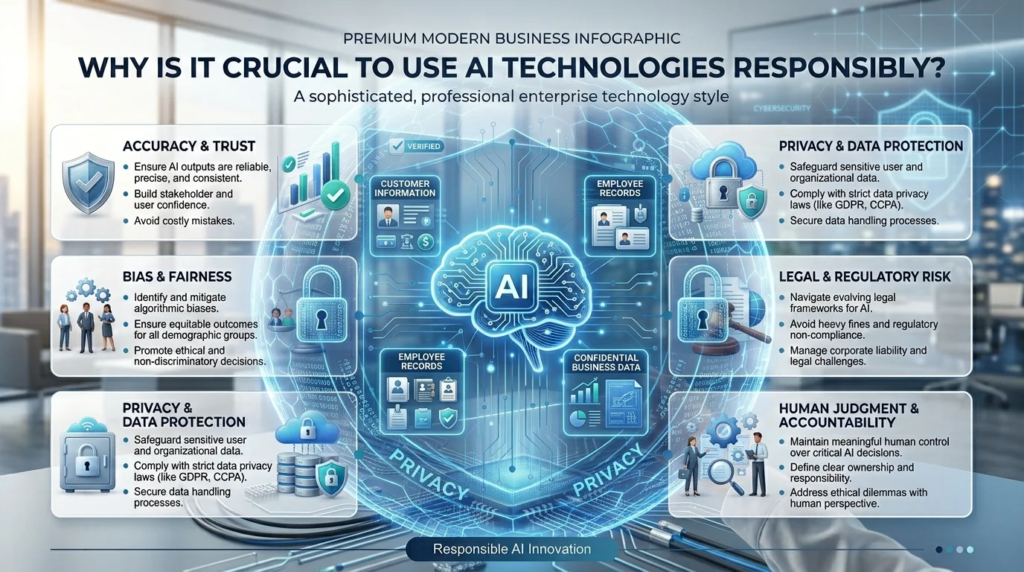
Reason 4: Legal, Regulatory, and Reputational Risk
Regulation around AI use is still developing, but it’s developing quickly, and it’s no longer reasonable to assume AI use falls outside existing legal frameworks. Data protection laws (like GDPR in the EU) already apply to how personal data is handled inside AI tools. Employment and anti-discrimination law already applies to AI-assisted hiring decisions. Consumer protection law already applies to AI-generated marketing claims. Using AI doesn’t create a legal exemption — it just adds a new way existing obligations can be violated, often without anyone noticing until it’s a problem.
Why Regulation Is Catching Up Fast
Frameworks like the EU AI Act and various national AI governance guidelines are specifically designed to formalize obligations that were previously implicit — requiring disclosure of AI involvement in certain contexts, risk assessments for higher-stakes AI uses, and documentation of how AI-assisted decisions are made. Even businesses outside directly regulated jurisdictions often end up affected indirectly, through customers, partners, or platforms that require compliance. Beyond formal regulation, reputational risk operates on a faster timeline than legal risk — a single visible AI mistake (a fabricated fact in published content, a biased hiring outcome, a data mishandling incident) can damage trust well before any regulatory process would even begin.
Reason 5: Preserving Human Judgment and Accountability
Perhaps the least discussed reason, but one of the most important in practice: over-relying on AI output can quietly erode the human judgment that catches AI’s mistakes in the first place. When AI-generated drafts, summaries, or recommendations are accepted routinely without real scrutiny, the habit of critical review atrophies — and the safety net that responsible use depends on gets weaker over time, not stronger.
Accountability follows the same logic. If something goes wrong with an AI-assisted decision, “the AI generated it” is not a satisfying answer to a customer, regulator, or employee affected by the outcome — and increasingly, it isn’t a legally satisfying answer either. Responsible use means someone remains clearly accountable for any AI-assisted output or decision, which in practice means someone reviewed it, understood its limitations, and chose to act on it.
What Happens When AI Is Used Irresponsibly (Real-World Scenario Patterns)
Without pointing to any single unverified incident, a few recurring patterns have become common enough to be widely discussed across industries: businesses publishing AI-generated content containing fabricated statistics or quotes that later had to be publicly corrected; AI-assisted hiring or lending tools later found to disadvantage certain groups, prompting legal scrutiny; customer service chatbots giving incorrect information about policies or pricing that the business was then held to; and employees pasting confidential data into public AI tools, unintentionally exposing it beyond the organization. These patterns share a common root — AI output was treated as finished and trustworthy without a responsible human check at the point where it mattered most.
Common Mistakes in Responsible AI Adoption
Treating “responsible AI” as a one-time policy document rather than an ongoing practice. Writing a policy and never revisiting it as tools and use cases change tends to produce compliance in name only.
Assuming responsibility only applies to “big” AI projects. Everyday uses — drafting an email, summarizing a contract, generating marketing copy — carry the same underlying risks (inaccuracy, bias, data exposure) as larger AI initiatives, just at smaller scale and lower visibility.
Skipping human review because the output “looks right.” Fluent, well-formatted AI output is precisely what makes errors easy to miss — confidence in tone has no relationship to accuracy.
Not distinguishing between AI tools’ data handling terms. Assuming all AI tools handle data the same way, when free consumer tiers and enterprise products often have meaningfully different commitments, is a common and avoidable mistake.
Delegating accountability to “the AI” instead of a person. Even informally, not assigning a clear human owner for AI-assisted outputs makes it harder to catch problems early and respond to them credibly when they occur.
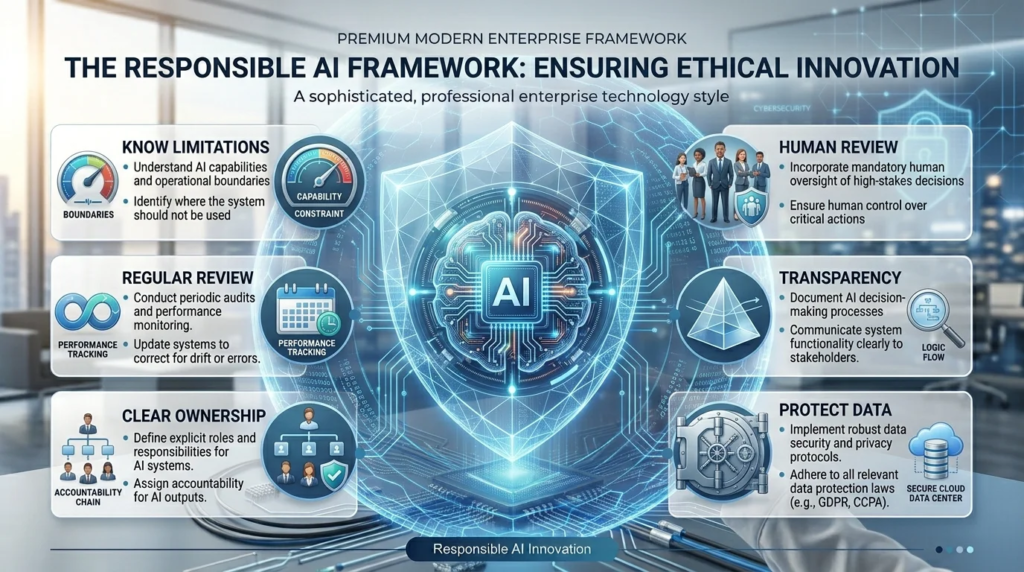
A Practical Framework for Using AI Responsibly
Turning these principles into practice doesn’t require a large governance program to get started. A workable framework most organizations can adopt:
- Know the tool’s limitations before relying on it. Understand whether a given AI tool is prone to inaccuracy, what data it was trained on (to the extent this is disclosed), and what it’s actually designed to do well.
- Keep a human in the loop for anything consequential. Content that gets published, decisions that affect people, and anything involving factual claims should have a human review step before it’s finalized.
- Be transparent where it matters. If AI played a meaningful role in something a customer, employee, or reader is engaging with — a chatbot conversation, an AI-assisted decision, AI-generated content — disclosure builds trust rather than undermining it.
- Protect sensitive data by default. Treat any information you wouldn’t want exposed publicly as off-limits for tools whose data handling terms you haven’t verified.
- Assign clear ownership. Every AI-assisted output that matters should have an identifiable human accountable for reviewing and approving it — not a diffuse sense that “the team” checked it.
- Revisit the approach as tools and regulations change. AI capabilities and the legal landscape around them are both moving quickly enough that a one-time policy will go stale; building in a periodic review (quarterly or biannually, depending on how central AI is to your operations) keeps the practice current.
When this becomes overkill: for very low-stakes, purely internal uses — brainstorming, personal note organization, first-draft ideation that a human will heavily rewrite anyway — the full weight of this framework is disproportionate. The level of scrutiny should scale with how much the output affects real people or real decisions, not apply uniformly to every use of AI.
FAQs About Using AI Technologies Responsibly
What does “responsible AI use” actually mean? It means using AI tools with awareness of their limitations, keeping human review in place for outputs that affect real decisions, protecting the privacy of data used with these tools, and maintaining clear accountability for outcomes rather than treating AI output as automatically correct or final.
Why is responsible AI use important for businesses specifically? Businesses face concentrated exposure to the consequences of AI mistakes — reputational damage from published inaccuracies, legal risk from biased or non-compliant AI-assisted decisions, and financial or trust costs from data mishandling — often at a scale an individual user wouldn’t encounter.
What are the biggest risks of using AI irresponsibly? The most common risks are inaccurate output presented with false confidence (hallucination), biased outcomes in AI-assisted decisions affecting people, mishandling of sensitive or private data, and legal/regulatory exposure from treating AI use as exempt from existing rules.
Does responsible AI use slow down productivity? It adds review time for higher-stakes uses, but this is generally offset by avoiding the much larger time and reputational cost of correcting errors after publication or deployment. For low-stakes internal uses, minimal additional process is usually needed.
Is responsible AI use only a legal/compliance issue? No. Legal and regulatory risk is one dimension, but trust, accuracy, and the quality of decisions made using AI output matter independently of whether a specific law applies — many of the reasons responsible use matters would still apply even without any regulation at all.
How can a small business use AI responsibly without a big budget? Start with low-cost habits: fact-check AI-generated content before publishing, avoid pasting sensitive data into unverified tools, disclose AI involvement where it’s meaningful to customers, and assign a specific person to review AI-assisted output rather than assuming someone will catch issues informally.
What is AI bias, and why does it matter? AI bias refers to AI systems reproducing or amplifying patterns of unfairness present in their training data or task design — for example, in hiring or lending contexts. It matters because it can produce discriminatory outcomes even without any intentional bias from the people using the tool.
Who is accountable when an AI system makes a mistake? In practice, and increasingly in regulatory frameworks, accountability sits with the organization and individuals who deployed or acted on the AI output — “the AI made the error” is not typically treated as a sufficient explanation on its own.
Are there laws that require responsible AI use? Existing laws around data protection, employment discrimination, and consumer protection already apply to AI-assisted activity in many jurisdictions, and newer frameworks like the EU AI Act specifically formalize additional obligations for certain AI uses. Requirements vary by jurisdiction and use case.
How do I start building an AI use policy? A practical starting point is documenting which AI tools your team currently uses, what data handling terms each one has, which uses are low-stakes versus consequential, and who is responsible for reviewing higher-stakes AI-assisted output — then formalizing that into a short internal policy rather than starting from a blank page.
Final Takeaway
Responsible AI use isn’t primarily about following a compliance checklist — it’s about recognizing that these tools produce confident output regardless of whether that output is accurate, fair, or safe to act on. The businesses and professionals who build in human review, protect sensitive data, stay transparent about AI’s role, and keep clear accountability aren’t slowing themselves down for its own sake; they’re the ones who catch problems before those problems become public, legal, or costly. Start small: pick one AI-assisted process you currently treat as “done” once the AI produces output, and add a specific human review step to it this week. That single change is often where responsible AI use actually begins.

Hamad Arshad
SEO Specialist | SEO Manager | GEO Strategist
7+ Years of Experience in SEO, GEO, AEO, AI SEO, Local SEO, Technical SEO, PPC, Google Ads & Meta Ads.




Leave a Reply