

What Is Qwen4 Max
Alibaba has a new flagship AI model, and it did not arrive quietly. Qwen4 Max launched on November 16, 2026 as the top model in the Qwen4 series, and Alibaba used the launch to make a direct claim against the American frontier labs: on coding, the company says, this model beats Anthropic’s Claude Opus 5.5 and runs close to Moonshot’s Kimi K3.1 Pro. Whether those claims survive independent testing is the story of the next few weeks. What is already clear is the shape of the model — very large, multimodal, cheaper than its predecessor, and aimed squarely at developers who build agents.
So what is Qwen4 Max, exactly? It is a sparse mixture-of-experts model with 2.4 trillion total parameters, of which about 71 billion are active for any given token. That design is the whole trick behind the pricing: the model can hold an enormous amount of learned knowledge while only paying the compute cost of a much smaller model on each request. It handles text, images and video in one system, and it accepts up to 1 million tokens of context — enough for a full codebase, a long legal file, or hours of documents in a single conversation.
The Coding Claim Everyone Is Talking About
The number Alibaba led with is 75.7 on DeepSWE v1.1, a benchmark of real software engineering tasks. According to the company, that score puts Qwen4 Max ahead of Claude Opus 5.5 and in competitive territory against Kimi K3.1 Pro, currently one of the strongest coding models available. Alibaba also reports top rankings across agentic tasks and visual reasoning, and an overall score of 52.69 across its own broad evaluation covering 26 domains.
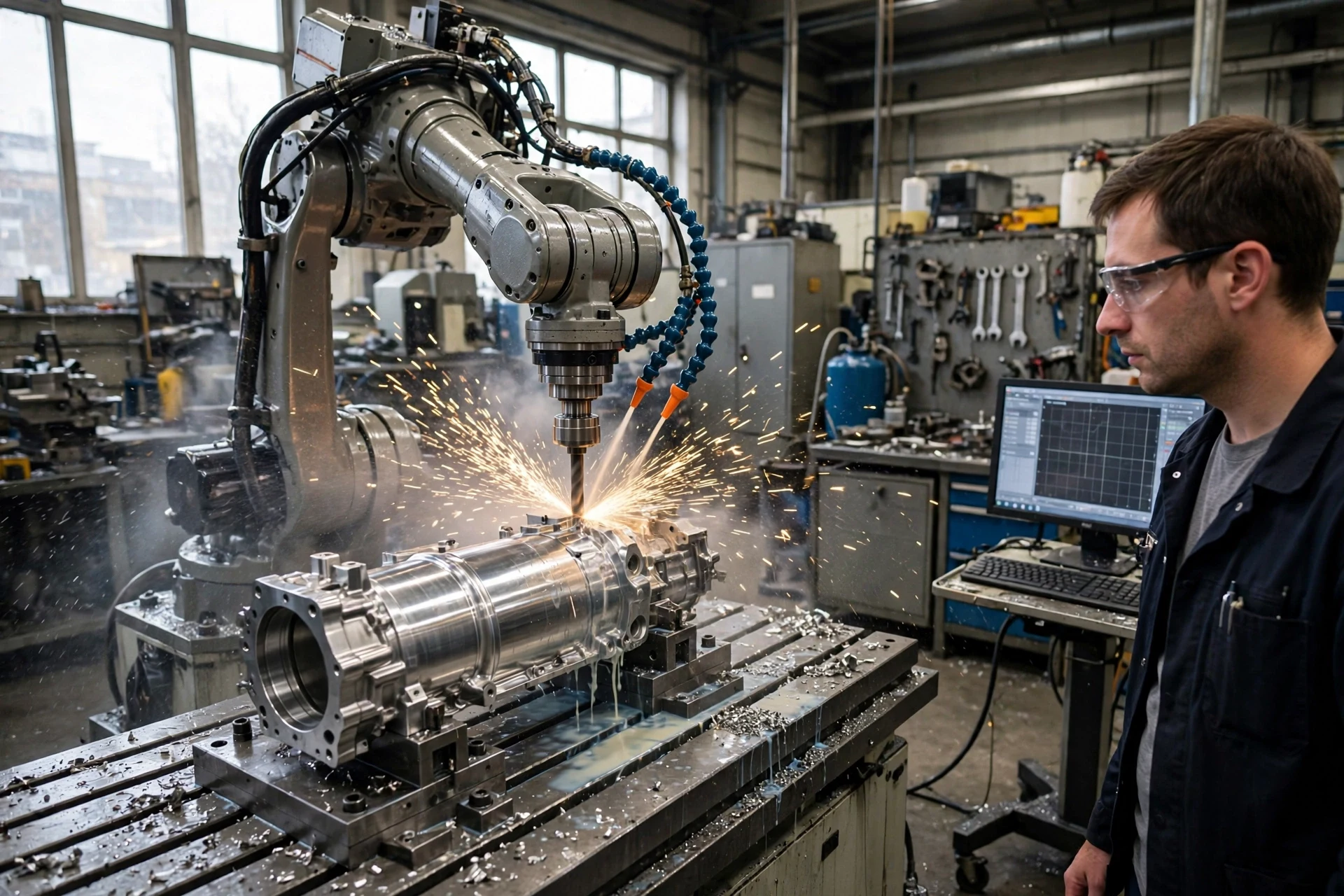
Independent measurement paints a slightly more measured picture. Artificial Analysis gives Qwen4 Max a 43 on its Intelligence Index — nine points above Qwen3.8 Max, and three points behind Kimi K3.1 Pro. That still places it among the strongest models in the world, and clearly at the top of China’s offerings. One practical demo stood out in the launch material: the model programmed the machining of an automotive part in 24 minutes, against a manual baseline of 475 minutes. Vendor demos should always be read with care, but the direction is hard to miss — this is a model built for work, not just chat.
If coding models and agents are your world, our explainer on intelligent automation shows how systems like this fit into real workflows.

Cheaper Than the Model It Replaces
Flagship launches usually mean flagship prices. Qwen4 Max goes the other way. Standard API pricing is $1.50 per million input tokens and $4.50 per million output tokens, with cached input down at $0.075 — Alibaba says caching costs fell about 70 percent. In its internal evaluations, the average cost per task dropped roughly 60 percent compared with Qwen3.8 Max, from $4.43 to $1.67, while using up to 50 percent fewer tokens to finish the same work.
For teams running agents at scale, that math matters more than any single benchmark. An agent that loops through dozens of model calls per task multiplies every cent of token pricing, which is exactly why the fast, cheaper tier of models — like the one we covered in what is Gemini 4 Hydrogen — has become the most contested ground in AI this year.
How You Can Use It
Qwen4 Max is available through the API on QwenCloud, and inside Qwen Studio, QwenWork and Qoder. Within hours of launch it also appeared on OpenRouter and OpenCode Go. The API speaks the protocols established by OpenAI and Anthropic, so existing applications built for those services can usually switch with little more than a new endpoint and key. A Token Plan preview opened on November 11 and runs until November 25.
One important difference from earlier Qwen releases: the flagship is not open weight. You cannot download Qwen4 Max and run it yourself. Alibaba says smaller open-weight models in the Qwen4 series are coming soon, and one detail will interest anyone who runs models locally — Qwen4 27B is expected to run on a machine with 16GB of RAM. The pattern matches what we saw with Tencent’s release in what is Tencent Hy4: a closed flagship on top, open models below it.
Why This Launch Matters
Qwen4 Max is the latest proof that the frontier is no longer a two-country-club of a few American labs. A 2.4 trillion parameter model with a million-token context, native vision and aggressive pricing, launched the same morning as another Chinese flagship, tells you how fast the gap is closing. Alibaba is already talking about a next generation at 5 to 10 trillion parameters. For developers, the practical takeaway is simpler: there is now one more serious option at the top of the model list, and it is cheaper than the one it replaces.
Frequently Asked Questions
Qwen4 Max is Alibaba’s flagship AI model, launched on November 16, 2026. It is a multimodal mixture-of-experts model with 2.4 trillion total parameters, a 1 million token context window, and a particular strength in coding and agentic tasks.
API pricing is $1.50 per million input tokens and $4.50 per million output tokens, with cached input at $0.075 per million. Alibaba says the average cost per task is about 60 percent lower than Qwen3.8 Max.
On the DeepSWE v1.1 coding benchmark, Alibaba reports Qwen4 Max scored 75.7, ahead of Claude Opus 5.5. Independent testing by Artificial Analysis gives it an Intelligence Index of 43, near the top of all models — but “better” depends on the task, and independent head-to-head results are still coming in.
No. The flagship is closed and available only through Alibaba’s API and products. Smaller open-weight models in the Qwen4 series are planned, including a 27B model expected to run on 16GB of RAM.
Through the QwenCloud API, Qwen Studio, QwenWork and Qoder, and through routers such as OpenRouter. The API is compatible with OpenAI and Anthropic protocols, which makes switching from an existing app relatively simple.
One million tokens, covering text, images and video inputs — enough for a large codebase or a very long document in a single request.

Hamad Arshad writes and edits AI Next Top from Rahim Yar Khan, Pakistan. He has worked in SEO and digital marketing for over 7 years and started this site to explain AI tools and news in plain language for non-technical readers. Every guide here is checked against the real tool before it is published.








Leave a Reply