
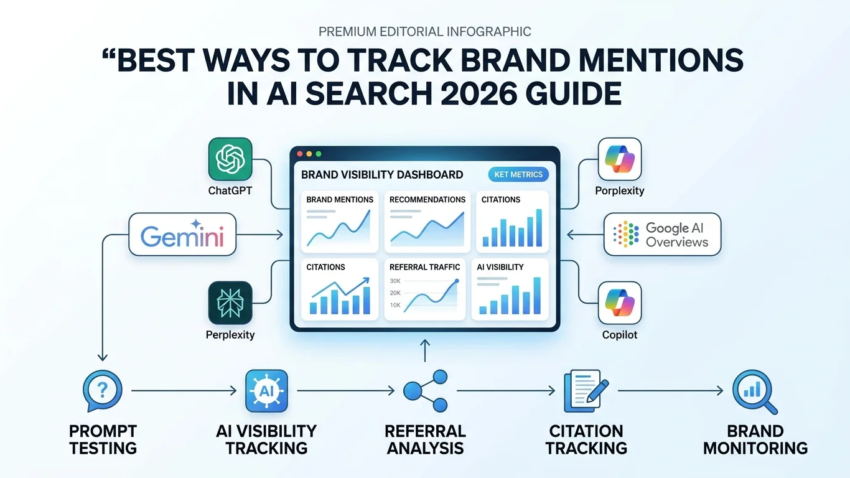
Best Ways to Track Brand Mentions in AI Search (2026 Guide)
Search behavior has changed. A growing share of people no longer type a query into Google and click through ten blue links — they ask ChatGPT, Gemini, Perplexity, or Google’s AI Overviews a question and act on whatever answer comes back. If your brand isn’t part of that answer, you’re invisible to a segment of your audience that never even reaches a traditional search results page.
This guide is for small business owners, marketers, and anyone responsible for brand visibility who wants a practical, non-hyped answer to one question: how do you actually find out whether — and how — AI tools are mentioning your brand? We’ll cover the manual methods anyone can start today, the newer category of dedicated tracking tools, and how to read the data your own website is already collecting.
Quick Answer: How to Track Brand Mentions in AI Search
There is no single “Google Alerts for AI” yet, so tracking brand mentions in AI search means combining a few methods: manually testing relevant prompts across ChatGPT, Gemini, Perplexity, and Copilot on a regular schedule; using a dedicated AI visibility or GEO tracking tool if you need scale and consistency; checking referral traffic and server logs for AI-driven visits and crawler activity; and monitoring which sources AI tools cite when your industry is discussed. Used together, these give a reasonably complete picture even though no method alone is perfect.
What Counts as a “Brand Mention” in AI Search?
Before tracking anything, it helps to be precise about what you’re actually looking for. A brand mention in AI search can mean several different things, and conflating them leads to wasted effort.
A mention can be: your brand named directly in an AI-generated answer; your brand recommended as an option when someone asks for a comparison (“what’s a good tool for X”); your website cited or linked as a source; or your brand described accurately (or inaccurately) when someone asks about it by name. Each of these matters differently depending on your goal — being cited as a source is valuable for authority and referral traffic, while being recommended in a comparison is valuable for demand generation.
AI Mentions vs. Traditional Search Rankings
Traditional SEO tracking relies on a stable, checkable artifact: a ranking position for a keyword on a given date. AI answers don’t work that way. The same prompt asked twice, on the same day, on the same platform, can return a different answer — different phrasing, a different set of recommended brands, or no mention at all. There’s no fixed “position 4” to check.
Why This Is Harder to Track Than Regular SEO
Three factors make this genuinely more difficult than classic rank tracking: AI answers are generated per-session rather than stored on an indexable page, so there’s nothing to crawl the way a search engine crawls a results page; each platform (ChatGPT, Gemini, Perplexity, Copilot) pulls from different underlying data and behaves differently; and answers can vary based on user location, account history, or prompt phrasing, which introduces randomness that a single check can’t account for. In practice, this means tracking AI mentions is closer to periodic sampling than continuous monitoring — you’re taking readings, not watching a live dashboard update in real time the way you might with a rank tracker.
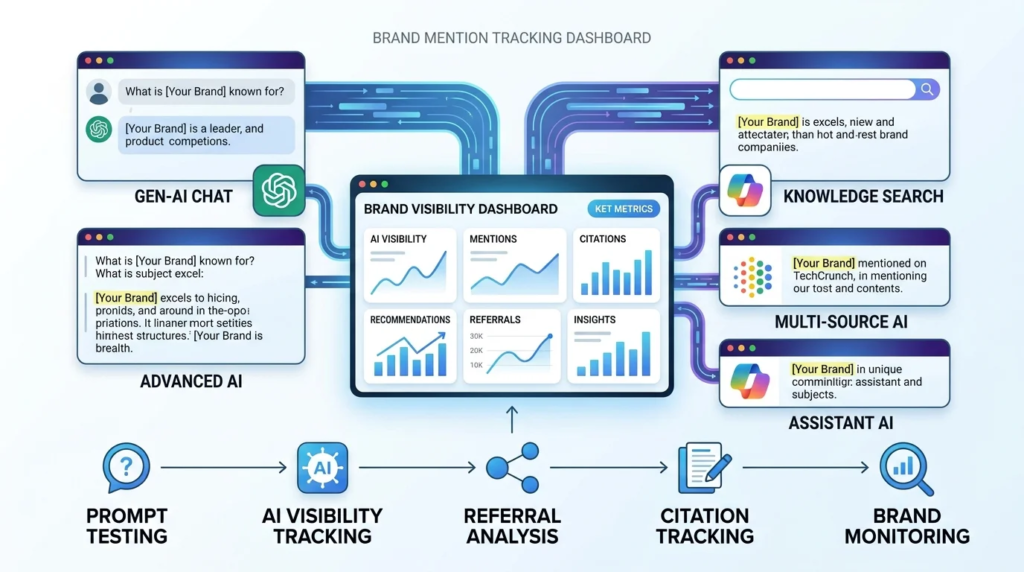
Method 1: Manual Prompt Testing Across AI Platforms
The most accessible method — and the right starting point for most small businesses — is simply asking AI tools the questions your customers would ask, and recording what comes back.
Which AI Tools to Test (ChatGPT, Gemini, Perplexity, Copilot, AI Overviews)
At minimum, a reasonable testing rotation covers ChatGPT (given its scale of everyday use), Google’s Gemini and AI Overviews (since these sit directly inside Google Search results), Perplexity (which leans heavily on live web sources and citations, making it a good signal for whether your content is being pulled in), and Microsoft Copilot (relevant if your audience skews toward Microsoft/enterprise tools). Depending on your audience, industry-specific assistants may also be worth checking.
How to Build a Repeatable Prompt List
The value of manual testing comes from consistency, not cleverness. A practical approach:
- Write down 10–20 prompts a real customer might type, covering three categories: direct brand questions (“what is [brand],” “is [brand] legitimate”), comparison questions (“best [category] tools,” “[brand] vs [competitor]”), and problem-based questions (“how do I solve [problem your product solves]”).
- Run the same list on the same platforms on a fixed schedule (weekly or biweekly is usually enough for a small business; more frequent checks rarely change the picture much).
- Record whether your brand appeared, how it was described, and whether a source link was included.
- Keep the raw answers, not just a yes/no, since tone and accuracy matter as much as presence.
A simple spreadsheet with columns for date, platform, prompt, mentioned (yes/no), and notes is enough to start — you don’t need special software to get useful signal here.
Method 2: Dedicated AI Visibility and GEO Tracking Tools
As manual testing becomes time-consuming — especially across multiple platforms, prompts, and a growing list of competitors — a category of tools has emerged specifically to automate this. These are often described as “AI visibility,” “AI search monitoring,” or “GEO tracking” tools, and they generally work by running large batches of prompts against multiple AI models on a schedule and reporting back whether and how a brand appears.
What These Tools Actually Measure
Most tools in this category report some combination of: mention frequency (how often your brand appears across a set of tracked prompts), share of voice relative to named competitors, sentiment or accuracy of the description, and which sources the AI cited when it mentioned your brand or your category. Some also track how your visibility changes over time, which is useful for spotting the impact of content or PR efforts.
It’s worth treating these numbers as directional rather than absolute. Because AI answers vary between runs, a tool’s “mention rate” is a sampled estimate, not a hard count — useful for spotting trends, less useful as a single precise metric to report to leadership without context.
When a Paid Tool Is Worth It
A dedicated tool tends to make sense once manual testing becomes unmanageable — typically when you’re tracking more than a handful of prompts, monitoring several competitors, or need to report visibility trends to stakeholders on a recurring basis. For a solo operator checking a dozen prompts monthly, manual testing plus a spreadsheet is often sufficient and free. For a marketing team responsible for demonstrating share-of-voice trends over a quarter, an automated tool saves substantial time and produces more consistent sampling than an individual could manage by hand.
Method 3: Referral Traffic and Server Log Analysis
Tracking whether AI tools mention you is one half of the picture. Tracking whether AI tools are actually sending you traffic — or crawling your site to learn about you — is the other, and it uses infrastructure most websites already have.
Spotting AI Referral Traffic in Analytics
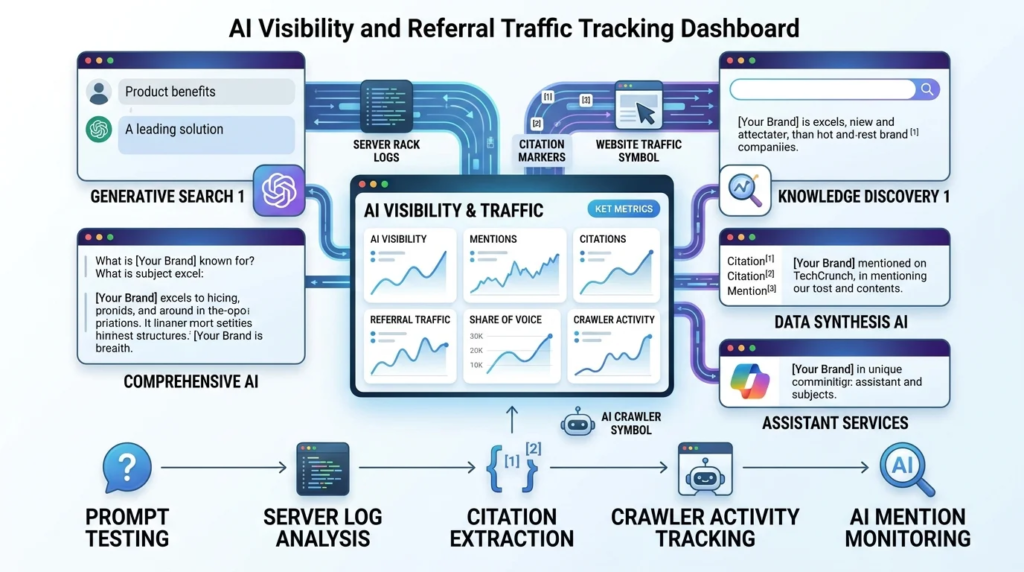
In Google Analytics 4 (or your analytics platform of choice), referral traffic from AI platforms typically shows up under referral or unassigned traffic sources, often labeled by domain (e.g., traffic referred from chatgpt.com or perplexity.ai). Because this is a relatively new traffic category, it’s worth manually reviewing your referral source report periodically rather than assuming your default channel groupings will neatly bucket it. Segmenting referral traffic by source domain and watching for AI-platform domains appearing over time is a practical, low-effort habit.
Log File Analysis for AI Crawler Activity
Separately from referral traffic (real users clicking through), server log files can show you when AI companies’ crawlers are visiting your site to gather information in the first place — a precondition for being mentioned or cited at all. Reviewing raw server logs (or a log analysis tool) for known AI crawler user-agents shows whether your content is even being read by these systems. If crawler visits are minimal or absent, that’s often a more fundamental problem than “we’re not tracking mentions well” — it may mean your content isn’t accessible or attractive to these systems in the first place.
Method 4: Tracking Citations and Source Attribution
Some AI platforms — Perplexity in particular, along with Google’s AI Overviews and AI Mode — frequently show source links alongside generated answers. Tracking which of your pages get cited, and for which queries, is a distinct and valuable signal separate from a plain-text brand mention.
A practical approach is to keep a running log, updated during your regular manual testing sessions, of: which specific URL was cited, what question triggered the citation, and which platform showed it. Over time this reveals which content types earn citations (often clear definitions, original data, or structured comparisons) versus which don’t (thin pages, purely promotional content), giving you a feedback loop for what to create more of.
Method 5: Combining Traditional Brand Monitoring With AI Monitoring
AI search monitoring shouldn’t replace traditional brand monitoring — it should sit alongside it. Standard tools that track mentions across news, blogs, forums, and social platforms remain relevant because AI-generated answers are frequently built from exactly that kind of web content. A spike in traditional media mentions often precedes a spike in AI mentions, since many AI systems are influenced by recent, widely-referenced web content.
In practice, a workable setup for a small business looks like: keeping existing alerts or monitoring tools running for traditional web/social mentions, adding a recurring manual AI-prompt-testing session (Method 1), and layering in a dedicated AI visibility tool (Method 2) only once the manual process becomes a bottleneck.
How Often Should You Check for AI Brand Mentions?
For most small businesses, checking weekly or biweekly is a reasonable default — frequent enough to catch meaningful shifts, infrequent enough to avoid over-reacting to normal answer-to-answer variation. Brands in fast-moving categories (software, finance, health) may benefit from more frequent checks, while more stable categories can check monthly without missing much. What matters more than frequency is consistency: checking the same prompts on the same platforms on a fixed cadence produces far more useful trend data than sporadic, inconsistent checks.
Common Mistakes When Tracking Brand Mentions in AI Search
Treating a single AI answer as definitive. Because answers vary between runs, one absent mention doesn’t necessarily mean a trend — it means one data point. Track across multiple runs before drawing conclusions.
Only testing branded prompts. Asking “what is [my brand]” repeatedly tells you little. The more useful test is unbranded, comparison, and problem-based prompts — the queries a prospective customer who has never heard of you would actually type.
Ignoring the platforms outside ChatGPT. Many teams focus exclusively on ChatGPT because it’s the most familiar, and miss that Google’s AI Overviews sit directly inside the search engine most of their traffic already comes from.
Confusing crawler access with citation. A crawler visiting your site doesn’t guarantee a mention or citation — it’s a prerequisite, not a result. Don’t stop investigating just because log files show crawler activity.
Expecting a single tool to solve this completely. No current tool — manual or paid — captures every platform, every prompt variation, and every regional/personalization difference. Treat any single method as one input among several.
How to Improve Your Brand’s Visibility in AI Search (Not Just Track It)
Tracking only tells you where you stand; most teams eventually want to improve the number, too. A few practical, non-fabricated recommendations based on common industry practice:
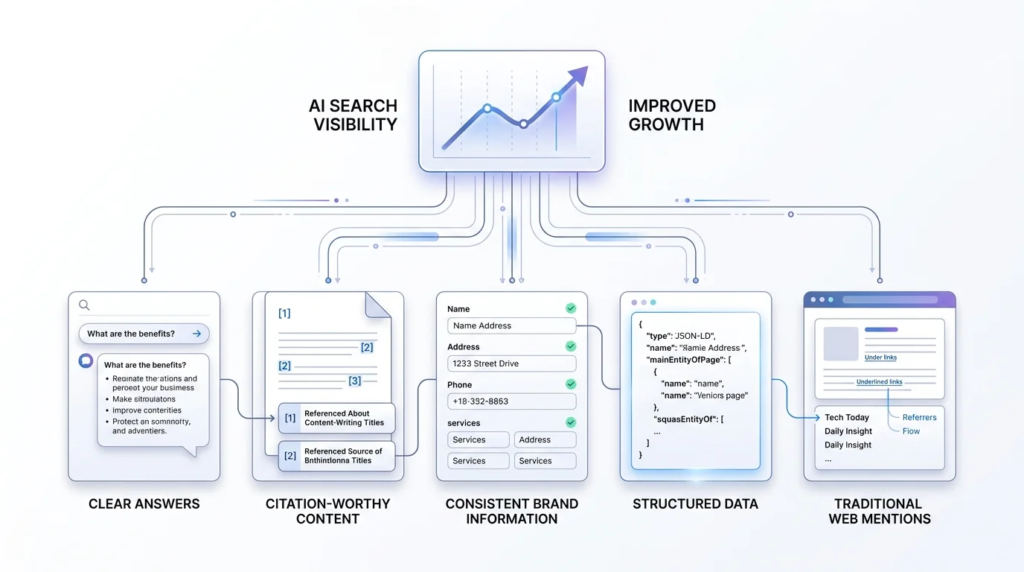
- Publish clear, extractable answers. Content that states a direct definition or answer early, in plain language, tends to be easier for AI systems to lift and summarize than content that buries the point under long introductions.
- Build genuinely citation-worthy pages. Original comparisons, clearly structured data, and specific practical guidance are more likely to be referenced than generic, repetitive content that mirrors what’s already published elsewhere.
- Keep information consistent across the web. AI systems often synthesize from multiple sources; inconsistent facts about your brand across your website, listings, and profiles can dilute or confuse how you’re described.
- Don’t neglect structured data. Accurate schema markup (Organization, Product, FAQ where genuinely applicable) helps machines parse who you are and what you offer, even though it’s not a guaranteed citation mechanism.
- Earn traditional mentions, too. Because many AI systems draw on broadly available web content, coverage in reputable publications and forums remains one of the more reliable indirect levers for AI visibility.
When NOT to prioritize this: if your brand serves a narrow, offline, or highly local audience unlikely to research purchases via AI chat tools, investing heavily in AI visibility tracking and optimization may be less valuable than doubling down on the channels where your actual customers spend time.
FAQs About Tracking Brand Mentions in AI Search
What does it mean to track a brand mention in AI search? It means monitoring whether, and how, your brand is named, described, recommended, or cited when people ask AI tools like ChatGPT, Gemini, or Perplexity questions related to your industry or your brand directly.
Is tracking AI mentions the same as SEO rank tracking? No. Rank tracking checks a fixed position on a stable results page. AI mention tracking checks generated answers that can vary between identical queries, so it functions more like periodic sampling than continuous position monitoring.
Can Google Analytics show me AI-driven traffic? Often, yes, in part. Referral traffic from AI platforms can show up in your referral or channel reports, typically identifiable by the referring domain, though how consistently this is categorized can vary and is worth checking manually.
Do I need a paid tool to track AI brand mentions? Not necessarily. Manual prompt testing across major AI platforms, logged in a simple spreadsheet, is a genuinely workable starting point for many small businesses. Paid tools become more valuable as the number of prompts, platforms, and competitors you track grows.
Which AI platforms should I prioritize monitoring? At minimum, ChatGPT and Google’s AI Overviews/AI Mode, given their scale of everyday use and integration directly into search. Perplexity is worth adding if citation tracking matters to you, and Copilot if your audience is enterprise/Microsoft-oriented.
How often should I check for brand mentions in AI tools? Weekly or biweekly is a reasonable default for most small businesses; faster-moving categories may warrant more frequent checks. Consistency in cadence matters more than raw frequency.
What if my brand never comes up in AI answers? Check whether AI crawlers are even accessing your site first — if not, that’s a more fundamental issue than mention frequency. If crawlers are active but mentions are still absent, focus on publishing clearer, more citation-worthy content and building traditional mentions that AI systems may draw from.
Can I automate manual prompt testing? Partially. Some teams script repeated queries against available APIs, but many consumer AI chat interfaces don’t offer straightforward bulk-testing access, which is part of why dedicated third-party tools exist — they’ve built the infrastructure to do this at scale.
Does AI search track mentions the same way across every model? No. Each platform pulls from different data sources, updates on different schedules, and can behave differently even for near-identical prompts, so results from one platform shouldn’t be assumed to represent all of them.
How is GEO different from AEO? The terms overlap and are often used loosely, but GEO (Generative Engine Optimization) generally refers to optimizing content to perform well in AI-generated answers broadly, while AEO (Answer Engine Optimization) more specifically refers to structuring content to directly answer questions in a way that’s easy to extract — such as for featured snippets and voice search. In practice, most of the same content practices support both.
Final Takeaway
There’s no single dashboard yet that gives you a complete, real-time view of every AI brand mention, and treating any one method as sufficient will leave gaps. The most reliable approach combines manual prompt testing on a fixed schedule, referral and log file analysis using tools you likely already have, and — once the manual process becomes a bottleneck — a dedicated AI visibility tool to add scale and consistency. Start small: build a prompt list this week, check it across two or three major AI platforms, and log what you find. That single habit, repeated consistently, will tell you more than any one tool checked once.

Hamad Arshad
SEO Specialist | SEO Manager | GEO Strategist
7+ Years of Experience in SEO, GEO, AEO, AI SEO, Local SEO, Technical SEO, PPC, Google Ads & Meta Ads.



Leave a Reply