

What Is MLOps
Getting an AI model to work once is the easy part. Keeping it accurate six months later, when the world around it has changed, is where things get tricky. That gap between a clever experiment and a model you can actually rely on every day is exactly where MLOps lives.
If you’ve ever wondered how the smart features in your favourite apps stay smart instead of slowly going stale, this is the behind-the-scenes work that makes it happen. And if you’re still getting comfortable with the basics, it helps to first understand what is a neural network, since those networks are usually the models being looked after here.
In short: MLOps is the set of habits, tools and routines teams use to launch AI models into real products, watch how they behave, fix them when they drift, and improve them over time. Think of it as the care system around a model, from the day it is built to the day it is replaced.

What MLOps actually means
MLOps is short for machine learning operations. The “operations” part is the giveaway. Building a model is a project, with a start and an end. Running a model is an operation, something that continues day after day.
A data scientist might spend weeks training a model that predicts which products a customer will like. In a test environment, it performs beautifully. But a test is not real life. Real customers behave differently from test data, products change, prices change, seasons change. Without a system for putting the model into the live product and caring for it afterwards, that brilliant model just sits in a folder somewhere, slowly becoming less relevant.
MLOps is the bridge between the two worlds. It takes a model out of the lab, puts it to work, and then keeps an eye on it for as long as it is used. It is less about a single tool and more about a way of working, one that borrows heavily from how software teams already run apps and websites.
Why AI models need looking after once they go live
Here’s the thing most people don’t realise. A normal piece of software does the same thing today that it did yesterday. A calculator app doesn’t wake up one morning and start giving wrong answers. AI models are different, because they learn from data, and data reflects a world that refuses to sit still.
A model trained to spot fraudulent payments learns the tricks fraudsters used at the time. Fraudsters adapt. A model that recommends winter coats in one season will look foolish pushing them in a heatwave. A spam filter trained on last year’s junk mail will miss the new styles of junk arriving this year.
This slow slide is often called drift, and it is silent. The model doesn’t crash or flash an error message. It just gets a little worse each week, quietly costing money or annoying users. Looking after a live model means watching for that drift, catching it early, and refreshing the model with newer data before anyone notices a problem.
That is also why MLOps matters more as AI spreads into new areas. The different types of AI showing up in hospitals, banks, shops and farms all share this same need. Once a model influences real decisions, somebody has to be responsible for how it behaves over time.
How MLOps differs from DevOps
You might have heard of DevOps, the practice software teams use to build, release and run ordinary apps. MLOps grew out of DevOps, and they share a lot of DNA. Both are about automating the boring steps, testing changes before they go live, and monitoring systems so problems surface early.
The difference is what is being looked after. DevOps looks after code. MLOps looks after code plus two extra moving parts, the data and the model itself, and both of those change in ways code never does.
A simple way to picture it is gardening versus building a house. DevOps is like maintaining a house. Once it is built, you fix the occasional leak, but the house mostly stays the house. MLOps is gardening. You plant something living, and then you water it, watch the weather, prune it, and replant when the season turns. Stop tending it, and it doesn’t break loudly. It just withers.
| In plain words | DevOps | MLOps |
|---|---|---|
| What it looks after | Software code | Code, data and the AI model |
| Why things change | Developers release new versions | The real world changes the data |
| Typical warning sign | The app crashes or errors | The model quietly gets less accurate |
| Main routine | Build, release, monitor | Build, deploy, monitor, retrain |
| Feels most like | House maintenance | Gardening |
Under the hood, well-run MLOps setups also rest on solid foundations, and it is worth understanding the pillars of AI platform architecture if you want the bigger picture of how these systems are put together. The infrastructure behind large-scale models also matters, as explained in Why Are Data Centers Controversial.

The main stages of MLOps
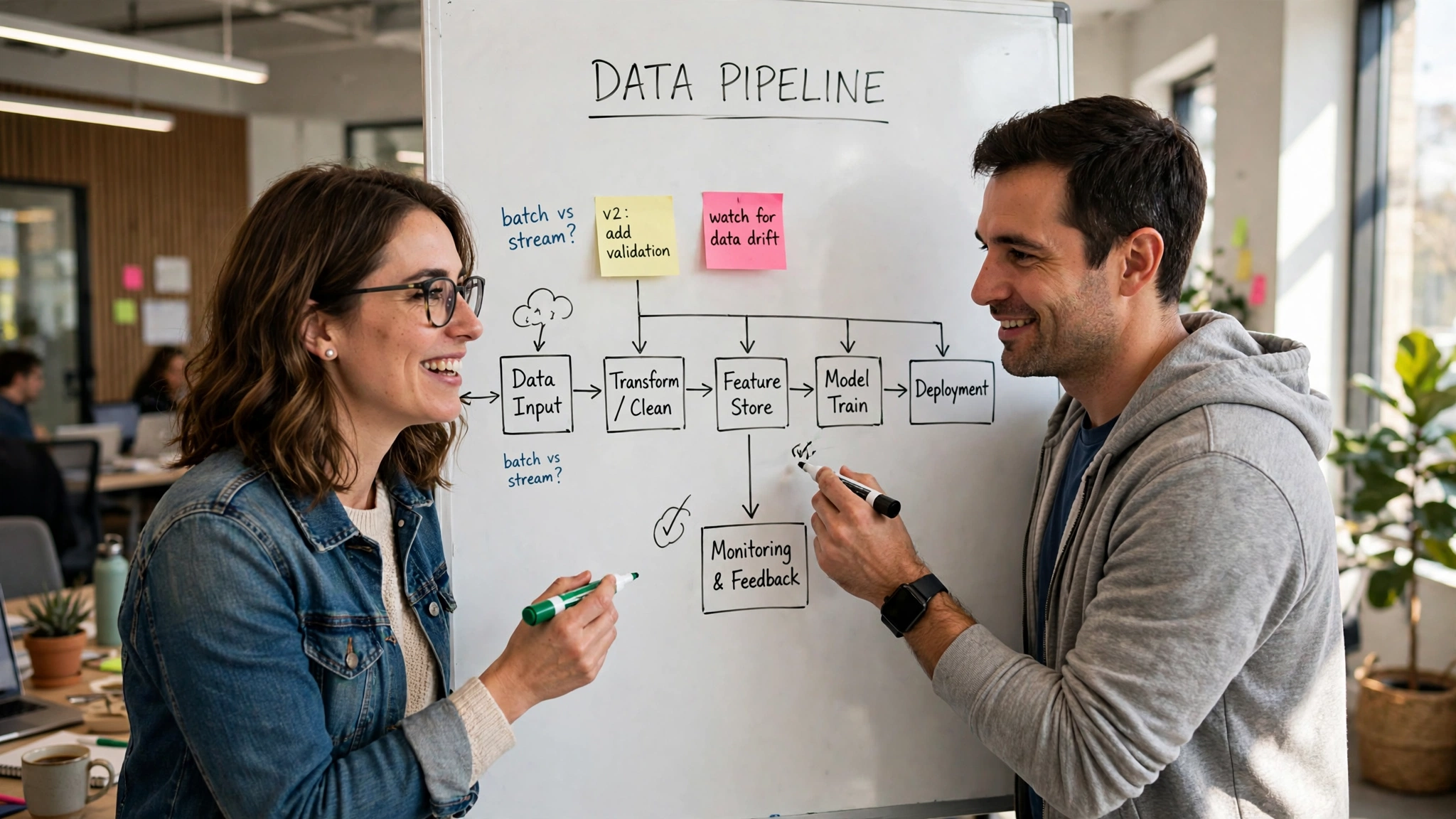
Although every team does it slightly differently, the work tends to move through the same four stages, in a loop rather than a straight line.
Build
This is where the model is created. Data is gathered and cleaned, the model is trained, and its accuracy is tested against examples it has never seen. In a good MLOps setup, all of this is recorded carefully, which version of the data was used, which settings were chosen, and what score the model achieved.
Deploy
Deploying means releasing the model into the real product, where real users meet it. Rather than flipping a switch for everyone at once, careful teams release gradually, perhaps to a small slice of users first. If the new model behaves oddly, it can be rolled back before it affects everybody.
Monitor
Once the model is live, it needs watching. Teams track how accurate its predictions are, how fast it answers, and whether the incoming data still looks like the data it was trained on. Dashboards and alerts do most of this watching automatically, flagging anything unusual for a human to check.
Retrain
When monitoring shows the model slipping, it goes back to school. It is retrained on fresher data, tested again, and released as a new version. Then the loop continues. Some models retrain every few months. Busy ones, like recommendation or fraud models, might retrain every week or even daily.
The problems MLOps prevents
It is tempting to see all this process as red tape, until you see what happens without it. Three problems show up again and again in teams that skip MLOps.
Models going stale. As explained above, the world moves and models don’t. Without scheduled retraining and monitoring, accuracy slides silently until users lose trust in the feature altogether.
Silent errors. A normal software bug usually announces itself. A model problem often doesn’t. The app keeps running, the numbers keep coming, and nobody realises the predictions underneath have gone sideways. Monitoring exists precisely to catch the failures that make no noise. Silent failures can also have a security angle, as shown by Military Commissary Freezer Cyberattack.
Messy versions. Without discipline, a team ends up with a tangle of models. Which version is live? Which data trained it? Why did last month’s version perform better? If nobody can answer those questions, fixing anything becomes guesswork. MLOps keeps a tidy record of every version, so any release can be understood, compared, or undone.
There is a trust angle here too. Organisations that run many models need consistent rules for how they are checked and approved, which is why MLOps often sits alongside a unified AI governance architecture that keeps oversight in one place.
Who uses MLOps
You don’t need to be a giant tech company, though they certainly use it heavily. Any team whose product depends on a model staying accurate is a candidate.
Machine learning engineers and data scientists are the most hands-on users, since they build and retrain the models. Software engineers get involved at the deployment stage, making sure the model fits neatly into the product. Operations and platform teams run the infrastructure underneath. And product managers care about the results, because a well-tended model usually means a feature customers keep loving.
Smaller companies often start informally, a shared checklist, a few automated tests, a weekly look at the numbers. That is fine. MLOps is a spectrum, not a certificate. What matters is that somebody owns the model’s life after launch day.
A simple real-world example
Imagine an online shop that shows each visitor a row of products they might like. A model powers those suggestions, trained on months of browsing and buying history. Multi-agent behaviour can look very different in practice, as shown by How AI Agent Swarms Behave in Minecraft.
At launch, it is excellent. Clicks go up, baskets get bigger. Then the seasons turn. Shoppers start looking at swimwear instead of scarves, a big sale changes buying habits, and a wave of new products arrives that the model has never seen. Slowly, the suggestions get less relevant. Nobody gets an error message. Revenue just quietly dips.
With MLOps in place, the story goes differently. Monitoring spots that the model’s accuracy has slipped compared with its first month. An alert prompts the team, the model is retrained on the newest shopping data, tested against the current version, and released gradually. Suggestions sharpen up again, and the dip never turns into a slump.
That little loop, watch, refresh, release, is MLOps in action. Not glamorous, perhaps, but it is the difference between an AI feature that has one good month and one that stays useful for years. Theory also keeps moving, including AI Disproves Exponential Time Hypothesis.
Frequently asked questions
MLOps is the routine care of AI models after they go live. It covers launching a model into a real product, watching how accurate it stays, and retraining it with fresh data when it starts to slip, all in an organised, repeatable way.
It is neither, exactly. MLOps is a way of working that combines habits, roles and various tools. Some companies hire MLOps engineers, but in smaller teams the work is shared between data scientists, software engineers and operations staff.
Because they learn from data, and data reflects a changing world. Customer habits shift, new products appear, and fraudsters change tactics. A model frozen in the past gradually stops matching the present, a problem known as drift.
DevOps looks after software code, which only changes when developers change it. MLOps looks after code plus data plus the model itself, and those extra parts change on their own as the real world moves. MLOps also adds retraining, a stage DevOps doesn’t have.
It depends on how fast its world changes. A fraud detection model might retrain weekly or daily, while a model in a slow-moving field might only need refreshing a few times a year. Good monitoring tells the team when retraining is actually needed.
If a small business relies on a model for something important, like recommendations, pricing or fraud checks, then yes, at least a light version. It can start simply, with version records, basic monitoring and a retraining schedule, and grow from there.

Hamad Arshad writes and edits AI Next Top from Rahim Yar Khan, Pakistan. He has worked in SEO and digital marketing for over 7 years and started this site to explain AI tools and news in plain language for non-technical readers. Every guide here is checked against the real tool before it is published.







Leave a Reply