

AI in Schools
AI in schools is software that helps teachers teach, students learn, and schools run. One phrase covers three jobs: AI in the classroom, AI in school management, and AI rules and safety. This guide stays at school level, with real districts and real examples, and ends with rules parents and teachers can use. For the wider learning angle, see our AI in education guide.
How AI Is Actually Being Used in Classrooms
The numbers show how fast it moved. Teacher AI use nearly doubled between 2023 and 2025, from 34% to 61% (EdWeek), and 80% of US school districts now have generative-AI initiatives under way or planned (CoSN). More than half of US teens, 54%, use AI chatbots for schoolwork (Pew, February 2026).
The best classroom tools work as tutors, not answer machines. Khanmigo, ChatGPT study mode and Gemini for Education ask students questions and walk them through a problem instead of handing over the answer — a tutor that only gives answers teaches students to copy, while one that asks questions teaches them to think.
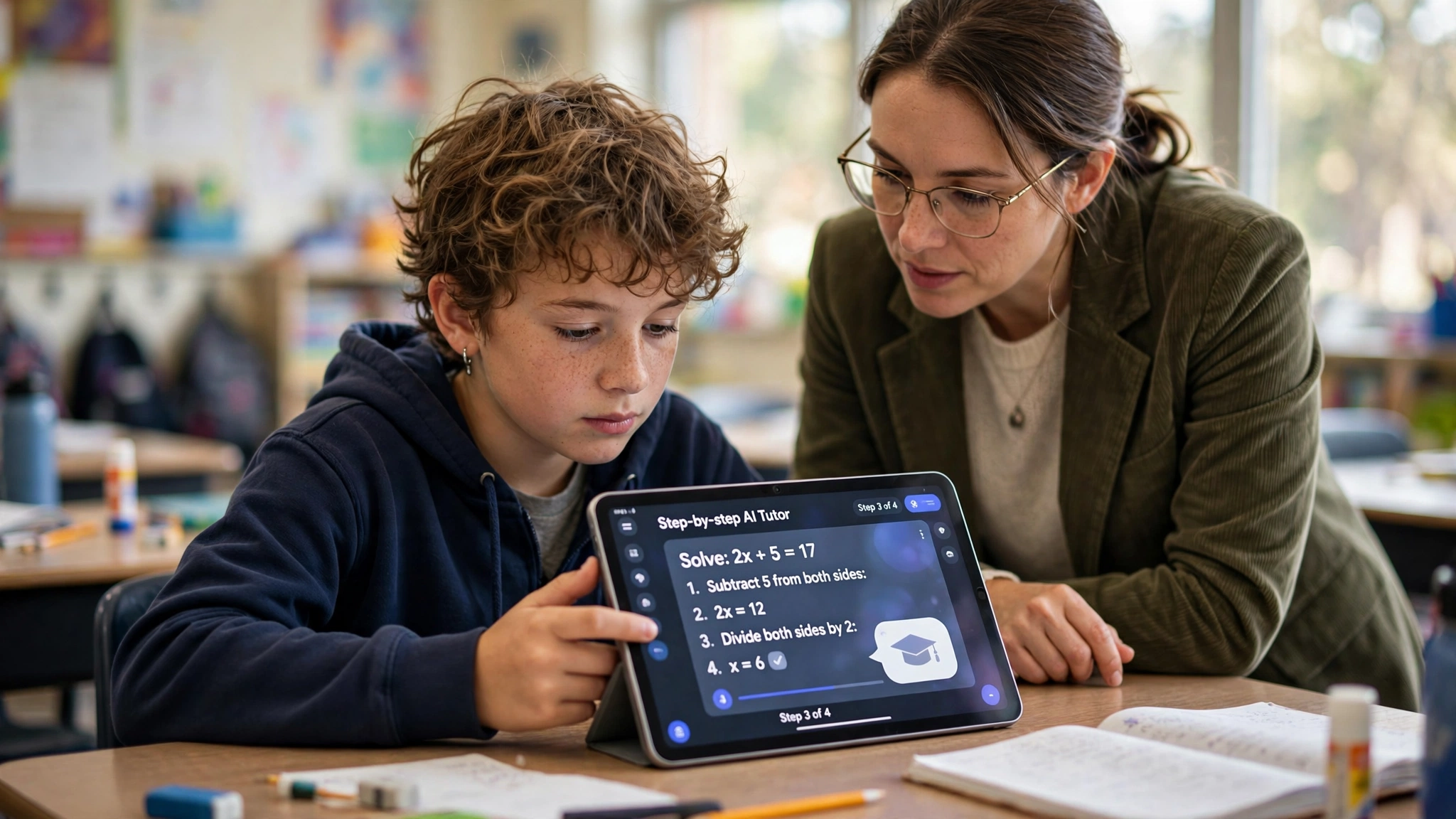
Teachers also use AI for the work around teaching — lesson plans, quiz questions, feedback drafts, grading support. Teachers who use AI weekly estimate it saves them 5.9 hours a week (Gallup and Walton Family Foundation, 2025) — time that goes back to one-to-one help. An AI schedule maker takes the same approach to a teacher’s week, turning tasks and meetings into a plan.
Personalised practice rounds it out: adaptive maths and reading that adjust to each student, translation for multilingual classrooms, and text-to-speech and captions for accessibility. Students planning revision can pair these tools with an AI study planner.
AI in School Management – The Part Parents Never See
Parents rarely see this half of AI in schools, but it is where districts save the most time. AI spots attendance patterns and flags at-risk students before a grade report does. It forecasts enrolment, sends billing reminders, plans bus routes, and drafts front-office emails.

Timetables are the clearest example. An AI timetable generator weighs teacher availability, rooms and subject rules and builds a clash-free timetable in minutes — work that used to take a school days. A school AI chatbot answers routine parent questions — term dates, lunch menus, absence reporting — so office staff handle cases that need a human.
The honest limit: a system is only as good as its data. Dirty attendance records produce wrong flags, so a human still checks every intervention first.
Real Examples From Real Schools
Miami-Dade County Public Schools, the third-largest district in the US, rolled Gemini for Education to around 100,000 high-school students, and its school board approved districtwide AI ethics guidelines in August 2025. Khan Academy’s Khanmigo runs in districtwide pilots, giving every student a tutor that asks questions first.
What does the evidence show? In one Stanford trial, students using an AI tutor alongside a human tutor gained 4 to 9 points more in maths mastery than students with the tutor alone. Early-warning systems flag struggling students before a grade report does.
One caution: most published results come from well-funded districts, and evidence from under-resourced schools is thinner. That gap matters more than any single success story.
AI in Schools – Pros and Cons in One Place
| Use | How it helps | What to watch |
|---|---|---|
| Tutoring | Patient one-to-one practice | Students may copy instead of learning |
| Teacher time | Lesson plans and grading help in minutes | Only helps if it reaches students |
| Personalised learning | Work matched to each student | Unequal access to devices and wifi |
| School management | Faster timetables, early-warning flags | Wrong flags from dirty data |
| Accessibility | Translation, captions, text-to-speech | Tools must protect student data |
Rules That Actually Work – For Teachers and Parents
For teachers: say in writing what is allowed and what is not, before the first assignment. Teach students to question AI answers and check them against the textbook. Pilot one class before rolling a tool out school-wide.
For parents: build one habit — “show me how you got that.” Check what data an app collects before signing a child up, and keep accounts age-appropriate.
For schools: write the AI policy first, check data handling before adopting a tool, and train teachers before students get access.
Software that helps teachers teach, students learn, and schools run — tutoring, lesson planning, timetables, and attendance.
Tutoring, lesson planning, grading help, personalised practice, attendance forecasting, timetables, parent communication.
It depends on the district. Most US districts now allow it with rules — check your school’s written AI policy before using any tool for homework.
Pros: one-to-one tutoring, teacher time saved, accessibility. Cons: cheating, over-reliance, data privacy, and unequal access.
No. AI handles routine tasks and practice, but teaching — motivation, judgement, and care — still needs a human. The best results come from AI plus a teacher.
Attendance tracking, early-warning flags, enrolment forecasts, timetables, bus routes, billing reminders, chatbots for parent questions.

Hamad Arshad writes and edits AI Next Top from Rahim Yar Khan, Pakistan. He has worked in SEO and digital marketing for over 7 years and started this site to explain AI tools and news in plain language for non-technical readers. Every guide here is checked against the real tool before it is published.







Leave a Reply