
The Real Impact of Generative AI on Business Publishing and Promotion (From Someone Who Lived Through the Shift)
Two years ago, publishing a piece of content for a client meant a full day of work. Research, outline, draft, edit, format, publish. One article, one day, sometimes two if the topic was technical impact of generative ai on business information publishing and promotion.
Now I can get a solid first draft done before my morning tea gets cold.
That change didn’t happen gradually for me — it happened almost overnight, somewhere between the first time I seriously used ChatGPT for outlining and the first time a client asked why we weren’t publishing three times a week instead of once. I run a few different content and SEO projects, including my own site ainexttop, and generative AI has genuinely rewired how I plan, write, and promote almost everything I put out now.
But here’s what nobody warned me about when I got excited about the speed: faster isn’t automatically better, and I learned that the hard way on more than one client project.
What Actually Changed (Beyond the Obvious Speed Thing)
Everyone talks about AI writing content faster. That part’s true, but it’s honestly the least interesting change.
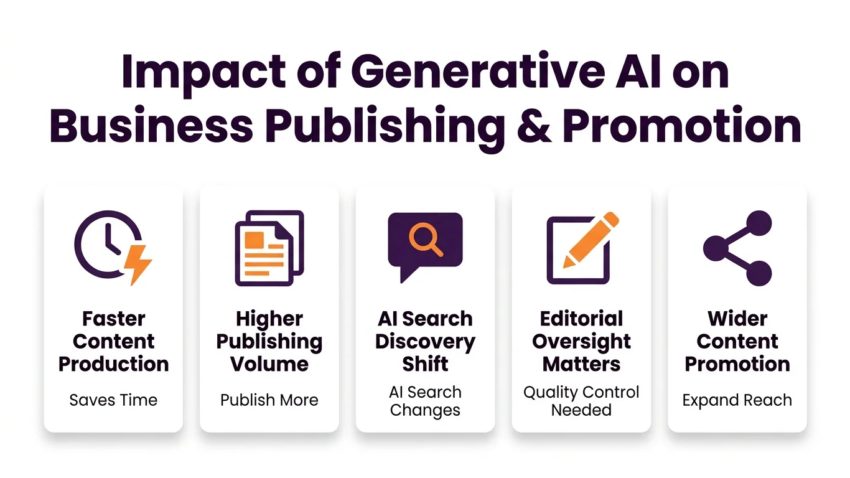
What actually shifted is how businesses get discovered in the first place. A big chunk of buyers now research products and services by asking ChatGPT or Google’s AI Overviews directly, instead of clicking through ten blue links and comparing pages themselves. AI Overviews alone now show up on nearly half of all Google searches, reaching an audience in the billions. That’s not a small shift — that’s a fundamentally different discovery path than the one most businesses built their SEO strategy around.
The second big change is publishing volume. Businesses using AI tools are putting out significantly more content per month than they used to — somewhere in the 40-50% range higher, based on multiple industry reports I’ve seen this year. I’ve felt that pressure directly. Clients who used to be happy with four blog posts a month are now asking why we can’t do twelve.
The third change, and honestly the one that matters most, is that pure volume stopped being a winning strategy on its own. Google’s core update earlier this year specifically hit sites publishing unedited AI content at scale — some lost 40% or more of their organic traffic almost overnight. Volume without editorial judgment turned into a liability instead of an advantage.
The Mistake I Made Early On
I’ll admit this one honestly because I think a lot of people are making the same call right now without realizing it.
Early on, I got comfortable letting AI-generated drafts go out nearly untouched for one client, mostly because the deadlines were brutal and the drafts read decently well on the surface. For about six weeks, everything looked fine — traffic held, nothing crashed.
Then rankings on several of those pages started sliding, quietly, page by page. Nothing dramatic, no penalty notice, just a slow bleed. When I actually went back and compared the AI-only pages against pages I’d heavily edited and added real product specifics to, the difference in performance was obvious. The heavily-edited pages held steady or grew. The lightly-touched ones didn’t.
That lines up with what a lot of the current research actually shows: content produced with AI as a starting point but shaped by an actual human editor performs meaningfully better than fully automated output — some studies put it at around four times better in terms of ranking performance. Pure AI content without real editorial oversight also wins competitive top rankings far less often than content with genuine human input.
Lesson learned. I don’t publish anything now, for any client, without a real pass where I add specific details AI tends to skip — actual product names, real numbers, genuine opinions, things that sound like they came from someone who actually knows the subject impact of generative ai on business information publishing and promotion.

How I Actually Use Generative AI Now, Step by Step
Here’s the workflow I settled into after that mistake, and it’s held up well across different clients and niches.
Step 1: Use AI for structure, not final wording. I let tools like ChatGPT or Claude help me build an outline and identify gaps in my research, rather than asking for a finished article straight away. The structure is usually solid. The wording almost always needs work.
Step 2: Add real specifics before anything else. This is the step I skipped early on and paid for. Real product models, real numbers, real comparisons — anything an AI model would have to guess at, I fill in manually from actual research or firsthand knowledge.
Step 3: Read it out loud before publishing. Sounds simple, but it catches the flat, generic tone AI writing tends to slip into. If a sentence sounds like it could apply to literally any business in any industry, it gets rewritten or cut.
Step 4: Check how the content might get cited, not just ranked. Since AI search engines pull specific chunks of text to build their answers, I now write with that in mind — clear, direct statements early in a section tend to get picked up more than buried, vague ones. A big share of AI citations come from just the opening portion of an article, so I stopped burying the actual answer three paragraphs deep.
Step 5: Promote beyond your own website. This one surprised me. Content that gets picked up or referenced on other sites — forums, review platforms, industry publications — has a noticeably higher chance of being cited by AI engines compared to content that only lives on your own domain. I started putting more effort into getting client content mentioned elsewhere, not just published well on-site.
A Real Example From My Own Work
For a client in a fairly technical niche, I rewrote an existing AI-assisted guide that had been sitting flat in rankings for months. I kept the basic structure the AI had helped build, but added specific real-world comparisons, fixed the generic language, and restructured the opening of each section to answer the core question immediately instead of building up to it.
Three weeks later, that page started showing up as a cited source in an AI-generated answer for one of its target queries — something the original version never managed. Nothing else about the page changed except the editorial work layered on top of the AI draft impact of generative ai on business information publishing and promotion.
Common Mistakes I See Businesses Making
Publishing AI drafts with zero real editorial review. This is the single biggest one, and it’s the one Google’s recent update specifically punished. Speed without oversight isn’t a strategy, it’s a risk.
Assuming more content automatically means more visibility. Publishing frequency helps, but only when quality holds steady. A dozen shallow posts rarely outperform four genuinely useful ones.
Ignoring AI search visibility entirely. A lot of businesses are still only checking Google Search Console and traditional rankings, completely missing whether they show up in ChatGPT or AI Overview answers at all — which is increasingly where research and buying decisions actually start.
Writing for search engines instead of for the actual reader. Ironically, content that reads like it’s written by and for an actual human tends to perform better in AI-generated answers too. The engines are trained to prefer clear, genuinely useful writing, not keyword-stuffed filler.
Where This Is Actually Heading
I don’t think generative AI replaced the writing job — it changed what the job actually is. The typing part got faster. The thinking part, the editorial judgment, the real expertise layered on top, matters more now than it did before, not less.
If you’re running a business and wondering how much to lean into AI for your content and promotion, my honest take after living through this shift is simple: use it to move faster on the parts that were always mechanical anyway, and spend the time you save on the parts that actually require a real person paying attention. That balance is the whole difference between content that quietly disappears and content that actually gets read, cited, and trusted.

Hamad Arshad
SEO Specialist | SEO Manager | GEO Strategist
7+ Years of Experience in SEO, GEO, AEO, AI SEO, Local SEO, Technical SEO, PPC, Google Ads & Meta Ads.






Leave a Reply