
Which Software Is Used to Make Artificial Intelligence A Breakdown by Skill Level
“Which software is used to make artificial intelligence” sounds like it should have one tidy answer, but it doesn’t — a computer science student building a neural network from scratch and a small business owner wanting an AI-powered chatbot are asking, in effect, two different questions with two different answers. This guide breaks the honest answer down by who’s actually asking, from no-code options through the frameworks real AI teams use every day.
Quick Answer: The Short List of Software Used to Build AI
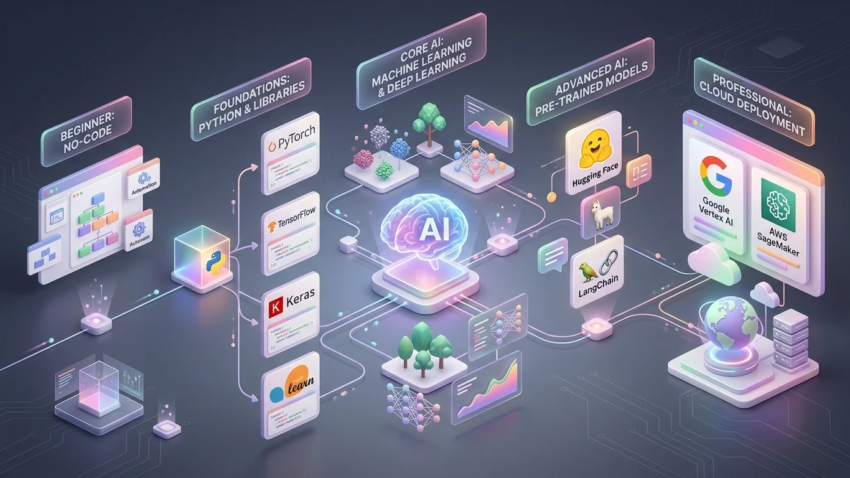
Most professionally built AI systems today are created using PyTorch or TensorFlow, two deep learning frameworks that dominate the field — PyTorch leads in research and is now widely used in production too, while TensorFlow remains especially strong for large-scale enterprise deployment. Around these frameworks sit supporting tools: scikit-learn for simpler statistical models, Hugging Face and LangChain for building on top of existing large language models rather than training from scratch, and cloud platforms like Google Vertex AI or AWS SageMaker for deployment. For people without a programming background, no-code AI builders exist too, though they trade flexibility for accessibility.
Why the Answer Depends on What You’re Actually Building
“Making AI” covers a huge range of actual work. Training a brand-new model from raw data is a fundamentally different task — with different software — than fine-tuning an existing model, or building an app that simply calls an AI model through an API without touching its internals at all. Most people who search this question, especially beginners, are picturing something closer to the third option: building something powered by AI, not training a neural network from mathematical first principles. That distinction matters enormously for which software actually answers the question for you.
The Programming Languages Behind Most AI Software
Nearly all of the major AI development frameworks are built around Python, which has become the dominant language in this field due to its readable syntax and enormous ecosystem of AI-specific libraries. Some performance-critical components are written in C++ underneath, but the layer developers actually interact with day to day is almost always Python. This is worth knowing upfront: if you’re planning to build AI software yourself rather than use a no-code tool, Python is the language nearly every path leads back to.
Which Software Is Used to Make Artificial Intelligence, by Skill Level
No-Code and Low-Code AI Builders
For people without programming experience, platforms exist that let you build simple AI-powered tools — chatbots, basic classification models, automation workflows — through a visual interface rather than code. These trade significant flexibility and control for accessibility, and they’re a reasonable starting point for understanding AI concepts or building something simple, but they won’t get you to a custom, research-grade model.
Core Frameworks Developers Actually Use
PyTorch, originally built by Meta’s AI research lab, has become the default choice for both research and an increasing share of production work, thanks to its intuitive, Python-first design and strong alignment with the broader open-source AI ecosystem, including Hugging Face. TensorFlow, built by Google, remains especially strong in large-scale enterprise deployment and mobile/edge use cases through TensorFlow Lite. Keras sits as a simplified, high-level interface that works with TensorFlow, making it a common starting point for beginners writing their first neural network. scikit-learn handles more traditional, non-deep-learning machine learning — regression, classification, clustering — and remains widely used for structured, tabular data problems that don’t need a full neural network. JAX, from Google, is a newer entrant favored specifically in research and scientific computing for its performance on parallel computation.
Tools for Working With Existing AI Models
A large and growing share of “making AI” today doesn’t involve training a model from scratch at all — it means building on top of an existing foundation model. Hugging Face provides a massive library of pre-trained models and the tools to fine-tune or deploy them without starting from zero. LangChain helps developers build applications that chain together calls to large language models, external data, and tools — useful for building AI-powered apps rather than AI models themselves. For many practical projects, this layer is genuinely the more relevant answer to “what software makes AI” than the deep learning frameworks underneath it.

Infrastructure and Deployment Software
Once a model is built, getting it running reliably for real users involves a different set of tools — cloud platforms like Google Vertex AI, AWS SageMaker, and Microsoft Azure AI provide managed infrastructure for training, hosting, and scaling models, along with tools like Docker for packaging software consistently across environments. This layer is often invisible to end users but is where a lot of real-world AI engineering time actually goes.
A Simple Example of How These Tools Fit Together
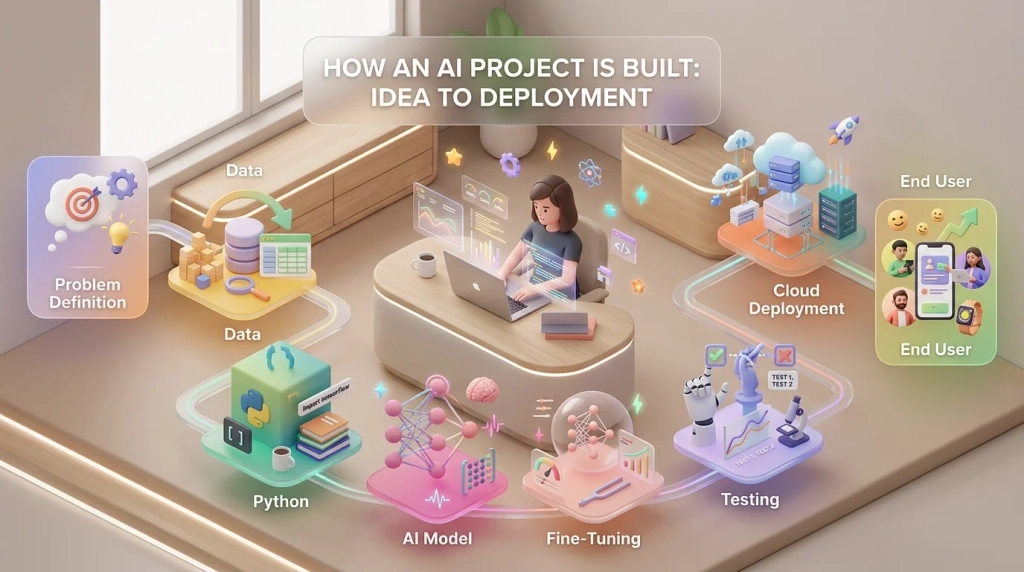
Picture a small team building an AI feature that summarizes customer support tickets. They might use Hugging Face to start from an existing language model rather than training one from scratch, PyTorch underneath that model for any fine-tuning needed, Python to write the surrounding application logic, and a cloud platform like AWS SageMaker to host and serve the final result to users. Almost none of this involves inventing a new AI architecture — it’s assembling existing, well-tested software in a specific combination for a specific task, which is a far more accurate picture of most real AI development than “writing a neural network from scratch.”
Common Mistakes People Make Choosing AI Software
Assuming you need to train a model from scratch. Most practical AI projects today build on existing pre-trained models rather than starting from zero — checking whether a foundation model already does most of what you need saves significant time.
Picking a framework before knowing what you’re building. PyTorch and TensorFlow solve different problems well; choosing based on what’s popular rather than what fits your actual project leads to more friction later.
Overlooking no-code options when they’d genuinely be enough. Not every project needs custom model training — a no-code tool can be the right, proportionate choice for a simple task.
Underestimating the deployment and infrastructure work. Training or fine-tuning a model is often a smaller part of the overall effort than reliably serving it to real users.
Where Software Alone Isn’t Enough
No framework, however capable, replaces the need for good data, a clearly defined problem, and realistic expectations about what a model can actually do. A well-chosen framework makes building easier; it doesn’t make a poorly defined problem well-defined, or bad data good. This is the part most software-focused articles skip — the tools matter, but they’re the smaller half of what makes an AI project actually succeed.
Expert Tips for Getting Started
- Start with Python basics before picking a framework, since nearly every serious path in AI development runs through it.
- Check whether an existing model already solves your problem before assuming you need to build or train something new.
- Use Google Colab or Jupyter Notebook for early experimentation rather than setting up a full local environment right away — it removes a lot of early setup friction.
- Don’t over-invest in framework choice as a beginner — the underlying concepts transfer between PyTorch and TensorFlow more than framework debates suggest.
Frequently Asked Questions
What software is actually used to build AI? Most professional AI development uses deep learning frameworks like PyTorch and TensorFlow, supported by tools like scikit-learn for simpler models, Hugging Face for working with pre-trained models, and cloud platforms for deployment.
Do you need to know how to code to make AI? For custom model development, yes — nearly all major frameworks are Python-based; for simpler projects, no-code AI builders exist that don’t require programming.
What’s the difference between PyTorch and TensorFlow? PyTorch is generally considered more intuitive for research and prototyping with its dynamic, Python-first design, while TensorFlow has traditionally been stronger for large-scale production deployment, though both are now used across research and production.
Can I build an AI model without any programming experience? For simple use cases, yes, through no-code AI builders — but building a custom, research-grade model still generally requires programming knowledge, typically in Python.
What programming language is most used for AI? Python, by a wide margin, due to its readable syntax and the fact that nearly every major AI framework and library is built around it.
Is ChatGPT built with the same software people use to make their own AI? The underlying training process for large language models like the ones behind ChatGPT uses similar categories of software (deep learning frameworks like PyTorch), but at a scale and with infrastructure well beyond what an individual project would typically use.
What software do beginners actually start with? Python plus a notebook environment like Google Colab or Jupyter Notebook, often paired with Keras for a gentler introduction to building a first neural network.
Do you need special hardware to build AI software? For small projects and learning, a standard computer with cloud-based tools like Google Colab (which provides free GPU access) is enough; larger models require GPU or TPU hardware, typically accessed through cloud platforms rather than owned locally.
Final Takeaway
There isn’t one single piece of software that “makes AI” — the honest answer depends on whether you’re training a model from scratch, building on an existing one, or assembling an AI-powered application without touching model internals at all. For most people today, especially beginners, the realistic starting point is Python, a notebook environment like Google Colab, and an existing pre-trained model through something like Hugging Face — not building a neural network from mathematical first principles. Start with the smallest version of what you’re actually trying to build, and let the specific problem guide which tools you actually need.

Hamad Arshad
SEO Specialist | SEO Manager | GEO Strategist
7+ Years of Experience in SEO, GEO, AEO, AI SEO, Local SEO, Technical SEO, PPC, Google Ads & Meta Ads.






Leave a Reply