

AI Tools For GBP Optimization 2026
My client owns a small HVAC repair business, and three months ago her Google Business Profile was basically a ghost town. No posts since 2023. Reviews sitting unanswered for weeks. A phone number that was actually one digit wrong because nobody had touched the listing in years.
She was paying for Google Ads and wondering why calls weren’t coming in. I pulled up her GBP and just stared at it for a minute. This was the actual problem, not her ad budget.
That’s when I went down the rabbit hole of AI tools built specifically for managing Google Business Profiles. Not general marketing AI, but stuff designed around posts, reviews, and rankings on Google Maps. Here’s everything I actually tried, what worked, and what I’d skip if I were starting over.
Why this even matters more in 2026
Google Business Profile isn’t just a listing anymore. It’s become the thing that feeds both the regular map pack results and the AI Overviews that show up when someone searches “hvac repair near me.” To understand how these answers are surfaced, read what are ai search optimization tools.
If your profile has thin descriptions, stale photos, and unanswered reviews, you’re basically invisible to both the old-school map pack and the newer AI-generated answers. A profile that gets weekly posts, quick review replies, and complete business attributes just has a much better shot at being the one Google actually surfaces.
The annoying part is that keeping all that fresh, every single week, for every client, is exactly the kind of repetitive task nobody has time for. That’s the gap these AI tools are trying to fill.
The first tool I tried, and what went wrong
I started with a free audit tool that scans your profile and spits out a “completeness score.” Felt good, gave me a nice checklist. I fixed everything it flagged, gave myself a pat on the back, and moved on.
Two weeks later, still nothing changed in her rankings. Turns out the audit only checked surface-level stuff like whether a phone number and category were filled in. It didn’t touch the actual content quality of her posts or how she was responding to reviews, which is apparently where a lot of the real ranking signal comes from.
Lesson learned: an audit tool tells you what’s missing, not what’s actually working against you. You still need something that helps you fix the content itself, not just flag the gaps.
What actually worked for us
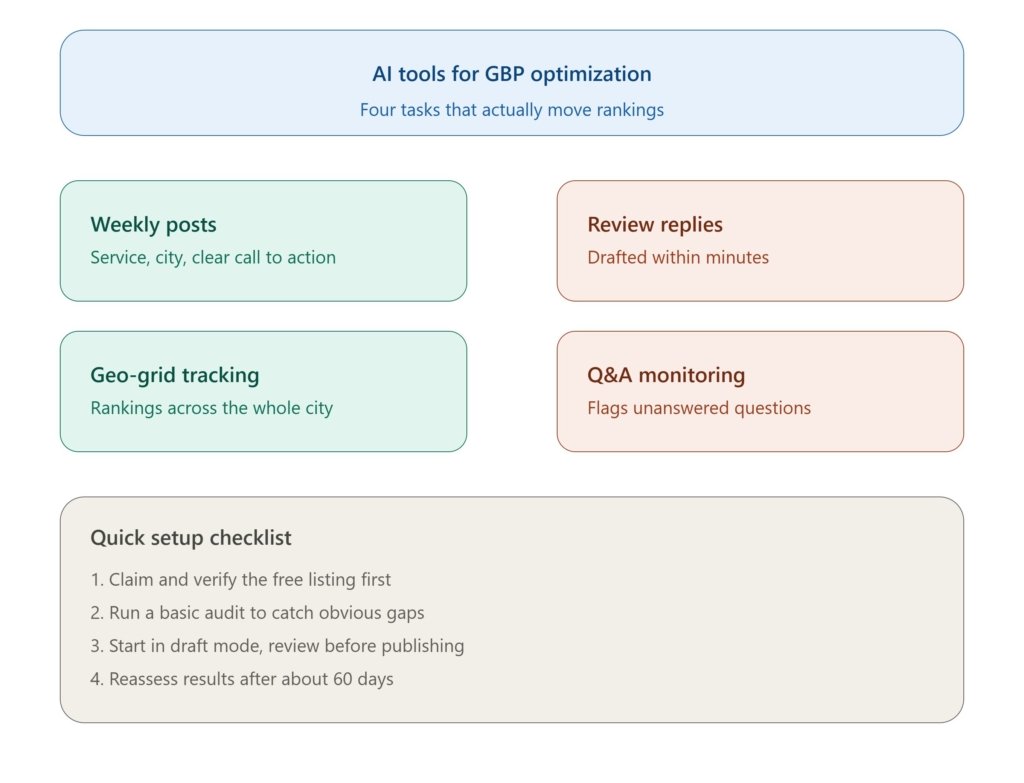
Weekly AI-generated posts with real specifics. I started using a GBP-focused platform that generates posts including the service type, the city name, and a clear call-to-action button like “Book Now.” Generic posts that just said “we’re open, call us today” barely got clicks. Once the posts mentioned specific services like “emergency AC repair in [her city],” views went up noticeably within about three weeks.
Faster review replies. Reviews used to sit for four or five days before she got around to replying. I switched to a tool that drafts a reply within minutes of a new review coming in, tailored to what the customer actually said instead of a generic “thanks for your feedback.” I still read every draft before it goes live, because a couple of the auto-drafts sounded a little too formal for her brand, but editing a draft takes two minutes instead of writing one from scratch.
Geo-grid rank tracking. This one surprised me. Instead of just checking “are we ranking for HVAC repair,” a geo-grid tool shows you a little map with dozens of points around the city, and how you rank at each one. Turns out she ranked great near her shop but practically didn’t exist eight miles north. That told us exactly where to focus new content and even where a second service area page might help. For precise measurement, see Best AI Search Optimization Software for Precise Data (2026).
Q&A monitoring. Her profile had three unanswered questions sitting there for months, including one asking if they do weekend appointments. Left unanswered, a Q&A section like that just looks abandoned. An AI tool flagged the gaps and drafted answers I could approve in seconds.
Step by step: how I set this up for a small business
- Claim and verify the profile first. This part is still free and done directly through Google, not through any third-party tool. Skip this step and nothing else matters.
- Run a basic audit using a free or low-cost tool to catch the obvious gaps — missing hours, wrong category, no service list, no attributes filled in.
- Fix the structural stuff manually. Category, service areas, business description, and attributes should be accurate before you automate anything on top.
- Pick one platform for ongoing content, rather than five different tools doing overlapping jobs. I settled on one that handles posts, review replies, and a dashboard together, since juggling separate logins for each task got old fast.
- Set it to draft mode, not full autopilot, at least at first. Every AI-generated post or review reply gets a quick human check before it goes live. This caught a few odd phrasings early on that I definitely didn’t want published under a real business name.
- Check the geo-grid or rank tracking monthly, not daily. Rankings shift slowly, and checking too often just creates anxiety without giving you anything new to act on.
- Reassess after 60 days. If a tool isn’t clearly saving time or improving numbers by then, it’s probably not worth the subscription.
Real example: the coffee shop across the street
A friend runs a small coffee shop and had basically the opposite problem — decent rankings already, but zero consistency with photos. Her profile still showed interior shots from before a renovation two years ago.
We used an AI photo and content suggestion feature to prompt her to upload fresh photos monthly, tagged with keywords like “cozy seating area” and “outdoor patio.” Nothing fancy, but within six weeks her profile views were up and she started getting comments in reviews specifically mentioning the new patio, which is a pretty good sign people are actually looking at the updated photos before walking in.
Common mistakes to avoid
- Turning everything to full autopilot immediately. AI-drafted content is a great starting point, not a finished product. I’ve seen auto-generated review replies that technically made sense but didn’t match how the business owner actually talks to customers.
- Ignoring the free, manual basics. No AI tool fixes a wrong phone number or an unclaimed listing. That part is on you, and it’s free.
- Running five tools that all do the same thing. I wasted a chunk of the first month juggling overlapping subscriptions before consolidating into one platform that covered posts, reviews, and monitoring together.
- Chasing the completeness score instead of actual engagement. A 100% complete profile with boring, generic posts still won’t outperform an 80% complete profile with genuinely useful, specific content.
- Forgetting your service area pages need attention too, if you serve multiple neighborhoods or towns. Geo-grid tracking showed us this gap directly, and it’s easy to miss otherwise.
A few names worth knowing if you’re shopping around
Just so you’re not starting from zero: BrightLocal is solid for quick audits and citation checks. Local Falcon is specifically built for that geo-grid rank tracking I mentioned. Birdeye leans more into reviews and multi-location management if you’re handling several branches. Platforms like Localo and Merchynt focus more on AI-generated posts and content at scale for agencies managing lots of clients. None of these are sponsors, just what actually showed up useful during my own testing. For students exploring similar tools, see Best AI Tools for Students 2026-27.
None of this replaces actually running a good business. A GBP tool won’t fix bad customer service or a genuinely broken product. What it does is stop your profile from quietly working against you while you’re busy doing everything else. To stay ahead as these tools evolve, build the Skills That Will Keep You Safe From AI in 2026.
If you’re managing this for your own small business, or for a handful of clients like I am, start with one tool, one task at a time. Fix the reviews first, or the posts first, whichever feels most neglected right now. You’ll know within a month or two whether it’s actually worth keeping around. For a broader roundup, see Best AI Tools. Freelancers weighing this shift should read Is AI a Threat or Opportunity for Freelancers?
GBP is no longer just a listing — it feeds both the regular map pack results and the AI Overviews that show up when someone searches, for example, ‘hvac repair near me.’ A profile with thin descriptions, stale photos and unanswered reviews is basically invisible to both, while a profile with weekly posts, quick review replies and complete business attributes has a much better shot at being the one Google surfaces.
The audit only checked surface-level things like whether a phone number and category were filled in, and it did not touch the actual content quality of posts or how reviews were answered, which is where a lot of the real ranking signal comes from. An audit tool tells you what is missing, not what is actually working against you — you still need something that helps you fix the content itself, not just flag the gaps.
Weekly AI-generated posts with real specifics, such as the service type, the city name and a clear call-to-action like ‘Book Now’ — once posts mentioned specific services like ’emergency AC repair in [her city],’ views went up noticeably within about three weeks. Faster review replies drafted within minutes, tailored to what the customer actually said, geo-grid rank tracking, and Q&A monitoring also helped.
Claim and verify the profile first through Google, then run a basic audit to catch obvious gaps, fix the structural details manually — category, service areas, business description and attributes — and pick one platform for ongoing content rather than five overlapping tools. Set it to draft mode, not full autopilot, at first, check geo-grid or rank tracking monthly, not daily, and reassess after 60 days.
The coffee shop had decent rankings but zero consistency with photos, still showing interior shots from before a renovation two years ago. An AI photo and content suggestion feature prompted fresh monthly photos tagged with keywords like ‘cozy seating area’ and ‘outdoor patio,’ and within six weeks profile views were up and reviewers started mentioning the new patio.
Turning everything to full autopilot immediately, since AI-drafted content is a starting point, not a finished product; ignoring the free, manual basics, since no AI tool fixes a wrong phone number or an unclaimed listing; running five tools that all do the same thing; chasing the completeness score instead of actual engagement; and forgetting that service area pages need attention too if you serve multiple neighborhoods or towns.

Hamad Arshad writes and edits AI Next Top from Rahim Yar Khan, Pakistan. He has worked in SEO and digital marketing for over 7 years and started this site to explain AI tools and news in plain language for non-technical readers. Every guide here is checked against the real tool before it is published.








Leave a Reply