
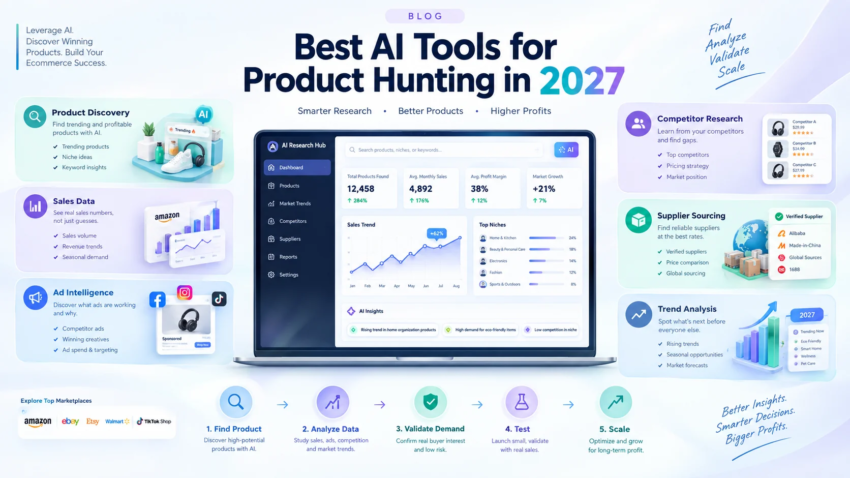
Best AI Tools for Product Hunting in 2027 The Top 10 Compared by Use Case
Finding a product worth selling used to mean hours of scrolling AliExpress, Amazon, and TikTok, trying to spot a pattern before your competitors did. That manual grind hasn’t disappeared, but it’s shrunk dramatically thanks to a wave of AI-powered research platforms that track live sales data, ad activity, and social engagement across multiple marketplaces at once — then surface the products actually gaining traction, before they’re saturated.10 best ai tool for product hunting 2027
This guide is for anyone building or scaling an ecommerce business — dropshippers, Amazon sellers, and small store owners — who wants to know which of these tools are actually worth paying for, grouped by the specific problem each one solves, rather than a single “best overall” pick that ignores how differently these platforms are built.
Quick Answer: Which Tool Should You Actually Use?
There isn’t one universal winner, because these tools are built around different sourcing ecosystems. For an all-in-one platform that combines research with automation, Sell The Trend and AutoDS are consistently ranked among the top choices, with AutoDS notable for combining AI-powered research across AliExpress, Amazon, Walmart, and CJ with automated fulfillment. For spotting viral products through ad data specifically, PipiAds analyzes tens of millions of TikTok ads to surface trending products and creatives. If you’re sourcing from US or EU suppliers instead of AliExpress, Spocket’s AI product search uses behavioral and category trend data to surface items gaining traction with US and EU buyers. The right choice depends far more on your sourcing platform than on which tool has the most AI buzzwords in its marketing.
Why Product Hunting Now Runs on AI, Not Guesswork
A few years ago, “product research” mostly meant manually browsing bestseller pages and guessing based on gut instinct. What changed is that these platforms now pull live data — order volume, engagement scores, ad spend patterns — and process it fast enough to flag a product while it’s still climbing, not after it’s already been copied by a hundred other stores. Minea, for example, refreshes AI-powered trend insights on products roughly every 8 hours, which is a meaningfully faster signal than checking a bestseller list once a week. That speed is the actual value proposition — not that AI has some mystical ability to “know” what will sell, but that it processes more live signal, faster, than a person scrolling manually ever could.

How to Judge an AI Research Tool Before You Subscribe
Before paying for any of these platforms, it’s worth checking four things, since marketing pages rarely spell this out clearly:
- Which sourcing platform is it actually built around? A tool optimized for AliExpress data won’t help much if you’re sourcing from US suppliers, and vice versa.
- Is the pricing subscription-based or credit-based? Credit systems can get expensive fast if you’re doing heavy daily research; flat subscriptions are more predictable for regular use.
- Does it show raw data or just curated picks? Curated “winning product of the day” lists are easier for beginners but mean you’re seeing what everyone else using that tool sees too — raw filterable data takes more skill but gives you more of an edge.
- Is there a genuinely usable free tier or trial, or is the “free” version too limited to actually evaluate the tool?
Best AI Tools for Product Hunting, Grouped by Use Case
Ranking these ten as a single numbered list would flatten real differences between them, so they’re grouped by what they’re actually best suited for.
Best All-in-One Research and Automation
1. Sell The Trend — Offers product research, video ad creation, and store import in one platform, working well for both beginners and advanced sellers without needing extra plugins. Its NEXUS Product Explorer uses AI-powered search with built-in profit margin calculations, and it includes a supplier database connecting to AliExpress, CJdropshipping, and Global Sources.
2. AutoDS — Combines AI-powered product research across AliExpress, Amazon, Walmart, and CJ with automated order fulfillment, price monitoring, and inventory sync, making it a strong pick if you want research and operations handled by one subscription rather than stitching tools together.
3. Dropship.io — Frequently named alongside Sell The Trend and AutoDS as one of the top three overall picks in the category, combining product discovery with store-performance tracking so you can see what’s actually selling in live stores rather than relying on projected trend scores alone.
Best for Ad and Competitor Spying
4. PipiAds — Analyzes tens of millions of TikTok ads daily to surface the most viral products and creatives, from a library of over 20 million TikTok ads. This is the strongest option specifically when your strategy depends on catching a product while its ad creative is still working, not after it’s already been recycled by dozens of stores.
5. Minea — Combines a Success Radar that refreshes AI-powered product insights every 8 hours with an Influencer Spy Tool for monitoring competitor influencer marketing. It also covers TikTok product analysis with engagement and virality scoring, alongside Facebook ad targeting insight, making it one of the more complete ad-intelligence platforms rather than a single-network tool.
6. AliShark — Provides detailed product performance data including sales history and wishlist activity over the past 2 to 6 months, helping predict trends and plan strategically. It offers live results with hourly updates on product order numbers, and its advanced filters are particularly useful for surfacing products before they’ve hit mainstream bestseller lists.
Best for AliExpress-Sourced Products
7. Ecomhunt — Provides several distinct tools under one platform: Classic for handpicked product research, Live for real-time trending products, Lucky for under-the-radar finds, Tracker for monitoring performance over time, and an AI assistant (Adam) for AliExpress product research. Its curated database includes more than 2,000 winning AliExpress products with daily updates, making it one of the more beginner-friendly options for AliExpress-based dropshipping specifically.
8. Dropshipping Copilot — An AI product finder that scans AliExpress directly and is positioned as an official AliExpress partner integrating with Shopify, combining product discovery with listing optimization and supplier evaluation in one workflow.
Best for US/EU Supplier Sourcing
9. Spocket — Its Spy Tool lets you browse millions of items from verified suppliers to spot trending and best-selling products before competitors do, with advanced filters for price range, shipping origin, processing time, and supplier rating. This matters if AliExpress-based sourcing isn’t your model — most tools in this space assume it is, and Spocket is one of the clearer exceptions.
10. ZIK Analytics — Takes a data-driven approach by pulling real sales data from eBay, Shopify, and AliExpress, without limiting users to a credit system or charging surprise fees the way many competing platforms do. It’s a particularly strong option if you’re selling on eBay specifically, a marketplace most product-research tools in this category largely ignore.
How to Validate What the AI Surfaces
An AI tool flagging a product as trending is the start of the process, not the end of it. A practical validation routine worth running before committing ad budget:
- Check how long it’s been trending, not just that it’s trending now. A product that spiked yesterday carries more risk than one showing steady growth over several weeks.
- Search the product directly on the ad platform you plan to use. If dozens of active ads already exist for the identical product and angle, you’re entering a saturated market, regardless of what the research tool’s trend score says.
- Confirm real shipping times and landed cost, not just the supplier price — margin calculations in these tools are estimates, and shipping delays or customs costs can erase a margin that looked solid on paper.
- Read actual product reviews on the sourcing platform, since a product can show strong order volume and still have a quality or return-rate problem that will show up in your own store later.
- Test with a small budget before scaling, treating the AI’s suggestion as a hypothesis to test, not a guaranteed winner.
Common Mistakes When Using AI for Product Hunting
Trusting a trend score without checking saturation. A high trend score tells you demand exists; it doesn’t tell you how many other stores are already selling the identical product with the identical ad angle.
Subscribing to a tool built for the wrong sourcing platform. Paying for an AliExpress-focused tool while sourcing from US suppliers (or the reverse) wastes the subscription entirely — check this before signing up, not after.
Treating curated “winning product” lists as private information. Every subscriber to a given tool sees the same curated list, so a product’s window before it’s saturated is often shorter than it appears.
Skipping manual review of the actual supplier or listing. Order volume and engagement scores don’t capture supplier reliability, actual shipping speed, or product quality — all of which affect whether a “winning” product actually performs once you’re selling it.
Running multiple overlapping tools that solve the same problem. A common beginner mistake is subscribing to two or three research tools with nearly identical feature sets, when the money would go further spent on testing ad budget for a product that’s already been validated.
Where These Tools Still Fall Short
AI product-hunting tools are genuinely good at surfacing signal from noise — showing you what’s moving before you’d notice it manually. What they can’t do is guarantee a product will work for your specific store, audience, or price point, and none of them account for factors like your shipping country, your existing customer base, or your brand positioning. They also tend to reflect what’s already visible in the data they’re built on, which means a genuinely novel or early-stage trend can be missed entirely if it hasn’t yet generated enough sales, ad spend, or engagement data for the algorithm to pick up on. Treating any of these tools as a replacement for basic market judgment — rather than an accelerant for it — is the most common way people end up disappointed with the results.

Expert Tips for Building a Research Stack, Not a Single Tool
- Pair a discovery tool with an ad-spy tool, since seeing that a product sells and seeing how it’s being marketed are two different, complementary signals.
- Start with whichever tool matches your sourcing platform first, and only add a second tool once you’ve actually used the first one enough to know what it’s missing.
- Watch for credit-based pricing traps if you plan to do daily, heavy research — a flat monthly subscription is usually more predictable for consistent use.
- Cross-check a product across at least two data sources before committing real ad budget, since no single tool has a complete picture of the market.
- Revisit your tool stack every few months, since this category moves fast and a tool that was the best option a year ago may have been overtaken by a newer platform with better data coverage.
Frequently Asked Questions
What are the best AI tools for product hunting right now? The strongest current options split by sourcing platform: Sell The Trend and AutoDS for all-in-one research plus automation, PipiAds and Minea for ad and competitor spying, Ecomhunt and Dropshipping Copilot for AliExpress-based sourcing, and Spocket for US/EU supplier sourcing.
Is there a free AI tool for finding winning products? Most platforms in this space offer a limited free trial or credit allowance rather than an indefinitely free full-featured tier — check current terms directly, since free-tier limits change often and vary significantly between platforms.
Do AI product research tools work for Amazon, not just dropshipping? Some do; platforms like Helium 10 are built specifically for Amazon sellers, while most of the tools covered here (Sell The Trend, AutoDS, Ecomhunt) are built primarily around dropshipping and general ecommerce rather than Amazon-specific keyword and listing optimization.
How do I know if an AI-suggested product is already saturated? Search the exact product directly on the ad platform you plan to use — if numerous active ads already exist for the same product and angle, that’s a stronger saturation signal than any trend score the research tool provides.
What’s the difference between a product research tool and an ad spy tool? A product research tool tracks sales and order data to identify what’s selling; an ad spy tool tracks actual advertising creative and spend, showing you how a product is being marketed, which is a different and complementary type of signal.
Can AI tools replace manual product validation entirely? No — they’re strongest at surfacing candidates faster than manual browsing, but confirming shipping costs, supplier reliability, and real market saturation still requires a manual check before committing budget.
Which tool is best for TikTok-driven products specifically? PipiAds and Minea are both built specifically around TikTok ad and engagement data, making them the strongest options if TikTok is your primary product-discovery and marketing channel.
Do I need more than one tool, or is one enough? One well-matched tool is enough to start, but pairing a discovery tool with an ad-spy tool gives a more complete picture once you’re past initial testing and ready to scale a product.
How much should I expect to spend on AI product research tools? Pricing varies by tool and plan tier, generally running from around $25 to $50 per month for entry-level plans on the platforms covered here, though credit-based tools can cost more with heavy use — always confirm current pricing directly before subscribing.
What’s the biggest risk of relying too heavily on AI for product selection? Treating a trend score as a guarantee rather than a starting signal — the tools surface candidates fast, but they don’t account for your specific margins, shipping realities, or how saturated a product has already become by the time you see it.
Final Takeaway
The best AI tools for product hunting aren’t interchangeable — they’re built around different sourcing platforms and different types of signal, so the right pick depends on whether you’re sourcing from AliExpress, US/EU suppliers, or selling on Amazon or eBay specifically, and whether you need ad intelligence or straightforward sales data. Whichever tool or combination you choose, treat what it surfaces as a strong starting signal rather than a guaranteed winner: check saturation on the ad platform directly, confirm real shipping and margin numbers, and test with a small budget before scaling. That validation step is what actually separates a product idea from a product that performs.

Hamad Arshad
SEO Specialist | SEO Manager | GEO Strategist
7+ Years of Experience in SEO, GEO, AEO, AI SEO, Local SEO, Technical SEO, PPC, Google Ads & Meta Ads.


Leave a Reply